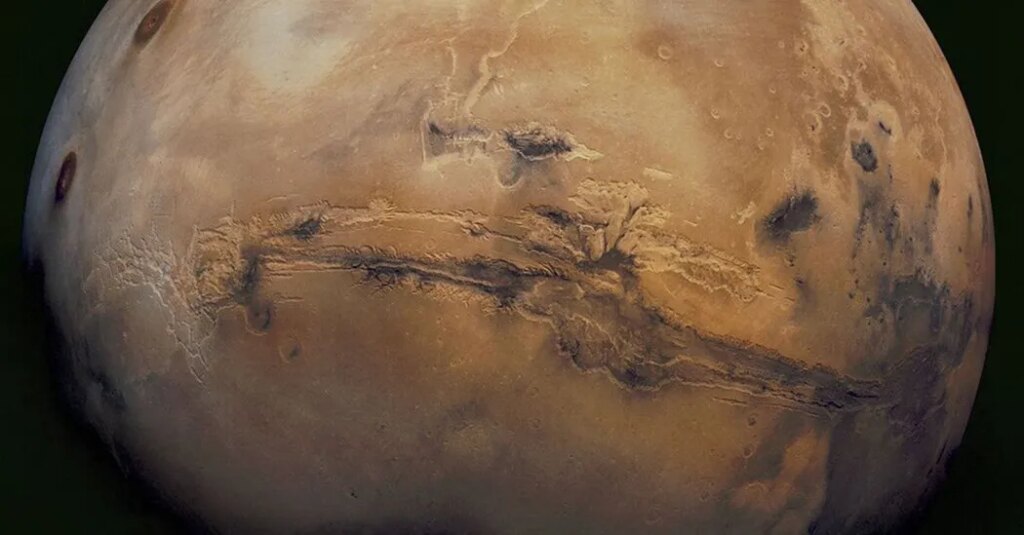
Making planets is an extreme enterprise. Although it starts with dust and gas gently sticking together, it culminates with gigantic space rocks walloping into one another at unfathomable speeds until, eventually, you’re left with newborn worlds.
Most scientists think that Earth and Mars took shape this way from rocky pieces swirling around the young sun around 4.5 billion years ago. But despite being the same age and having broadly the same basic ingredients, Earth (a biodiverse paradise) and Mars (a cold, irradiated desert) are very different worlds today.
That may be, in part, because Earth and Mars had surprisingly different origin stories.
Scientists effectively designed a new game that can forge virtual planets. They took an array of chemical clues found in the rocks of both worlds, and then ran them through a battery of statistical models and computer simulations, repeatedly trying to end up with an Earth and a Mars that resembled the real things.
Their results, published in the journal Nature Astronomy, suggest that Mars was mostly pieced together from big, asteroid-like objects. Conversely, Earth’s existence largely relied on a swarm of self-assembling pebbles.
The new model adds an exciting piece to a planetary puzzle: How did Earth get its enduring supply of life-giving water eons ago? Experts think a mixture of comets and damp asteroids was largely responsible, but others have suggested that a cavalcade of icy pebbles arriving from the outer solar system may have added to the torrent. If Earth is mostly pebble-made, that supports this idea.
Anders Johansen, a planetary scientist at the University of Copenhagen and one of the study authors, said that his team was taken aback by how two neighboring planets could form in two unique ways. “We were genuinely surprised,” he said.
This research also suggests that Earth and Mars were fashioned out of a mixture of larger objects and tiny stones, not just one or the other. “This paper is breaking new ground in combining these processes in a coherent picture,” said Tim Lichtenberg, leader of the Forming Worlds Lab at the University of Groningen in the Netherlands, who was not involved with the new study.
Scientists already had some clues that Earth and Mars were assembled differently — the clearest being that Mars is just one-tenth the mass of Earth. Scientists typically attribute the Mars mass mystery to the emergence of Jupiter. This behemoth has such immense gravity that it could have grabbed many of the rocky building blocks in embryonic Mars’s orbital path and thrown them elsewhere.
The elements that make up the crust and mantle of both planets offer another clue.
Ancient meteorites record the composition of the solar system’s starting material. Compared with those meteorites, Earth and Mars are depleted in things such as sodium, potassium, lithium and zinc. If Earth and Mars had divergent origins, they would have lost these moderately volatile elements in different ways.
Colliding space rocks generate very high temperatures that tend to cook off these volatiles into space, although as the objects involved get bigger, some volatiles buried deep below the surface may be preserved. Objects made mostly from gently coalescing pebbles will retain more of their volatiles in the earlier stages of the planet-building process.
Based on its volatile mix, Mars must have gathered 73 percent of its mass from larger, asteroid-like bodies colliding, according to Dr. Johansen’s team. The rest came from sweeping up small pebbles.
By contrast, the researchers said, 75 percent of Earth’s mass probably comes from pebbles that clumped together to form two protoplanets, which then smashed into one another. This titanic pileup was later supplemented by a bombardment of smaller space rocks.
Not everyone agrees on the role pebbles might play in forming rocky planets. Some think that Earth’s chemistry doesn’t make sense without them, while others suspect that making Earth and Mars with pebbles alone doesn’t work. Experts often cite Jupiter and its formidable gravity as a potential barrier that would prevent pebbles from flying in from the outer solar system.
The new model relies on several simplifications, so trying to determine exactly what proportion of pebbles went into making Earth and Mars “is out of the question,” said Paolo Sossi, a planetary scientist at ETH Zürich in Switzerland who was not involved with the new study.
But Dr. Sossi added that Earth’s volatile depletion pattern strongly hints that multiple types of building blocks were involved in its construction. And this new study implies that “pebbles could be allowed in the formation of the Earth,” he said.
“This paper is intriguing,” said Conel Alexander, a cosmochemist at Carnegie Science in Washington, D.C., who was not involved with the study. But he stressed that these specific elements are just one piece of the puzzle, and there are many ways to get an Earth-like and a Mars-like mix of volatiles.
“It’s certainly not the final answer,” he said, but the proposed hybrid model is worth considering. When it comes to the messy business of making planets, he added, “it’s good that people take opposing positions and duke it out.”
The post Earth and Mars May Have Formed in Weirdly Different Ways appeared first on New York Times.