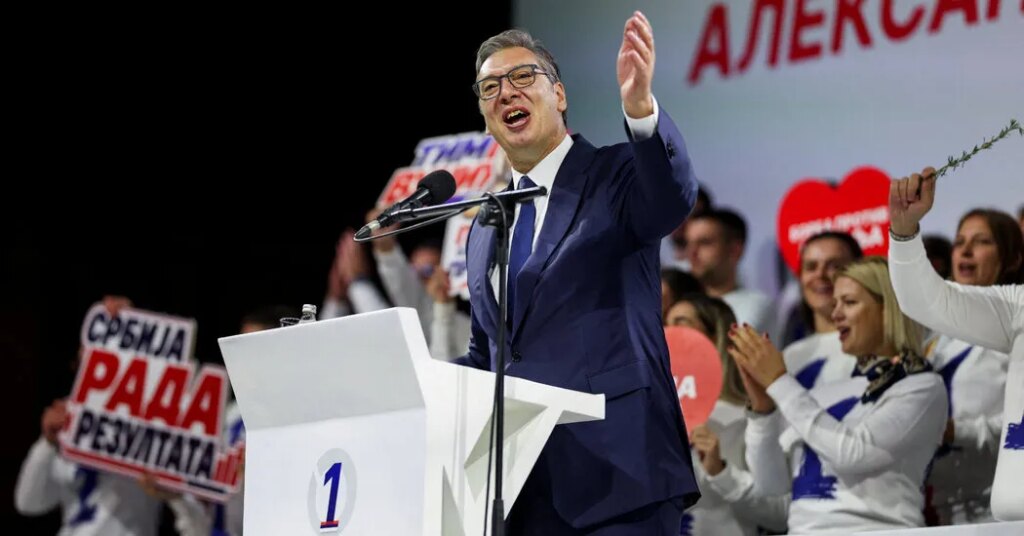
Hunting for ways to rally voters, the media machine of Serbia’s embattled strongman Aleksandar Vucic has been accusing his rivals of smearing a notorious Serb general, who was convicted of genocide and crimes against humanity.
Ratko Mladic, who died in custody in The Hague in August, was the general behind the 1995 Srebrenica massacre in Bosnia. Yet many Serbs remember him as a valiant warrior who defended his people and their identity from attack by Bosnian Muslims seeking their own state.
Denying his crimes has become a note in Mr. Vucic’s campaign pitch, seen by his camp as a surefire way to stoke nationalist sentiment and win votes before the high-stakes general election on Oct. 25.
“Everyone in Serbia plays the same identity card,” said Vladimir Vuletic, a pro-Vucic sociology professor at Belgrade University. Most Serbs, he added, know that Mr. Mladic committed crimes. But Mr. Mladic was buried in Belgrade, Serbia’s capital, in September with military honors anyway.
“This is an identity problem, not a rational problem,” added Professor Vuletic, who noted that ethno-nationalist loyalties often trump reason.
Mr. Vucic has been Serbia’s dominant political figure since 2012, serving as both prime minister and president. He stepped down last month as head of state to lead the election campaign of his Serbian Progressive Party, rebranded for Sunday’s vote as “Aleksandar Vucic — United Serbia.”
If his party wins again, as many analysts expect given the lopsided playing field and wide scope for fraud, he will return as prime minister, his long hold on Serbia strengthened after nearly two years of sometimes huge protests against him led by students.
Student protesters selected their own slate of candidates for the election called “Student List — Students Win.” It includes no students but, according to some opinion polls, is running neck and neck with Mr. Vucic’s party.
Whatever the result, it is already clear that the enduring grip of nationalist identity politics is a powerful political tool.
For example, assailing the opposition as traitors, Informer, a Serbian tabloid that channels Mr. Vucic’s views, recently denounced his election rivals for hoisting a “scandalous banner.” Its message: “Gen. Ratko Mladic is a criminal.” Politika, another pro-Vucic outlet, said that by making such a claim, the opposition was “demonstrating its anti-Serb views.”
Student protesters, eager to avoid being branded unpatriotic, in May issued a “Memorandum on Kosovo and Metohija,” using the Serbian name for territory that, since 2008, has been an independent state. It rhapsodized over “the blood-soaked battlefield” and vowed to never surrender what it described as “not merely territory” but “a component of Serbian national identity.”
Long before Donald J. Trump entered politics promising to put “America first” and Marine Le Pen of France and other right-wing European populists surged on pledges to defend “native-born” citizens against “others,” Serbia and its neighbors put ethno-nationalism at the forefront of politics. They continue to do so.
That has helped lock Serbia, Bosnia and Herzegovina, North Macedonia and Kosovo, four countries that emerged from the wreckage of war in former Yugoslavia, in a decades-old political limbo.
Croatia and Slovenia, two other former parts of Yugoslavia, have also struggled with identity politics turbocharged by 1990s bloodshed but curbed them enough to win admission to the European Union.
Wartime ethnic passions might have faded but, said Vladimir Arsenijevic, a Serbian novelist, “the 1990s are still breathing down all our necks.”
The rank breath of that decade is especially strong in places like Krusevac, Serbia’s capital in the 14th century and a bastion of support for Mr. Vucic in the center of the country. The city was heavily bombed by NATO warplanes in 1999 during the conflict over Kosovo.
A big statue in the center of town honors a revered local hero, Prince Lazar, a Serb leader who died leading a Christian army to confront advancing Ottoman forces in Kosovo in 1389.
“We will never accept that Kosovo is not part of Serbia,” said Milos Nenezic, the general director of Krusevac’s biggest employer, Trayal Corporation, a state-controlled company with more than 1,000 employees. It got its start making explosives and now focuses on car tires.
Thanks to Mr. Vucic, he said, his factory has recovered from a disastrous privatization that had pushed it toward bankruptcy.
With new city streets, a new highway to Belgrade, a new hospital and many other improvements that Mr. Nenezic credits to Mr. Vucic’s policies, Krusevac highlights the twin pillars of what the government hopes is a winning election formula: robust patriotism and economic growth that could reach nearly 4 percent this year.
That is more than double the pace in neighboring Hungary, where the longtime leader Viktor Orban, a close ally of Mr. Vucic’s and fellow nationalist, lost an April election by a wide margin.
Srdjan Gasic, 34, a Krusevac resident who now works in finance, said he left his hometown in 2011 to study in Switzerland because the city felt “like a tomb.” Returning after Mr. Vucic took power, he found Krusevac “completely changed,” its potholed streets repaved and crumbling apartment buildings renovated.
Not everyone is rooting for Mr. Vucic, although openly siding with the student protesters who oppose him comes with heavy risks because of the governing party’s tight grip on the city. Danijel Ivanovic, a physical education teacher, said he lost his job last year at a local high school after joining protest marches. “I was fired because I had a different political view,” he said.
Yet he has no quarrel with Mr. Vucic’s nationalism and said the claims that the protesters “are not real Serbs” and think that Mr. Mladic was a criminal “are just lies” aimed at tricking voters into supporting Mr. Vucic.
The protest movement, a loose alliance of diverse political views with no clear leader, has stirred unease among some Serbs who want their country to make a clear choice in favor of the European Union.
Historically Serbia has deep ties to Russia, linked by a shared Orthodox faith and close economic and diplomatic relations.
Mr. Arsenijevic, the novelist, said he initially had high hopes for the student-led protests when they began in 2024 amid a wave of public anger at the death of 16 people killed by falling concrete at a newly renovated railway station. But, he added, he was aghast when the protesters, too, started embracing nationalist themes and symbols.
Serbia, its halfhearted ambitions to join the European Union stalled and its dream of recovering Kosovo seemingly doomed but still loudly proclaimed, “seems completely lost in time and space,” Mr. Arsenijevic added.
In 2009 he founded a group he still heads called Krokodil, which promotes cultural exchange and reconciliation between former Yugoslav peoples.
He is a frequent target of death threats and in July was badly beaten in Belgrade by young nationalist thugs who accused him of betraying Serb interests. His group’s activities include painting over graffiti that hail Gen. Mladic as a “hero” and President Vladimir V. Putin of Russia as Serbia’s only true friend.
Violent thugs, he added, “are just a fringe” but their view that Serbia has been unfairly victimized and must stand up against foreign pressure over war criminals and Russia “represents just about everyone in society.”
The Student List, the strongest rival to Mr. Vucic’s party in Sunday’s general election, recently announced that it wants to continue the current government’s policy of resisting pressure from the European Union to impose sanctions on Moscow.
Nonetheless the Student List candidates are regularly tarred as traitors working for Croatia and Serbia’s other enemies in the 1990s, said Zoran Gavrilovic, the executive director of Birodi, an independent group that monitors Serbian media.
“Claiming that Mladic is not a criminal and that Kosovo is part of Serbia is a lie, but it wins votes,” Mr. Gavrilovic, a sociologist, said, because of the Vucic camp’s ability to stir up nationalist sentiment through its control of the media.
His data show that Mr. Vucic got 78 percent of the total airtime devoted to politics in September on Serbia’s five television stations that had a national reach. A further 13 percent went to his party.
Student-List candidates got only 6 percent of airtime while European Serbia, the only party openly pushing for entry to the E.U., was given less than 1 percent.
Milan Protic, a historian who was mayor of Belgrade after the fall of Serbia’s wartime leader Slobodan Milosevic in 2000, said “decades of brainwashing” had left many Serbs convinced that “if you say anything” against nationalist narratives “you are a traitor and anti-Serb.”
Most Serbs, he added, “know nothing of their history” because the topic was suppressed under Josip Broz Tito, Yugoslavia’s longtime communist dictator, and then hijacked by opportunist party apparatchiks like Mr. Milosevic when the Yugoslav multiethnic state disintegrated.
“The only thing they know about is the Battle of Kosovo,” Mr. Protic said, referring to the 1389 battle. The 600th anniversary of the battle, a taproot of Serb national identity, was used by Mr. Milosevic to stir up nationalist fervor that put Serbia on the road to war with its neighbors in the 1990s.
Kosovo, Mr. Gavrilovic, the media monitor, said, “is obviously now lost but nobody wants to hear this. They reject reality.”
Alisa Dogramadzievacontributed reporting.
The post In Serbia’s Election, Identity Politics Looks to Be Winning Again appeared first on New York Times.