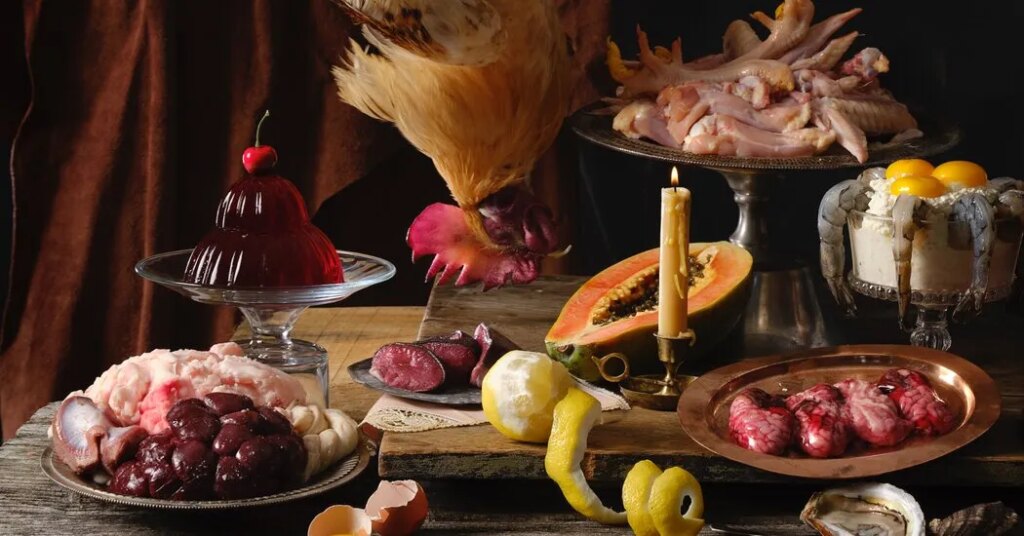
Kelly Pi pulled a container of buffalo brains out of her bag and removed the top to show me the meat, which sat in a pool of red liquid. She pointed to a fragment of black amid the pinks and whites of the tissue: “Look, you can see a little bit of the skull!”
The brain slithered as she pulled it from its container and held it up for me to admire. Then, as though it were a juicy apple, she took a bite of the raw meat. “Mmmm,” she said. “This is so good.”
It was August, and we were standing in the parking lot of an Amish farm in southeastern Pennsylvania. Kelly, a 30-year-old electrical engineer who lives in the suburbs of Philadelphia, drives her Honda Accord out to Amish country a few times a month to gather a supply of hormone-free, vaccine-free, corn-free, soy-free meat and dairy. She has long hair, a wide smile and a bubbly energy that came out in force as we surveyed the walk-in fridge at Amos Miller Organic Farm. “They have testicles!” she exclaimed. She wore a long patterned dress and filled her cart quickly — with pounds and pounds of beef, yellowish colostrum, three types of raw-milk ice cream, kefir water and, of course, buffalo brain, which she was excited to try because she normally ate beef brain.
The core principle of Kelly’s diet — which is based on the Raw Primal Diet developed by the alternative nutritionist Aajonus Vonderplanitz — is straightforward: No cooking anything. She eats mostly meat, with an emphasis on organ meat. She eats fruit but not vegetables. She’s all-in on raw, unpasteurized dairy. A meal might consist of raw beef liver, raw egg yolks and bee pollen. Sometimes she forages for fresh roadkill and eats it raw. You can watch her, on Instagram, digging into roadkill rabbit.
“Kelly Pi” is what she sometimes goes by online; she asked not to use her full name because her diet and beliefs can be controversial. (She has received threats, she said, and the world of online carnivores has its own internal disputes, so she fears being too easy to locate.) She is aware that most people find her eating strange, even shocking. When we first met, though, she turned that strangeness back at me like a mirror. “People think my diet is extreme,” she said, “but they’re eating processed food and drinking alcohol and basically poisoning themselves. I would argue that’s extreme.”
It was neither the first nor the last time I would hear this argument. I spent much of spring and summer talking to people who, like Kelly, were experimenting at the fringes of nutrition, following all sorts of unusual diets. Some avoided specific vitamins, or disavowed seed oils, or believed that vegetables were unhealthy. Some swore by organ meats, some by cane sugar. Some snacked on raw chicken or took large doses of supplements. However weird their diets seemed, they told me, the standard American diet — filled as it is with pesticides and preservatives, dyes and junk — was weirder.
When I first started thinking about these people, I had just turned 31. I ate in a way that I considered normal and at least loosely healthful: I cooked at home and focused on vegetables and whole foods, though there were plenty of French fries and beer around the edges. But as my friends and I made our way into our 30s, I noticed people starting to pay more attention to health and wellness, adopting various diets and “protocols.” There seemed to be an infinite supply of options circulating online, some of them wildly experimental. When I described my fascination with the more outlandish ones to a friend, she forwarded me a PDF of Ray Peat’s “Nutrition for Women,” an esoteric book whose principles are echoed by some of today’s diet influencers. Ah, my friend said, dark nutrition.
That was it: The term seemed to encompass everything from Kelly Pi’s eating to the people I’d seen promoting the health benefits of Coca-Cola. Dark nutrition wasn’t a specific diet; it was a style of thinking about food and health. Its adherents had concluded that the usual sources of authority — doctors, public health officials, food executives, pharmaceutical corporations — could not be trusted. The old order that told us to eat our vegetables was discarded. New ideas emerged, via podcasts and Instagram accounts and message boards, to fill the void. These perspectives didn’t all fit together; there were arguments over low fat versus high fat, low carb versus high sugar, Silicon Valley biohacking versus strains of naturopathy that approached mysticism. Still, these realms collided and overlapped. “The raw-milk guys and homesteading girls are watching each other’s reels now,” says Sami Reiss, who writes a popular newsletter about nutrition and wellness. “Whatever walls existed between those groups are disappearing.”
Their worlds were united by a tendency to ask contrarian questions, many stemming from a central principle: Most of what you think you know about food is wrong. What if broccoli is toxic? What if red meat and butter are actually really good for you? What if the human body is built not only to handle raw roadkill but to thrive on it? Mainstream scientific consensus doesn’t support any of those hypotheticals. (Government agencies warn against several things mentioned in this article, including the consumption of raw chicken, and the F.D.A. has strict rules concerning cow brains and the risk of prion disease. In other words: Do not try this at home.) I was less interested in the science, though, than in the reasons people were asking these questions. Niche nutrition has surged over the past half-decade, right alongside pandemic conspiracy theories, vaccine hesitancy and the Make America Healthy Again movement. About a year ago, Reiss told me, dark nutrition seemed to be erupting into mainstream culture. A version of it has even reached the heights of public policy: In January, the Department of Health and Human Services and the Department of Agriculture essentially flipped the food pyramid upside down, putting steak at the top. Dark nutrition was in. I wanted to talk to people who were eating accordingly.
My interest started, like many things do these days, with videos I kept seeing on the internet. Women would address their cameras and tell me nothing was as it seemed — they were avoiding vegetables and sucking down Jell-O and feeling much, much better than I probably did.
On X, an influencer and “metabolic researcher” named Veronica posted her impression of a typical young woman: “‘Yeah, I eat really healthy: veggies, salads, nuts and seeds, I avoid dairy, butter and sugar, I just don’t understand’ — every woman with the worst skin imaginable, mega bloat and literal fungus growing in her hair.” She recommended liver, oxtail broth, oysters and Polish mineral water. Raw egg yolks were essential. “Cottage cheese? Raw yolk. Dip for steak chunks? Raw yolk. Steak tartare? Obviously raw yolk. Sauce? Raw yolk base. Snack? Crack an egg, salt the yolk, slurrrrp. You should see the quality of my skin, my hair and my thoughts.” Her photos attested to the quality of her skin and her hair; her thoughts were free, though her skin-care serum was not.
Her way of eating certainly sounded liberating. A healthful diet had always been presented as a chore, but now “a whole new language is being spoken,” Reiss told me. “People are saying: You can have steak tartare.” Should I have abandoned Sweetgreen salads and started eating as I imagine Henry VIII did?
That question led me, in May, to the Smoky Mountains of Tennessee, where I drove to a convention center in the resort town Gatlinburg, stood for the national anthem and then watched an auditorium erupt into cheers as people onstage cut into juicy rib-eye steaks. This was the opening ceremony for Meatstock, “the meatiest community convention in the world” — a festival of carnivores, biohackers, Primal-dieters and anyone else enthusiastic about meat. Panels featured doctor-influencers and some well-known figures from the MAHA movement, including Calley Means (a senior adviser in the Department of Health and Human Services) and Alex Clark (who hosts a wellness podcast for Turning Point USA). There were also what an announcer called “your favorites from Instagram and YouTube”: influencers who were not yet famous to me but very much so to other attendees. These included Bella Ma, the Steak and Butter Gal, who films herself biting into sticks of butter and large rare steaks; and Mikhaila Peterson, Jordan Peterson’s daughter, who had long promoted a strict “lion diet” — nothing but ruminant meat, water and salt. (She had recently announced, on YouTube, that she was adding some greens.)
The scene was infused with Americana. A bluegrass trio played between panels, and attendees were encouraged to wear cowboy boots. Many added cowboy hats and themed T-shirts: “Not a vegan,” “Beef, butter, bacon, and eggs,” “Unvaccinated,” “I don’t believe in veggies,” “Midwest meatheads,” “Eat meat, not wheat.” As panels discussed peptides, vitamin D and, in one case, “Toxic Superfoods: Plants Are Trying to Kill You,” the hall outside filled with the faint but distinctive smell of meat. A man in a full lion suit stalked past the different offerings for sale: tallow skin-care products, raw-meat samples on toothpicks, a meat-based cereal called Meaties.
At one booth, a man in an old-school milkman’s costume asked if I wanted “a shot of butter.” I said yes. This was how I met Max Kane, a garrulous purveyor of nonpasteurized dairy products who calls himself the Milk Runner and is quick to launch into tales about his standoffs with the government. In 2009, the state of Wisconsin mounted an investigation into his underground raw-milk delivery network; Kane ended up arguing before a state district court in an effort to quash a subpoena. His home, he said, was raided by the authorities. Now he runs a company called FarmMatch, which has coordinated nearly 1.5 million food and dairy drop-offs. He is also in the process of opening an unlicensed, low-waste grocery store in Viroqua, Wis., meant to test the laws (and, he argues, his constitutional rights) surrounding food sales. “Like the Rosa Parks of grocery stores,” he told me.
Kane said he was diagnosed with degenerative Crohn’s disease at age 12 and spent years heavily medicated. In his 20s, he had an epiphany and changed how he ate, visiting a nutritionist who recommended an omnivorous raw diet. Soon, he said, he no longer needed medication or disability support. He eventually arrived at his own Vonderplanitz-inspired diet, eating mostly raw meat and raw dairy, which he believes saved his life and gave him back a sense of agency. Instead of going to doctors and asking what they could do for him, he said, “I started asking, What could I do for myself?”
It was here that I met Kelly Pi, who was working the booth in a milkmaid’s dress. Her diet, she told me, was a result of chronic migraines and seizures she had in her early 20s. Medication didn’t seem to help, so she started cutting out gluten, MSG and other things she suspected were triggering headaches. She felt better. She tried a low-carb Paleo diet and felt even better. She tried eating only meat and felt even better than that. She has been eating almost totally raw for two and a half years and says that she’s never once gotten food poisoning.
It did not take long to notice a pronounced overlap between chronic illness and the Meatstock community. No one, it seemed, decided to eat only raw meat because they felt good before. I met people who had embraced a carnivorous lifestyle in attempts to cure autoimmune diseases, skin conditions, chronic pain, digestive problems, fertility issues, eating disorders, even psychiatric illnesses. A 29-year-old named Natalie Monger told me about coming off a suicide hold at 26 and thinking that none of the treatments or advice she’d been given were working. Meat wasn’t the only cure, she said — she tried new forms of therapy and improved slowly, over the course of years — but diet was “the foundation of my healing.”
The auditorium stage offered countless resurrection stories like this one. Meat saved my life. Don’t trust doctors. Trust in meat, and trust in yourself. An obstetrician-gynecologist named Robert Kiltz asked whether plants were required for the human diet, then answered in the negative. Human beings were being “domesticated” by bread and beer, he said; did we want to be sheep or lions? He invoked God, taking on the fire-and-brimstone cadence of someone preaching to the converted — and in fact, several people I talked to at Meatstock were former vegans or vegetarians who had struggled with health issues on their old diets and come to meat like Paul on the road to Damascus.
Kevin Corl, 61, had traveled from Michigan with his wife, Wendy. Their diet was, by Meatstock standards, pretty conventional: They’d gone keto, very low on carbs. He told me they both spent years heavily medicated and struggling with chronic pain. At a certain point, he said, he was simply done with it all, the doctors and medicines and tests. He showed me pictures of their fridge — stocked mostly with butter, heavy cream and cuts of red meat — and raved about their diet, comparing it to the brain-enhancing drug from the movie “Limitless,” which turns Bradley Cooper into a sort of heroic genius. “I used to hit walls,” he said. “I never hit walls anymore.”
In the months that followed, back at home, I kept soaking in more claims about how food could change my life. I lurked in Substack chats about oregano oil, scoured a board called the Low-Toxin Bioenergetic Forum and messaged with nutrition obsessives on Reddit. I made plans to attend a potluck dinner that would include a performance celebrating raw milk, but one of the organizers disinvited me the day before, saying the event was closed to press. (I was also told I couldn’t attend a Primal meet-up in Virginia, not just because I was a journalist but also because I was not “truly battling some health issues.”) I spent hours on the phone with scientists, and with doctors, and with people who were experimenting with their diets in a dizzying number of ways.
It was already a summer of weird food stuff. There was a wave of high-profile recalls, scares about parasites in lettuce, salmonella in eggs. An E. coli outbreak in California was tied to a raw-milk cheese farm. A package of popsicles I purchased was recalled because it might have contained shards of glass. Some of these problems were generated by industrial food systems that dark-nutrition people were constantly assailing; others seemed like a result of the lax regulation those same people argued for.
The people I spoke with were not necessarily radical. There was a wedding photographer, living in New York’s Hudson Valley, who’d switched to mostly steak, fermented foods and fruit after hearing about it on a podcast. There was a graduate student in physiology who avoided polyunsaturated fatty acids and was trying to eat more dairy. There was Will Akel, a 30-year-old who loosely followed Ray Peat’s principles and ate oysters once a week. You could probably have dinner with any of these people without noticing anything odd about their plates. “It’s whole food, high carb, moderate protein, low fat,” Akel told me of his diet. “I’m not doing anything completely inverted.”
But all of them were thinking, consciously and deeply, about food and how it affected them — reading, talking, experimenting. There was a kind of solidarity in the way dark-nutrition communities discussed the body, the diet, everything consumed and avoided. All summer I saw photos of influencers meeting at a circuit of events and gatherings, hanging out, barbecuing, showing off their outfits and their meals. It reminded me of a jam band’s summer tour, with the same characters popping up at shows in new locations. A few took on elevated status. “Have you talked to Georgi Dinkov?” people kept asking me. I had: He was one of Peat’s best-known acolytes, carrying on Peat’s teachings about carrot salads and aspirin and metabolic rates.
Some people dabbled, casually picking up ideas they saw online; others, like Kane, had comprehensive, scholarly worldviews that encompassed not just food but science, history and law. It was like any other absorbing pastime: You could tunnel deep into nutrition, endlessly studying and adjusting your diet, treating your body as an ongoing experiment. When traditional researchers do experiments, they use n to represent the sample size, like the number of individuals tested. Dark-nutrition circles were constantly talking about the “n of one” — the idea that the only way to learn what is good for you is by ignoring broad samples and experimenting on your unique self.
I encountered a man named Rob Richards, who posted detailed updates about his own supplement and diet experiments on the Low-Toxin Bioenergetic Forum. “I got a bunch of arm pain a few days ago, a low B5 thing, so I decided to recalibrate dose,” he would write. Or: “One thing I’ve noticed during this is that taking collagen peptides quickly gives me low vitamin C symptoms: gum pain, dry skin.” When I talked to him on the phone, he said he had tried many diets over the years, beginning with full carnivore; at the moment, he was following one that avoided vitamin A and nickel. He took large amounts of a supplement stack called HG7. He wasn’t ill, but he had experienced issues with his back, skin and digestion, along with anxiety and brain fog, which he said the supplements relieved. He also felt, at 34, that he was experiencing aging at a quick clip and was interested in reversing its effects. Not because he was afraid of dying, he said, but because he feared his body slowly breaking down, “like a car with a check-engine light on.”
Everything he was trying, he told me, was part of a quest for knowledge. “About nutrition, I’m assuming we don’t know that much, and it’s hard to do experiments long-term on humans,” he said. “So that’s sort of what the dark-nutrition circles are about: trying stuff aggressively, for better and worse. Sometimes people really mess themselves up. But you can also get a lot of information that you can’t get from the mainstream. I’m increasingly convinced if there’s an answer to longevity, it’s not in the mainstream. So you have people who are willing to sacrifice a bit of their safety to get there.”
In August, when I joined Kelly Pi on one of her meat-shopping trips, she brought her friend Leo, a bushy-haired, fast-talking 21-year-old who has been following a version of the Primal diet for five years. He’s also a YouTuber who described himself as having “the third-largest account in the raw-meat space.” (He, too, asked not to use his full name, for reasons much like Kelly’s.) He prefers raw chicken to Kelly’s redder meats — though he was snacking, for most of the time we talked, on raw ground beef mixed with honey, which he ate out of a glass jar with a fork.
When Kelly offered us both some of her buffalo brain, Leo was happy to partake. The texture, he said, was like melted marshmallow; he imagined he’d buy beef brain all the time, if it weren’t “like, $50 a pound.” Later, Kelly produced a container of bull testicles from her shopping bag. “It’s a lot like scallops,” she assured me. Leo concurred. I took a tiny, experimental bite, eyes watering — not enough to feel either a tide of nausea or a sense of limitlessness.
A question that hung over all this talk about nutrition, for me, was: How am I supposed to feel?
Three pastimes that had sustained me through my 20s — running, skiing and drinking beer — had lately become harder on my body. This was annoying but seemed natural enough. Doctors said I needed to be more consistent about taking vitamin supplements and could have lowered my cholesterol a touch, but I was, overall, basically healthy.
And yet all through the dark-nutrition world, people were talking about unlocking new levels of energy and eliminating pain. On one forum, people discussed ways to stop your energy from crashing in the afternoon; it was news to me that this was even possible. Kevin Corl was 61 and said he “never hit walls,” moving through the world with meat-induced superpowers. I wondered if there were levels of energy I had never unlocked and therefore didn’t know about.
I began to dabble. I sampled raw milk. I drank orange juice in the morning, as Ray Peat recommended, and traded the occasional Diet Coke for a lot of regular Coke. I ordered steak at restaurants and felt virtuous. I drank kefir smoothies, until I read claims that cold smoothies in the morning were terrible for you. I put off a course of antibiotics I was prescribed for a skin issue, then took them and healed. I looked up restaurants on an app that supposedly tracked seed-oil use. One day, while watching soccer and attending a barbecue, I drank probably eight whole beers. I went on vacation to Greece, where I had fish and cheese and wine, and returned feeling better than I’d felt in years — either because I wasn’t eating seed oils or because I’d just enjoyed a nice vacation in Greece.
None of this even approached the novel diets I’d been learning about, but something about it felt similar: I was n-of-one experimenting, cherry-picking from the counterintuitive claims online, enjoying an excuse to trade salads for steaks. I read and talked about diet constantly, vibrating with an excess of information. How did I feel? Sometimes good and sometimes bad, in ways I could sometimes connect to food and sometimes couldn’t.
Something became clearer to me when I spoke with a man named Christopher Gardner. Gardner is everything that people in dark-nutrition circles stand against: an institutionalist, the director of nutrition studies at the Stanford Prevention Research Center, a recent chair of the American Heart Association Nutrition Committee, published many times over in The Journal of the American Medical Association.
“Let me tell you a story about garlic,” Gardner said, chatting via Zoom from a vacation in Hawaii. Early in his career, he told me, he ran a small study on garlic supplements. They had been rumored to lower LDL cholesterol, but in the study, they performed no better than a placebo. When Gardner published this finding, a chemist called and questioned whether he’d used the right type of garlic pill. The two joined forces for another study, in which 200 people spent six months taking supplements, eating real garlic or receiving placebos. In the end, no group saw lower LDL cholesterol. Then the published study reached the news.
“One of the media outlets says, ‘Stanford finds garlic isn’t good for you,’” Gardner told me. “And I thought, Wait a sec. It was one clove of garlic for one condition — LDL cholesterol. It might be good for inflammation. It might be good for blood pressure. It might be good in a higher dose.” He was once again assailed with calls and emails claiming he’d tested the wrong kind of garlic.
The point of this anecdote, which Gardner related with great flair, was that it is very, very hard to make definitive claims in nutritional science. We can almost never say something like “garlic isn’t good for you” with real certainty. Human studies are hard to design. Long-term research often has to rely on unreliable self-reporting. Even a contained, well-designed study like Gardner’s could only prove something limited. In that sense, Gardner agreed with all the people I’d heard critiquing researchers in lab coats: We don’t know everything about nutrition.
But we do know a lot, he reminded me. We have plenty of evidence in support of certain things — for instance, that vegetables are, broadly speaking, good for us. “I have been doing my best to point out how much consensus there is,” he said. Part of what bothers him about people’s skepticism is that so much of what we do know about nutrition is, in his opinion, fairly simple.
“It’s just, Eat vegetables and fruits. Don’t eat so much junk. Eat better-quality food,” he said. “I mean, it’s like pornography and art. It might be super hard to define exactly where it crosses the line from being food to crap. But most of it, you can see, is food or crap. It’s not that hard.”
I thought of a complicated schism I’d been tracking among Ray Peat’s followers, which one, Will Akel, compared to the history of Christianity: Different interpretations of Peat’s writings had created rival sects of “Bulgarian Peaters” and “Mexican Peaters,” locked in a weedy debate that made nutrition feel far too complex for any broad “food or crap” test.
I thought, too, of a skit Max Kane had staged at Meatstock. He was holding a mace and standing next to a woman named Ella. The lights went out, and when they came back on, Ella was on the floor, playing dead, with the mace beside her. The question was: Who killed Ella? Could we be sure it was Kane? The moral of this skit was about evidentiary standards: Bacteria in raw meat, Kane said, is often blamed for food-borne illnesses without the same standard of proof used in a court of law. At the E.R., he said, they don’t ask if you’ve been inhaling soot or consuming pesticides. Thousands of farmworkers die from pesticide poisoning each year — “How about the people eating them?” he asked. “Or all the brake pads that need changing that are screeching with resins emitted into the atmosphere? And yet we accuse the bacteria, which has been here forever.”
The performance captured a dynamic I’d noticed in a lot of my conversations this summer. People started with concerns that I shared — about pesticides, or industrial toxins, or pollutants — then they tipped in directions I could not follow.
Our differences seemed to come down to epistemology. What did we know for sure, and what didn’t we know at all? I thought about health trends that had reversed in my lifetime — butter is bad, butter is good, butter is complicated — and about people’s desire for clear, definitive answers about food beyond the current consensus, which is often “it depends” or “we don’t entirely know.” The dividing line between somebody like Gardner and somebody like Kelly Pi wasn’t just about what to eat; it seemed to be about how a person responded to that fundamental uncertainty. Some people were satisfied with broad guidance: more vegetables, not too much sugar or fat. Others seemed troubled by our lack of clarity, and by the vulnerability that came with it — the sense that their health was at the mercy of corporate interests or a flawed medical system. They became seekers, drawn in by the idea that there was a code to be cracked, some more perfect way that they should be eating.
The seeking had a kind of endlessness to it. It was a potentially lifelong quest. When I saw Kelly Pi at the end of the summer, she told me that she’d recently given up salt. By fall, she had come back to it.
Sophie Haigney is a writer currently working on a book about our obsessions with collecting — why and how we accumulate objects, from priceless fossils to plastic Power Rangers.
The post The Proponents of ‘Dark Nutrition’ Think Everything You Know About Food Is Wrong appeared first on New York Times.