Young Spaniards and Portuguese have pitched tents in their countries’ capitals to protest high rents. French and Italian students have marched en masse for better school conditions in demonstrations marred by looters.
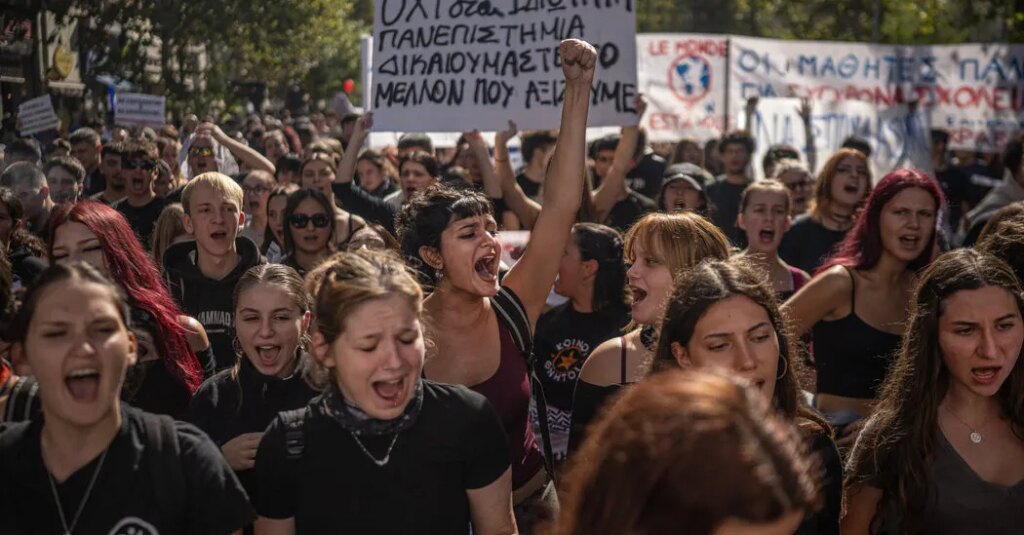
Greeks protested for more university funding and young Albanians clashed with the police after joining broad anti-corruption demonstrations against a government they accused of impeding their prospects.
These are among the young Europeans who have taken to the streets in recent days in at least eight countries across the continent. Their demands vary according to the context and the government, but a common thread unites them all: They fear for their future.
“The no-future generation is back,” Sacha Cossi, 27, a concert stagehand, said on Tuesday as he sat with a group of other young Spaniards under a low tarp in the tent encampment in central Madrid.
Mr. Cossi said the tent city, there for weeks, reflected a continent-wide exasperation over low salaries and high rents, an impotence in the face of global warming and a general anxiety about job prospects and the potential disappearance of the generous welfare benefits enjoyed by previous generations.
“We are tired of everything,” he said, adding: “Things keep changing in a way that doesn’t benefit us.”
The protesters’ gloom reflects a continent that is struggling to find a way forward. Europe’s populations are aging, its debt is rising as governments struggle with growing expenses for pensions and other programs, and governments are reluctant to raise taxes. Immigration is polarizing electorates.
There is widespread fear that Europe is failing to keep pace with the technological upheavals that are expected to define the near future, and it is caught in the middle of a contest between the world’s two great powers, America and China. Things seem less secure in the face of spreading Russian aggression, as President Trump, who threatened to attack the territory of a European ally, Denmark, withdraws support for Ukraine.
The malaise affects Europeans of all ages, but it is the continent’s young who face the bleakest long-term landscape. The public services and benefits that defined European society for decades are becoming increasingly unsustainable, with governments struggling to pay for pensions for the old, schools for the young, and housing, transportation and health care needed by everyone. Military spending, which has increased as the United States reduces its defense commitment, has added extra stress on budgets.
Governments of all ideological stripes — a right-wing leader in Italy, a left-wing one in Spain, a moderate in France — are all struggling to provide a plausible answer. Europe’s young increasingly feel left out of the picture.
“There’s this sense of rejection, fatigue,” said Stella Salis, 22, a protester and university student in Padua.
In terms of protester numbers and longevity, the movements are still not near the scale of the anti-austerity protests that spread across the world in the years that followed the 2008 financial crisis.
But they are beginning to catch the world’s attention and spur talk among protesters of a transnational movement. French high school students helped energize teenage counterparts in Belgium, while protesters in Italy and Germany have begun using a slogan that originated in France.
Ms. Salis said that she hoped that the protest movement was “starting to be in a phase that transcends national borders.”
Yet in some countries, the unrest has emboldened the far right as much as it has galvanized the left, often overshadowing the protesters’ messages.
Rioting in northern Italy this past weekend led to dozens of arrests, and gave Matteo Salvini, a government minister and hard-right leader, the pretext to announce that the government would dispatch 500 soldiers to “defend Milan,” from “criminals.” With his party slipping in the polls, Mr. Salvini seized on the unrest to promote his anti-immigration agenda, saying he hoped the rioting ended, “once and for all,” leftist calls to extend citizenship to children of immigrants before they reach the age of 18.
In France, the far-right National Rally has had a field day presenting itself as the party best able to prevent a repeat of the lawlessness perpetrated in French cities this past weekend.
“In six months, the French people will be able to choose a different path: That of restored authority and security,” Marine Le Pen, the party’s candidate in the presidential election next spring, said in a speech on Sunday.
It was a message echoed that same day by her party president, Jordan Bardella. “We stand ready to restore order in the country,” Mr. Bardella said after emerging from a police station located near the epicenter of recent unrest.
Yet whoever takes power across Europe in the coming months will have few easy offerings for young people. They will face excruciating decisions about what public services to fund with declining resources in an environment marked by economic headwinds, including inflation, rising bond yields and soaring fuel prices.
“My dream would be to have a job that I love,” said Salomé Regnaud, a 15-year-old student who has been protesting for better school conditions in France. “Not to have to look at my expenses every month and ask myself, ‘Will I be able to do this?’ or ‘Can I afford to buy that?’”
It was a lament that had echoes from Portugal in the west to Albania in the east.
“People say we don’t want to work? We do want to work, but with dignified conditions,” said Mourana Monteiro, 29, a psychologist in Lisbon who on Tuesday night joined a few thousand Portuguese to protest real estate speculation that has contributed to rising housing costs.
She had been staying in a tent encampment since Saturday and looked forward to a teacher’s strike the following week. “What’s the point of working and then not being able to afford a house, pay our bills at the end of the month, have a family?” Ms. Monteiro asked.
In Albania, students have joined a broader anti-government “Flamingo” movement. It is named for the bird habitat in an area where Jared Kushner, Mr. Trump’s son-in-law, won government approval for a major luxury tourism development that is opposed by environmental groups.
Albanians in the anti-corruption movement are calling for the ouster of Prime Minister Edi Rama, who has in turn called them radical leftists, but the students have focused on protections for education.
“We are a generation that has chosen not to remain silent, unlike our parents, who did not enjoy the same freedoms or the full right to freedom of expression,” said Redjan Shkëmbi, a 22-year-old actor, referring to the dictatorship that ruled the country until 1991.
Mr. Shkëmbi joined the first protests in Zvernec nearly 150 days ago to call for more funding for the education system and public hospitals, and said his main motivation was to fight for a more transparent and democratic Albania.
“We want a better country,” he said, “and we want to contribute to its future.”
Reporting was contributed by Ségolène Le Stradic from Paris; Josephine de La Bruyère from Rome; Carlos Barragán from Madrid; Daniela Ferreira Pinto from Lisbon; and Fatjona Mejdini from Tirana, Albania.
The post Student Protests Mushroom Across Europe, Exposing Bleak Views of the Future appeared first on New York Times.