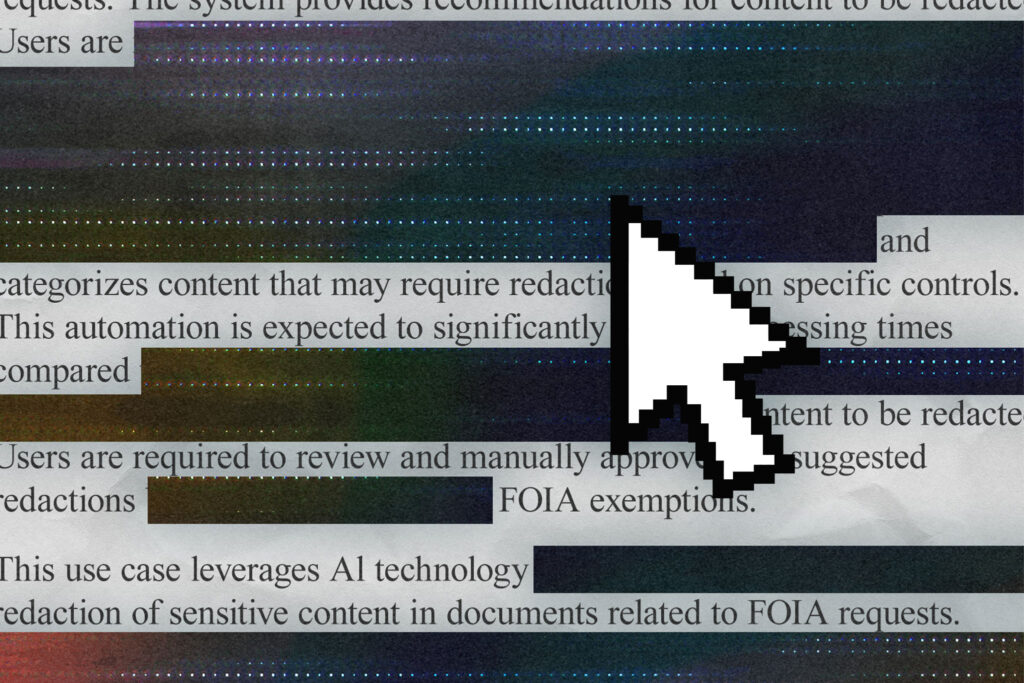
Redactions are the Freedom of Information Act requester’s bane. Those black boxes that often hide wide swaths of words when the government finally delivers on a request for public records. While even the most ardent openness advocate will grant that some information — such as Social Security numbers — needs to be redacted, almost all requesters believe the government uses redactions to hide far more than it should.
Now, federal agencies are embarking on a possibly game-changing project to speed up the handling of FOIA requests: using artificial intelligence to turbocharge redactions.
The Department of Homeland Security will use AI to “streamline the identification and redaction of sensitive content” when responding to FOIA requests, according to a description posted in January to a federal AI Use Case Inventory. The Inventory, required by a 2020 executive order signed by President Donald Trump to encourage transparency, is a public list of AI tools that federal agencies plan to or have deployed.
Specifically, U.S. Customs and Border Protection, which is part of DHS, plans to use Google’s AI and machine learning tools to recommend what information its FOIA officers should redact. “[T]his automation is expected to significantly reduce processing times,” according to the description.
The AI use appears poised to spread. By the end of September, DHS will “revolutionize” its FOIA process by using AI for certain types of requests that represent more than 10 percent of FOIAs, “approximately 100,000-140,000, of all FOIA submissions received at the Department,” a spokesperson told The Washington Post.
After the AI makes a recommendation, “DHS employees will review the case and ensure that the requester is getting the accurate and complete information requested,” the spokesperson said.
Of course, a record marred with black lines would not be considered “complete” by most requesters.
The FOIA requires that any record requested from an agency be released unless it can be redacted or withheld in full under one of the nine exemptions specified in the law, some of which are discretionary. However, one of these exemptions permits Congress to create new laws to withhold information at any time. It has passed more than 250 such statutes, forbidding the public to know some information about topics from watermelon handling to cigarette additives.
Revealing Records
An occasional series explaining public records and how they illuminate the innerworkings of government.
In the Inventory, I also found descriptions of AI tools related to redaction that are in development or in use by several other agencies. The Interior Department is using technology developed by Microsoft to redact potential attorney-client information. The Justice Department is using a tool developed by Veritone, aiWARE, to redact video. And the Department of Health and Human Services is developing a tool called “FRED” with a contractor to redact unspecified types of information.
Within HHS, “FDA is responsibly exploring limited uses of AI to help FOIA staff process records more efficiently, while maintaining human oversight at every step,” said HHS press secretary Grace Davis Jamison, who did not respond to a query about the name of the contractor.
The departments of Interior and Justice did not respond to requests for comment.
So, what would this mean for government transparency?
The “AI-ification” of FOIA would affect almost all users of the law. Last year, over 1.7 million FOIA requests were filed with federal agencies. FOIA requesters include veterans requesting their service histories, reporters uncovering scams targeting the GI Bill program, and even members of Congress attempting to obtain records needed to oversee the executive branch.
When asked about DHS’s and other agencies’ planned adoption of AI, some experts warned that use of the technology could lead to even less information being released.
“I think we have to watch the government really carefully on how they use AI to redact records, because I think it’s going to be a very powerful tool for secrecy,” said David Cuillier, director of the Freedom of Information Project at the Brechner Center for the Advancement of the First Amendment at the University of Florida.
Others told me that the use of AI for redactions may not be very effective yet.
“Agencies are still in the early days of using sophisticated forms of AI in FOIA workflows,” said Jason R. Baron, the former director of litigation at the National Archives and Records Administration, who believes AI redaction does have the potential to improve the FOIA process by releasing more records more quickly.
If AI consistently redacted the minimum — rather than the maximum — allowable amount of information more quickly than the years or even decades it often takes to process FOIAs, it would likely be embraced by requesters.
But a September 2025 survey of 280 departments and agencies subject to FOIA — conducted by the federal FOIA ombuds office — found that just 18.6 percent reported using AI and/or machine learning to aid in processing requests.
Baron said that number counts widely adopted technologies such as key word searches, the de-duplication of email chains and optical character recognition (which turns scanned images of text into digital text) as “AI use.”
Certainly, the bulk of agencies have been using primitive types of AI for FOIA responses since the 1990s, for instance when they used spell check before sending release or denial letters.
So far, there is limited evidence that AI can be successfully used to recommend appropriate redactions.
In a paper published in 2022 in the Journal on Computing and Cultural Heritage, Baron and two co-authors used AI to review over 3,000 paragraphs in email records and attachments from the Clinton Presidential Library. They told it to look for information that could be withheld under FOIA’s “deliberative process privilege,” an exemption that can — but is not required to — be used to redact discussions between government officials. Then they compared the AI’s recommended redactions with those that Baron and a fellow lawyer determined should be made. They found that AI methods generally performed at an accuracy rate of 70 percent in finding and segregating paragraphs that could be legally withheld under the exemption.
Baron told me that during his research, AI sometimes improperly recommended withholding information, and sometimes improperly recommended to release it.
Even though agencies are just beginning to embrace AI to redact information, we’ve seen how quickly the technology is taking off. My great fear is that this transformation will lead to even more information being withheld from the public — even if it is done more quickly.
In fiscal year 2025, the Department of Homeland Security released records without redactions in just 2.3 percent of its 994,992 FOIA requests processed, according to the most recent published statistics. It disclosed records with redactions — which could be as minimal as one word withheld — in 40 percent of the requests completed. The remaining 574,075 requests were denied in full based on an exemption (1.5 percent), claim that no records existed (40.2 percent) or another reason.
One bulwark against overreach with AI redactions may be a line in the FOIA Improvement Act of 2016, which states that an agency may only withhold information if it “reasonably foresees that disclosure would harm” a legitimate interest.
The FOIA ombuds survey confirmed the power of that line today: “AI and machine learning … are not a substitute for a FOIA professional’s judgment on application of exemptions and foreseeable harm.”
“The key question is whether government agencies are going to be transparent on the whole process, including how they teach the model and its outcomes,” notably on the use of the foreseeable harm standard, which is intended to force the release of as much information as possible, Cuillier said. “Because any sense of a ‘black box’ leading to blacked out documents is going to make everybody really skeptical.”
Andrew Ba Tran contributed to this report.
Do you have a question, comment or FOIA idea? Leave a comment or email me at[email protected].
The post The government is enlisting AI to help decide what public records you get to see appeared first on Washington Post.