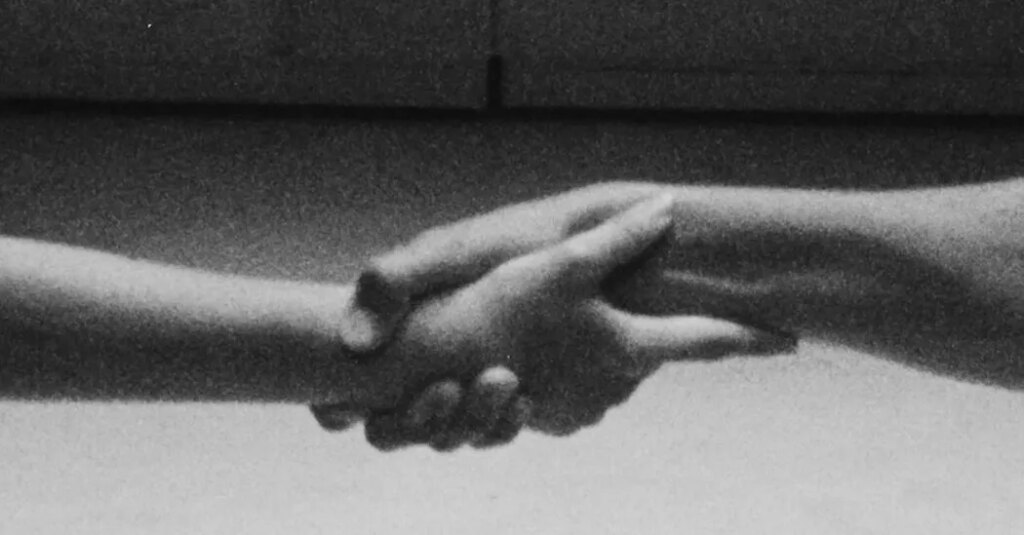
The subject is the holding of hands. You take my hand; I take yours. What does it mean?
My wife, Ginny, and I hold hands when we walk outside. Passers-by smile approvingly, thinking that what they’re observing is a gesture of love. It is. But it’s also a demonstration of necessity. If one of us stumbles, there’s always a hand to steady the other, like a listing ship righted.
Two of the things that count most in life are love and usefulness. Holding hands offers both. Take my hand. Keep me straight, protect me and warm my heart.
Holding the hand of another involves all the meanings of hands, which are multiple and various. Hands are essential to our being. Ever since God and Adam reached toward each other, a power, almost supernatural, has been ascribed to the touch of one hand by another.
In Scripture, the laying on of hands denotes healing. The word “hand” has been enlarged to mean help itself: lend a hand. Hands also represent work: all hands on deck. They are signs of approval: give her a hand. Or the basic gesture of surrender: hands up. The sealing of a deal? Put it there, pal. If you need self-control, get a grip.
You pray with your hands. Use sign language with your hands. Some read the lines in your hands as predictive of your life. Approval is indicated by a show of hands. To celebrate, you give a high-five. Extend your hand toward a baby, and it will cling to a finger.
With small children hand-holding means protection, safety and comfort. The feeling of leading and being led. Those sweet caravans of pre-K little ones, walking to and from their schools, hand in hand.
When people are ill or in mourning, we hold their hands. Idle hands may be the Devil’s workshop, but when your hands are holding other hands, it often means you have put everything else down or aside for someone else.
The significance of hand-holding rests on how fundamental our hands are. What would romance do without hand-holding? The Beatles scored a massive hit with “I Want to Hold Your Hand.” The first gesture of love of a boy or girl is usually to reach for the other’s hand.
My son-in-law, Harris Solomon, an orthopedic hand surgeon, has been in practice for decades and remains impressed with how prominent hands are “in our entire interaction with the world.” He marvels at the relationship of the brain with the hand: “The back-and-forth communication. Five fingers working together. Two hands working together. The required computing power is staggering.”
So powerful is the idea of the hand that it is often given a life of its own, independent of the mind. A 1946 horror film starring Robert Alda was “The Beast With Five Fingers,” about a disembodied hand that commits murders. The idea of that dangerous independence occurs in Christianity, to express one’s helplessness to evil acts and influences: my mind cannot believe what my hand has done.
On the whole, though, we think of our hands as instruments of good. They protect us if we fall forward. They help others. A doctor’s hands save lives. Of the profound influence of motherhood, it is said that the hand that rocks the cradle rules the world.
Whatever the applications, the intimacy is profound. In that perfect movie “Moonstruck,” Nicolas Cage’s character, Ronny, makes a gesture of both finding love and himself by extending his hand to Cher’s Loretta. The hand is artificial, made of wood, because his real one got cut off in an act of self-destruction born of misdirected love. Now, with Loretta, he has found the woman he was meant for. The false hand reaches for the real thing, and is brought to life by it.
In old age, holding hands is a guide to the past. Ginny and I held hands in high school. We hold hands today. They are not the same hands. Today’s hands are discolored, with roads of wrinkles and blue highways of veins. They have been through the mill and through the wars. That we hold hands still is partly an act of pride — and defiance. We can last. Our hands prove it. In old age one looks for something reliable to hold on to.
Here we are, a shaky and weakened Hansel and Gretel, lost in the woods, wary of witches. Alone, afraid, yet less afraid for the touch of each other. Around us, the storms of the world. Within us, images of family and friends. Before us, life. Take my hand.
Roger Rosenblatt is the author of “More Rules for Aging.”
The Times is committed to publishing a diversity of letters to the editor. We’d like to hear what you think about this or any of our articles. Here are some tips. And here’s our email: [email protected].
Follow the New York Times Opinion section on Facebook, Instagram, TikTok, Bluesky, WhatsApp and Threads.
The post I Want to Hold Her Hand appeared first on New York Times.