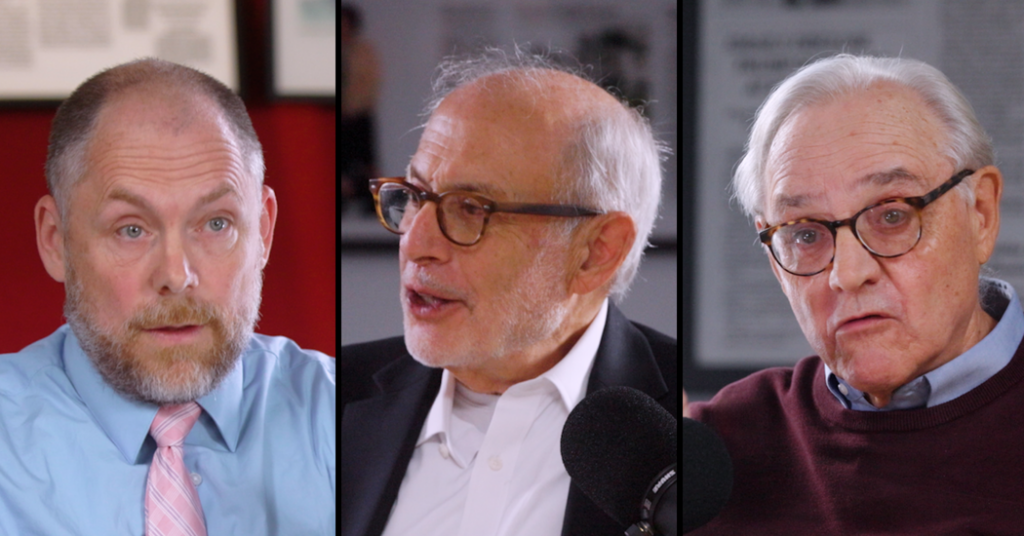
The midterm elections are still six weeks away, but Republicans are already looking ahead to 2028. In this episode, the Opinion contributor Robert Siegel and the contributing writer E.J. Dionne Jr. are joined by Timothy P. Carney, a columnist for The Washington Examiner and a senior fellow at the American Enterprise Institute, to talk about the week’s big news in American politics. The three discuss who will lead the G.O.P. in 2028, the challenges Republicans will face before then and how the news media reluctantly took center stage this week.
Below is a transcript of an episode of “The Opinions.” We recommend listening to it in its original form for the full effect. You can do so using the player above or on the NYTimes app, Apple, Spotify, Amazon Music, YouTube, iHeartRadio or wherever you get your podcasts.
The transcript has been lightly edited for length and clarity.
Robert Siegel: Hi, I’m Robert Siegel, and this is a conversation about politics with — as always — Times Opinion contributor, E.J. Dionne. Welcome again.
E.J. Dionne Jr.: Great to be with you, as always.
Siegel: Nice to see you. And joining us for the first time is Tim Carney, columnist for The Washington Examiner, and senior fellow at the American Enterprise Institute. Thank you for joining us.
Timothy P. Carney: Thank you. It’s a pleasure to join you guys.
Siegel: Great to have you.
Dionne: Great to be with you, Tim.
Siegel: We are recording on Thursday morning. It is less than a month and a half until Election Day — a midterm election that will decide whether the Republicans retain control of the House and the Senate. And also some 36 state governorships are up on the ballot; 18 currently held by Democrats, 18 held by Republicans. In this conversation, the media’s reluctant centrality in this election year, and also the implications of what happens this year on 2028.
But we begin by looking at the middle of the country, the country’s midsection, from the Rust Belt to the Farm Belt that stretches as far west as Nebraska, as far north as the Dakotas. Are potential Democratic successes conceivably omens of a realignment in the middle of the country? E.J., you’ve been traveling recently; why don’t you start?
Dionne: Yeah. Donald Trump is dragging down Republicans, even in some of the most Trump-y states. I was in Indiana for a project on building community, and in Kansas to write about the surprisingly strong challenge that Democrat Adam Hamilton, a Methodist minister, is making to the Republican senator, Roger Marshall.
Hamilton was actually ahead in a recent poll, by a couple of points, in Kansas, which is actually a more complicated state than we often acknowledge. But there hasn’t been a Democrat elected to the Senate there since 1932. So if something’s happening in Kansas, something is really happening.
Several things struck me. One is in both Indiana and Kansas, Trump’s approval rating is down to the 40s. The farm crisis is a real thing. You’ve got the cost of tariffs and how that has made the business life of farmers much more difficult. You’ve got the high cost of fertilizer and diesel fuel as a result of the war in Iran. And so, you’ve really got a lot of discontent.
And I think one of the other things that’s happening is that the cultural issues, they’re there. Republicans are using them. Even though Adam Hamilton is a rather mainstream Methodist — nothing radical about his theology — they’re attacking him as a “woke” pastor. If Republicans can’t run against a Democrat as anti-religious, they’re going to make him a heretic.
But I think what’s really interesting is that, if the Democrats are ever going to have a chance to build a durable and substantial enough majority to govern — to pass some of the stuff they want — they’re going to have to end their isolation in the Plains states, in the rural states. And if they can have breakthroughs in places like Kansas, and Iowa nearby, that’s going to be a big deal. And then, the question is: Are we in some kind of realignment?
I have an intimation, which I don’t fully trust since my intimations have not always been right in the Trump era. But an intimation that this era is really at an end; that Trump’s behavior in the last two years has really thrown everything open again. I think realignment in the rural states and the Plains states would be a sign of a larger realignment in the country.
Siegel: Tim?
Carney: I think the realignments that have been going on over the last 30 years, that Trump accelerated — there’s two sides to look at it. One is the upper-middle-class suburban vote.
So in Kansas, this would be Johnson County.
Dionne: Right.
Carney: Those folks, moving from solid Republican — when the country club used to be Republican — to Democrat. And then the blue-collar, working-class vote moving from Democrat to Republican. Those are the main realignments. The problem for Republicans is — not so much in Kansas, but you go to other parts of the upper Midwest, these states that Trump won twice, Pennsylvania, Wisconsin, Michigan, how he dominated in Ohio — a lot of those voters who are showing up for Trump aren’t becoming Republicans, they’re just Trump voters.
Remember Sean Trende, the journalist and elections analyst — after the Democrats won in 2012, he said, “the missing white voter.” These guys, they showed up for Ross Perot, and then they didn’t show up again. Well, guess what? They showed up for Trump. When Trump’s off the ballot, I don’t think they are going to show up.
So that is part of the Great Plains, but I think that’s a bigger problem for Republicans — why Democrats look like they’re probably going to win. Sherrod Brown is going to win that Senate seat in Ohio. Why places like Michigan, even with a flawed candidate, Democrats are likely to win is because some portion of that working-class voter — and this isn’t the religious right, these are working-class, disaffected, disaffiliated, deinstitutionalized voters — they’re not going to show up when Trump’s gone.
So that, I think, is a big realignment. I do not think Democrats, or liberals, are going to get the realignment they’re hoping for in some of the “What’s the Matter With Kansas?” story from the last 20 or 30 years of “Oh, well, maybe a lot of religious voters will come over to our side.” I think they’re put off by Trump’s self-dealing and lack of morality, but I think that this is a pipe dream, if Dems think they’re going to pick up a lot of the churchgoing white vote.
Dionne: Well, I broadly agree with a lot of what you said, but I think there are a couple of fundamental things that are happening: First, it’s very important that you raise this conversion of middle-class, upper-middle-class, suburban voters to the Democrats. I think that’s a problem; that’s a deep problem that I don’t know how Republicans solve in the long run, unless the Democrats go as far left as Republicans say they are, but I don’t think they’re going there.
But on the working class — cultural politics works when economic issues either kind of reinforce that, that the Trump realignment is anger over culture, but also anger over economics. I think the big Trump problem is that he’s thrown away a lot of the advantage he had with working-class voters on economic issues, because he really hasn’t done anything for them.
In fact, if anything, their situation is, at best, the same and probably worse than it was. And I think there’s a kind of alienation there. Doesn’t mean they’re all going to run and embrace Democrats, but I think this year it’s a problem for turnout. And not just among the Trump voters, who only vote in presidential elections — I think a larger turnout problem. But I think it also puts them up for grabs in a way they haven’t been for about 10 years.
Carney: And I think there’s a lesson here that Democrats could learn from. You were talking about the farm problem. So many times, when Democrats say, well, these working-class or poor people in the foothills of Kentucky, why don’t they support us? We’re the ones who are giving them all these government benefits, and Republicans are pulling it back.
I think in Washington it’s easy to miss how unsatisfying that is. Oh, we’re going to outlaw your job working in a coal mine, but we’re going to give you more government benefits. That’s never worked for the Democrats, but that’s exactly what Trump is trying today. Oh, we’re going to mess up your ability to sell your crops, but we’ll make it up to you with big checks.
Yes, you can get people to line up behind you on stage and support that, but that’s ultimately unsatisfying. So the irony is that Trump is playing what I’ve often seen as Democratic politics: Government’s going to get in your way, and then try to make it up to you with a check.
Dionne: Fact-check: Those mines largely went away, as you know, from technological change, not because of ——
Carney: Well, because of fracking.
Dionne: Yes. But the other thing is, yes, I think people, if you give them a choice, want a job rather than a government benefit.
Carney: Yes.
Dionne: That’s clearly the case. And I think the language Democrats are using now reflects that a lot more. But I also think, on health care in particular, those voters are very aware that they may not like Obamacare when it’s called Obamacare, but they know that the Affordable Care Act and Medicaid are central to their ability to survive.
And I think one of the interesting things about this election is whether those issues will stick. One of the reasons Andy Beshear got elected and re-elected, was some backlash against Republicans who want to cut those benefits. So yeah, a job is better than government benefits. But some government benefits are really important to these voters.
Siegel: I have a question about two states in the region that we’re talking about broadly: Ohio and Iowa. If I understand how the Democrats lost Ohio — I think I do, having seen the destroyed industrial system of that state, and the decline of union power and whatever else — I don’t understand how Iowa became so far out of reach for the Democrats; the state that used to send Tom Harkin and John Culver to the Senate. Is there an Iowa I’m missing here, E.J.?
Dionne: First, they do have some things, importantly, in common that explains both big realignments away from the Democrats. We think of Ohio in terms of Youngstown and all those industrial jobs. But there are parts of Iowa, places in Iowa — Waterloo, Dubuque, Clinton, Ottumwa, places like that — where they suffered some of the same decline in industrial jobs. So there’s something in common there.
There’s also something in common in the fact that both have a high number of white voters without college degrees, and those voters have been a big realigning force in favor of the Republican Party.
But I think in Iowa, you have a couple of other things that are going on. Rural areas are even more important. Des Moines is an important metro, but it doesn’t compare with Cleveland, Cincinnati, Columbus. And so, it’s a more rural state. Rural polarization has been a real deal in the last 10 or 15 years. And I’m stealing, in a way, from Tim’s work in this area. So I will kick it over to Tim to pick it up from there.
Carney: Well, there’s a big thing: One, Barack Obama, in 2008 when he was running, famously was asked why he has trouble with the working-class, rural voter. And he says: Well, these people, they’re clinging to their guns and their Bibles a little bit bitterly.
I’m not quoting him precisely, but clinging, bitter, guns, Bibles were part of that. It reflected a sort of disdain from the Democratic elite toward people who want to live a lifestyle that’s not shared by part of the Democratic elite. And just for the evangelical vote, which I divide into two different camps — the evangelicals who go to church and the evangelicals who don’t.
Dionne: That’s really important.
Carney: That latter camp, that’s the Trump core. But then the conservatives, the people who voted for Ted Cruz, those are the evangelicals who go to church. You know, Cruz tied Trump in the 2016 Iowa caucuses, and it really showed that ——
Dionne: He beat him actually if ——
Carney: Yes. And it really showed that these were two different conservative bases: a sort of disaffected, alienated populous base, and what we traditionally call the religious right.
And that religious right is just harder for the Democrats to reach when you’ve got the national party. I mean, the Joe Biden administration — and Biden wasn’t some crazy culture warrior — they changed documents to say “chestfeeding” and “birthing people,” instead of “breastfeeding” and “moms.” That cultural extremism — that’s going to turn off people who are just regular churchgoing people in Middle America, who might not even be 100 percent pro-life. They might not even care so much about cultural issues. They just want somebody who seems sort of normal, and I think that is part of Iowa.
And if Democrats want to win that place back, they’re going to run candidates in those places who are more moderate. Can those people distance themselves from the national leadership, or can the national leadership and the Democratic Party dial down the culture warring?
Dionne: I always thought there was a terrible irony about that Obama comment, because I don’t think any Democrat has given as comprehensive a speech about religion, that showed enormous respect for religious people and actually called out liberals for disrespecting religious people [more] than Barack Obama. For those of us who followed it, his 2006 Call to Renewal speech — a lot of my conservative religious friends read that speech and said, “Hey, that’s really good.” And Obama, in 2008, actually bumped up his share of the white evangelical vote a little bit. He still lost it, like Democrats do, but he made a breakthrough there.
But that comment and the sense that the alienation between these two constituencies is kind of a push/pull thing, because for an awful lot of liberals, including some religious liberals, the dominance of a hard religious right on the conservative religious side has really turned off a lot of people. You wonder, are those struggles going to abate a bit going forward? You’ve got Democrats, and again, Republicans are trying to say they’re not real Christians. But you got a lot of Democrats running this year — Hamilton in Kansas notably — who themselves are genuinely religious.
I visited his, effectively, mega church. And boy did this look like any other mega church that I have seen. A lot of Jesus, a lot of the Lord’s Prayer, as well as some social justice talk. I don’t know if this is going to abate soon, but I’m wondering if the ice is melting at least a little bit.
Carney: I mean, what I’ve seen in the churches across the country is that mainline and left-of-center churches are shrinking, while the ones that are growing are going to be ones that are more conservative.
Siegel: Let’s move on to the media. Something very remarkable has happened. It happened when the credentials were pulled for CNN, MS NOW, and Politico. They were banned from the White House. And the media backed them and there was a lawsuit, and the media carried the day. A Federal District Court judge said that those credentials were improperly lifted. How big a deal was this, that the big media acted in concert?
Carney: It was an overreach. Trump shouldn’t have done this. He made it clear, in his own comments — I would hate to be Donald Trump’s lawyer, because some people are like, “It’s national security.” And he’s like: “No, it’s because they’re horrible, and they attack me too much, basically.”
And so, that silliness made it easy for a Trump-appointed judge, Timothy J. Kelly, to say: No, you’re not allowed to pull their credentials for the content of what they report.
Not to say that the White House doesn’t have control over it, but this is an inappropriate restriction on free press. And I do think the uniformity of the press is good and interesting. And I’m going to praise Fox News for getting on board with this, especially because I remember a few years ago, when you had people on CNN who were trying to sort of de-platform Fox News. Saying, well, they were basically lobbying — Oliver Darcy, who’s a very successful media reporter, but he thought that the Jan. 6 attacks had meant that Fox News had gone too far, and they were trying to get cable carriers to drop Fox. So you didn’t have the uniformity there. And to go back in history, Obama sent out some of his surrogates in 2009, including Rahm Emanuel, to say: Fox is not a news outlet. It’s just an opinion outlet. And this was to set the stage ——
Dionne: But they didn’t throw him out of the White House.
Carney: They started to. At a Treasury briefing, they said: We’re not going to allow them. And at that point, again, all of the media lined up behind Fox and said: No, you can’t kick us out. So there is precedent to this, media uniformity standing up against the White House, when they do this.
Dionne: Just on the history there; first, nothing like what Trump did has happened before, either in a Republican or a Democratic administration. This wholesale, all three of these — MS NOW, CNN, and Politico — you’re out.
In the Obama case, yes, there was one briefing by a Treasury official, where Fox was left off the list. The Obama people say, you know, they didn’t ask to be invited. But as soon as they heard from the other networks, they put them back in. But they never banned Fox News from the White House like this. So I think this is really a case, pardon me, for a false equivalence ——
Carney: I’m not saying equivalence. I’m saying ——
Dionne: ——taking what Trump did, comparing that with what any other administration did before. I am really interested in the fact that Trump seems to be weakening, and people seem to be more willing to stand up to him strongly. I don’t think there was the same kind of response when The A.P. was “banned,” because it wouldn’t use “Gulf of America” instead of “Gulf of Mexico” at the beginning of his administration. You didn’t see this kind of solidarity — no, we are not going to let the administration intimidate us — with universities or lawyers early on.
And the fact that, at this moment, the networks immediately — I mean, there was really very little pause. And I agree, it’s important that Fox News joined this effort, but you see them all pushing back because this is so outrageous. And a footnote here — this is Iowa day in our conversation — Trump sued The Des Moines Register, because of their poll in 2024 showing that Trump was in trouble in the state. It turned out he wasn’t. And Lord knows, if we got sued for poll mistakes the courts would be tied up forever. A judge threw that out on Wednesday, which is a good thing. But think about the intimidation. The president himself suing about a poll, basically to push back against The Des Moines Register.
Carney: Speaking as someone who’s a fierce defender of the media, I don’t have the optimism that you do; that there’s a positive change here. First of all, I think the press has been pretty consistent. You remember it was earlier in this term that the Pentagon issued its rules, and there you had — again, instant, immediate — people saying, “We’re not going to follow these rules,” including my colleagues at The Washington Examiner. There wasn’t much of a debate about it. What, I think, the underlying problem here is that the public’s distrust of our industry on — both the left and the right public — has been growing. The public more and more is having trouble trusting us as the authority that they did in the past.
So I don’t share your optimism. I would like to think that the administration and the next administration won’t try to attack the press in this way.
Siegel: I think part of the question here ——
Dionne: I don’t think any administration is going to do what Trump did. And I think that — I am not going to report here, because I don’t see any evidence yet that the public is swinging back massively toward the media. But I do think this administration — because of some of the corruption issues that have been raised and other things — that people wanted to know about the botching of the planning for this war in Iran. Whereas before, the sort of general I-don’t-like-the-media sentiment prevailed or Trump could use it. I think he can use that less and less because the media is reporting stuff that people want to know about the administration’s failures.
Siegel: I guess the question here is: Is it the behavior of the media that stands out, or is the offense so egregious that it doesn’t require enormous courage for the media to protest it?
Dionne: Both!
Carney: I agree with E.J. I was not trying to state an equivalence. It was more of a difference in degree what Trump did than what Obama did. But that’s not to say it’s a small degree. It is a large difference of degree.
Siegel: I called it the reluctant centrality of the media, because I think people in the news business generally want to cover the news. Most of them don’t want to cover the people who cover the news, which is ——
Dionne: Hundred percent. And you know what? I’ve heard from a lot of progressives and Democrats that Trump doesn’t want us talking about tariffs; he doesn’t want us talking about Iran; he doesn’t want us talking about prices. And let’s attack the media, because it will get time on the media, sort of pushing aside those stories. I have no idea if this is intentional, with Donald Trump. It could just be that he was really mad some day. There’s talk that he just saw some clips and decided to do this. But it does have that effect.
Carney: I think what you’re saying is truer than you’re even stating it. Over the years, his counterpart has not been Hillary Clinton or Biden or Kamala Harris so much as it’s been the news media. And when I go around the country, and I talk to the people — we were talking about it earlier, working-class, Middle America, white voters — and I say, “What has he delivered for you?” A lot of it comes down to, “Well, he stood up against the people who don’t like us.” And so, that meme online that Trump posted, of Trump punching CNN in the head — if you remember, this was this ridiculous video, repurposing one of his W.W.E. appearances. And, to some extent, that’s what he sees his job as doing. Less than governing, it’s attacking — it’s punching CNN in the face.
Siegel: I’m going to take us to consideration of the future for a few minutes now. I remember years ago, Theodore White, who wrote the famous “The Making of the President” books, starting with the 1960 election, right up until the 1980 election. I remember him once saying that, after the midterms, before a presidential election, the hands are dealt — that’s what he would make of the coming midterm election. Pursuing that image, who stands to come out of the midterms with a strong hand for 2028? Whose hand might be weakened by whatever the result could be?
Carney: I think that Trump has left the most wide open Republican field, in some ways, than ever before, and I don’t just mean politically — I mean ideologically. There was a consensus in the Republican Party that lasted extraordinarily long. It was, basically, still the Ronald Reagan consensus in the 2012 election. The Republicans in that primary were fighting over being Reagan’s heir. And then Trump came in and he blew it all up. What conservatism came to fill that gap? Nothing coherent. It was a cult of personality. So now that he’s leaving, before we even look at who the candidates are, I think it’s a really exciting time to be a conservative and to debate over what conservatism means, because it can’t mean the same thing in 2026 that it meant in 1984.
So then on the personalities, I think the shellacking that all three of us expect Republicans to take, I think that’s got to hurt JD Vance, because I think it has to highlight how closeness to Trump is a negative.
Siegel: Despite all of those stories, by the hostile evil press, that seem to draw some distance between Vance and the policies of his boss?
Carney: I think Vance just simply cannot criticize Trump, because — you might be surprised to hear this — Trump doesn’t have a deep loyalty to anybody. And that he will get thoroughly stabbed, JD will, if he criticizes Donald. And some of these guys who have some distance — even Marco Rubio, serving in the Trump administration, I think can run and try to stay silent on Trump in the way that, say, I think of Glenn Youngkin winning in Virginia with that sort of thing. But ——
Siegel: Does Marco get to keep Venezuela in 2028? I’m sorry.
Carney: Venezuela was a big win. Marco gets to keep all his jobs, I think. But there are conservatives who say that there needs to be somebody not attached to Trump, because of Trump’s sort of drag on the party. I just think the only guy who’s really going to suffer from this is going to be JD Vance.
Dionne: When I was in Indiana, I ran into a lot of wonderful local Republican politicians, and one of the things I sense is — and these aren’t liberals or traditional moderates, they’re pretty conservative — but there is an exhaustion among them, too.
In one case at least, he wasn’t averse to Democrats winning, because he wants the party to be shaken up. He wants to move forward. And so, sometimes I think that we in the media, and people who analyze politics for a living, make things more ideological than they actually are for people on the ground, for workaday politicians. I say that with respect. I think that’s true when we talk about the left of the Democratic Party. I think there’s truth to that for the right of the Republican Party. And I think there are Republicans out there, who simply want something that looks more normal than any of this.
Carney: Which would be anything more normal than this.
Dionne: Exactly. And then, the world being what it is, we will have some ideological fighting in the Republican Party among, obviously, identifiable camps: the complicated Trump camp, conservative nationalism, sort of the-Reagan-comeback camp. Can there be a new Reagan conservatism, a more ideological camp? Most moderate Republicans are now Democrats, so you won’t really have that camp. But I think there will be a call for somebody not on our lists yet, or some of the people that Tim named, because I just think there are Republicans who say, “Gosh, it would be nice to have normal politics again.”
Siegel: But Tim, let me ask you: What you’re saying is that there really isn’t — there’s Donald Trump, but there really isn’t, in MAGA, a Trumpism that can be defined. I would think that there is this aggressive anti-immigrant policy, and there is the approach to tariffs as the most important instrument of economic policy. Those are real approaches.
Carney: Yes. But part of the way I look at why Trump was able to take over the Republican Party is that if, again, we go back to 2015 — both parties before that point, on the question of nationalism versus internationalism, the elites of both parties were internationalists. They were pretty interventionist on war. I mean, you had the Iraq war — you go back, Bosnia, George H.W. Bush; Barack Obama did his Libya war — interventionists on war, pretty basically free trade and pretty close to not open borders, but let’s get a lot of immigrants in here while enforcing the law. And I think a huge swath of the public was not aligned with the elites of either party.
A huge swath of the public thought there was too much immigration, was skeptical of free trade, and was very skeptical of this sort of humanitarian interventionism that we were doing. And Trump was the only guy who would stand up, on either stage, and be a nationalist. And then the Biden administration comes in, and does, basically, an open borders experiment, and the Democrats have learned from that. So I think, actually, both parties on immigration are going to be a lot more restrictionist than the Democrats were recently, or than either party was in the past. So I do agree that, to the degree that MAGA is a coherent policy, it’s: Be a little more nationalist at least, especially on immigration, and be a lot less internationalist.
Dionne: Here’s the problem for MAGA. One: Tariffs, the way Trump did them, are discredited. I know Democrats — and I grew up in a mill town. Where I grew up, “protectionism” was not a bad word. So there was a constituency for tariffs, and there still is to some degree. But tariffs, the way Trump has done them, he utterly discredited this. And many, many Republican constituencies, particularly farmers, large parts of business, really don’t like tariffs. Immigration, he has spoiled it. I think that, yes, people wanted the border tightened up. They did not want these inhumane roundups that are taking citizens, legal people, people who are here illegally but have broken no laws. But people don’t like this. So he has taken two of the biggest MAGA issues off the table, and then there’s a third, which is non-interventionism. No wars in the Middle East — and here we are in Iran. So you wonder, what is left of this? This MAGA flag is in tatters.
Carney: Can you have Trumpism without Trump? And I think JD Vance is the one who’s trying to say: We’re going to reindustrialize.
And this is a real popular message. If you can go to Pennsylvania, where 50 years ago, guys were living the good life, working at these steel mills, and say, “We’re going to rebuild these steel mills,” that would be a massive winner. My understanding of economics is ——
Siegel: It’s a tall order.
Carney: Such that you can’t do that.
Dionne: And Trump’s tariffs haven’t done what they were supposed to in this respect.
Carney: They weren’t even targeted to do that. They were targeted to bring people to the table, because his favorite thing to do is negotiate and demand things from his counterparties.
Dionne: Or to get mad at people.
Carney: So I think JD Vance will try to make an ideologically coherent reindustrialization nationalism. Can he pull that off and make it coherent is one question. Will that be a political winner is another. I don’t have your answer.
Siegel: Well, on that note, it’s time for the way we end all of these conversations, which is for each of us to recall some recent source of joy in their lives.
Carney: I’m not a big fan of the Kansas City Chiefs. To some extent, they’re becoming the new Patriots for me, which is the titan we all have to root against.
Dionne: I am an ardent — I knew we disagreed on this. I’m a Patriots fan.
Carney: But when Travis Kelce scored his first touchdown of the season, to see his wife, much more successful as an artist, as a businesswoman — to see her be filled with wifely pride and point at her ring and say, “That’s my husband.” This was an amazingly wholesome moment, where she has her slightly underachieving husband compared to her, but yet his success, his touchdown was her touchdown. This is a great wholesome understanding of marriage, where there is no his and hers. Everything is joined in one.
Dionne: Tim as marriage counselor. I got to say, being in the greater Kansas City area, boy did I fully understand why they call it a “kingdom.” I saw more Patrick Mahomes shirts than I’ll ever see in my life.
You know, a lot of times when we do joy, it’s about a nonpolitical public thing, and not our jobs. But the last week, for me, is about the blessing of what I get to do and I just want to talk, very briefly, about my visit to Madison, Ind. This town is in southern Indiana. I was invited by a group called Capita, which does a lot of work on building community and on loneliness and social isolation. And I got to meet just extraordinary people in this town, who are involved in voluntary efforts across the board: Taking formerly incarcerated people and getting them jobs, helping isolated elderly people, coaches, schoolteachers — and you felt like, you know — Madison is not a perfect town. There was great acknowledgment of the problems they had not solved. But, A, to see those people doing their work; and B, to have work myself, where you get a chance to explore places you’ve never been and meet people who can teach you stuff, that’s a real source of joy.
Siegel: Hear, hear. I have to say, on Monday night, I was fully hoping to be able to report the joy that I would experience in watching the New York Giants play a creditable game against a really good team, Los Angeles ——
Dionne: I’m sorry, Robert.
Siegel: With their very good young quarterback. And instead, by halftime, he and his best receiver were both injured. They were down a couple of touchdowns. There would be no joy there. So I’m reduced to a pretty ample joy that had preceded that on Monday evening, which was breaking the Yom Kippur fast with my congregation, and feeling a sense of spiritual cleansing that comes from me every year, around the Day of Atonement. That was a source of joy.
Dionne: Amen.
Siegel: Amen. Tim Carney, E.J. Dionne — thank you both very much.
Dionne: Thank you.
Carney: Thank you.
Thoughts? Email us at [email protected].
This episode of “The Opinions” was produced by Derek Arthur. It was edited by Kaari Pitkin. Mixing by Carole Sabouraud. Video editing by Kristen Williamson and Mahdokht Mahmoudabadi. The postproduction manager is Mike Puretz. Original music by Carole Sabouraud. Fact-checking by Mary Marge Locker. Audience strategy by Shannon Busta, Kristina Samulewski and Ali Baluch. The director of Opinion Video is Jonah M. Kessel. The deputy director of Opinion Shows is Alison Bruzek. The director of Opinion Shows is Annie-Rose Strasser.
The Times is committed to publishing a diversity of letters to the editor. We’d like to hear what you think about this or any of our articles. Here are some tips. And here’s our email: [email protected].
Follow the New York Times Opinion section on Facebook, Instagram, TikTok, Bluesky, WhatsApp and Threads.
The post ‘The MAGA Flag Is in Tatters’ appeared first on New York Times.