The story of what went on inside a dilapidated brick duplex in North Philadelphia has yet to be fully told. As one police inspector said of the prolonged sexual violence: “It’s dark. Real dark.”
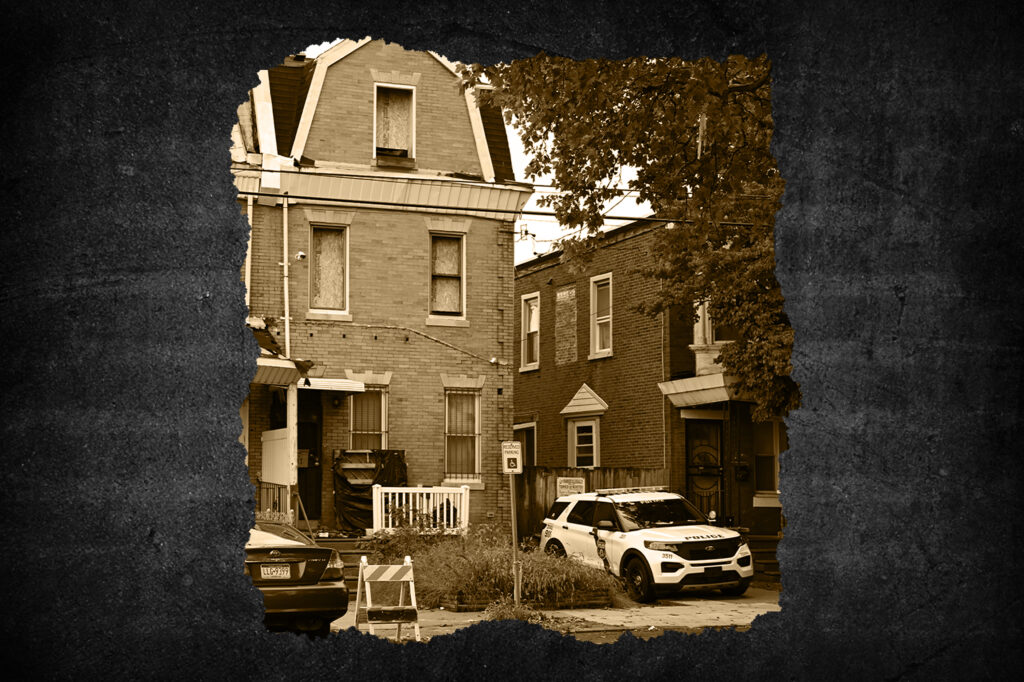
Since midsummer, behind a cordon of crime-scene tape in the city’s working-class Olney neighborhood, homicide detectives, FBI agents, cadaver dogs and evidence techs have been combing the property for clues to what was happening in hundreds of thousands of lurid pictures and videos.
So far, authorities said, they have determined the identities of 58 women who appear to have been grotesquely exploited, 10 of whom later died of drug overdoses away from the house.
Forty-four of the surviving women have been in contact with investigators. Four others are believed to have been killed in the duplex, along with a fifth possible homicide victim whose name is still a mystery to police.
Their nexus was a pornographer named Raymond Charles Horsch, who lived in the house until his death last year at 82. Horsch was a prolific producer of sexually explicit videos and photos, often depicting real or simulated brutality. His subjects were vulnerable women lured from local drug corridors, according to police and the Philadelphia Inquirer.
Authorities said the number of suspected dead women could rise as the FBI continues analyzing more than a million digital photos and videos seized in ongoing searches of 417 West Chew Ave., a three-story brick edifice that has been in Horsch’s family for generations. The images, about 30 percent of which had been reviewed as of mid-September, appear to tell a tale of sexual degradation rendered as purported visual art.
The age of the oldest graphic material is unclear, but some of it dates back more than a decade. Of the 58 identified women, 25 have been located by investigators but not yet interviewed, and 19 have spoken with detectives but declined to cooperate.
“They don’t really want to talk about what occurred in that house,” Deputy Police Commissioner Frank Vanore told reporters recently.
With hundreds of thousands of images still to be studied, authorities said, the whereabouts of the five suspected homicide victims have become the central focus of the investigation.
“Let’s remember, he was making movies,” Vanore said, adding: “Some of this is playacting and some of it we believe could be real.”
After reviewing images of the five women, each seemingly injured and unconscious, the Philadelphia Medical Examiner’s Office said they “appear to be deceased.”
Horsch, who served prison time for drug felonies in the 1980s and 2010s, died in May 2025. Judging from some of his work that survives on the internet, and a 2006 interview published by a fetish website, Horsch considered himself an avant garde visual provocateur worthy of critical notice. He favored scenes of naked, emaciated women forlornly injecting heroin, which he perceived as art.
He pursued his genre in 1973 in his first commercial porn flick (“The Erotic Memoirs of a Male Chauvinist Pig”) and, over the years, in self-published novels, video shorts and countless lurid photographs.
“At the risk of sounding stuffy, I believe my purpose is to communicate,” he was quoted as saying in the 2006 interview. “My intent is some sort of thought-provoking correspondence between the image and the viewer. … The images are about young women first seduced and then quite literally enslaved, degraded and abused by an insidious drug.”
Horsch was quoted as saying of his subjects: “They aren’t models. They aren’t actors. As for payment, without exception, their singular interest is their drug. Provide that, and they will do anything. … That is the horror. There is no limit.”
Authorities found Horsch’s digital collection this summer, about a year after his death from natural causes. They had been searching the house in connection with the arrest of Horsch’s son on drug and gun charges.
Eugene Horsch, 44, now in federal pretrial detention, also lived in the duplex, its second- and third-floor windows boarded from a long-ago fire. His lawyer did not respond to messages seeking comment. Police said the son has not been implicated in his late father’s activities.
While authorities have been mostly tight-lipped about what they’ve seen in the vast trove of images removed from the house, Vanore, the deputy commissioner, gave a grim summation of a video involving one of the five missing women. Police know her name, Vanore said, but her family asked that it not be made public. Metadata shows the recording was made in 2017.
“The video depicts a female and R.C. Horsch,” Vanore said at a news briefing, adding: “Both are not wearing clothes. There are two separate cameras — one he’s controlling and one that’s affixed somewhere in the bedroom.”
After the woman uses drugs, Horsch gives her money, handcuffs her to the bed and tightens a zip tie around her neck until she “appeared to be lifeless,” Vanore said. “But it’s just appearing that way. I’ve got to caution you and emphasize: We have not recovered a body.”
Nor have investigators found definitive remains of the four other women who appear to be dead in the images examined so far, authorities have said. Like the woman in the video, all were, or looked to be, in their 20s and seemed unconscious, with visible injuries, according to police. Investigators also discovered a significant amount of an undisclosed type of chemical in the house, along with five urns holding ashes.
“There was a homemade laboratory of some kind in the basement area,” Vanore said. Regarding the ashes, he said: “We believe one of the urns is R.C. We believe one is his sister. One’s a friend. The other two are still unidentified.”
Police have publicly named two of the five women believed to be dead: Maribel Fresses, who was 27 when her father reported her missing in 2018, and Gabrielle Amarando, who was 22 in 2012 when she was last seen by acquaintances. Fresses’s father declined to comment to The Washington Post, and Amarando’s family could not be reached.
In interviews with the Inquirer, Fresses’s father and Amarando’s stepmother reportedly shared memories of once-promising girls brought down by addiction. According to the article, both began using drugs as teenagers and wound up addicted on the Philadelphia streets.
“Absolutely every day she called me, and one day she stopped calling me,” Ricardo Fresses told the Inquirer. He said he last saw his daughter on June 19, 2018, when they met for pizza and he gave her $50. “As years went by,” he said, “I knew she was gone.”
The Inquirer article quotes Lora Timmons as saying her stepdaughter, Amarando, “always found the wrong crowd” and eventually “just went away. We searched here and there but we never found her. We always thought she was just off doing her drug thing, living her life.”
As for the three other women feared dead, Vanore said investigators know the identities of two of them. He said their families want the names kept private.
The case also has spurred renewed police interest in the disappearance of Horsch’s ex-wife, Anna McHale. Their four-year marriage began in 2004, when Horsch was in his 60s and McHale in her 30s. On June 13, 2016, just before she vanished, McHale told her family by phone that she was at Horsch’s home, according to published reports.
“So there’s a lot more to unpack at this point,” Vanore said, echoing other law enforcement officials who stressed that the investigation could last months.
Authorities have obtained numerous search warrants for the property and for an array of electronic devices. They are searching “computers, hard drives, flash drives, DVRs, cameras, phones,” Vanore said.
“The amount of information and digital evidence we got is astonishing,” police Inspector Ray Evers said at a July news conference, adding, “We have to look over 600,000 images — 70,000 videos — and over 10,000 pages of writings, manuscripts and drawings.”
Investigators said the number of digital images has since climbed to more than a million.
In promoting his novels online, Horsch, who wore an eye patch in his elder years, described himself as a man of many dimensions: “Alternately an artist, filmmaker, composer, writer, porn performer, drug smuggler, some-time political activist, art forger, counterfeiter, pot grower, air show pilot, army deserter, fugitive, sociopath, ex-convict and all-out villain.”
Now, posthumously, his visuals are drawing the widespread attention he always felt they deserved.
“I’m not going to get into what I saw,” Evers said grimly. But in a city that recorded more than 220 homicides last year, “this is new territory for the homicide unit in Philadelphia.”
The post A horror story unfolds as police examine pornographer’s brutal trove appeared first on Washington Post.