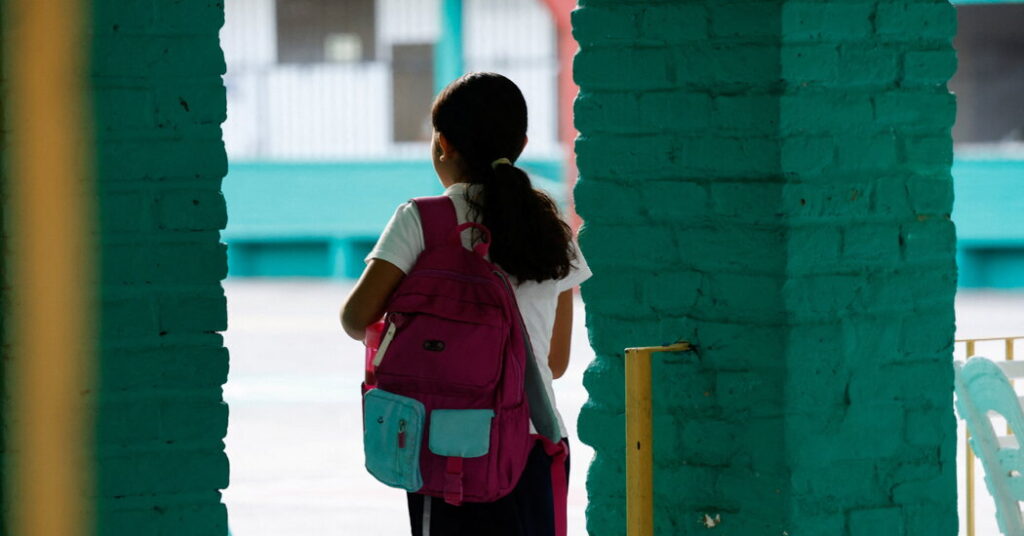
Mexico issued a nationwide restriction on Tuesday on cellphones and screens in the country’s educational system, taking a stand in the global debate over how much technology should be allowed in the classroom.
Under the new policy, access to cellphones, smartwatches and other personal devices will be restricted throughout the school day, including during recess and breaks, at both elementary schools and middle schools. High schools and universities were also asked to curb device use but were given more leeway on how.
The measure, which was determined by a consensus among state education officials and did not require Congress to pass a new law, will go into effect in November.
“The goal is to recover creativity and avoid this indiscriminate use of screens that, especially when linked to social media, can have negative impacts,” President Claudia Sheinbaum of Mexico said at her morning news conference on Monday.
“That doesn’t mean that artificial intelligence or screens aren’t useful,” she added, “but not in the classroom.”
Educators around the globe are grappling with how to balance the benefits of using technology in the classroom with the documented hazards of social media and excessive screen time, as parents press both social media giants and schools for accountability. Last month, Meta reached a $17 billion settlement with nearly all U.S. states to resolve claims that Facebook and Instagram had been deliberately designed to addict young users.
More than 110 countries have now imposed nationwide restrictions on mobile phones in schools, according to a UNESCO report.
Mexico, however, faces a distinct challenge: With only about 30 percent of public schools equipped with computers that have internet access, cellphones often serve as vital educational tools.
But the country’s new policy comes in the wake of a Mexican government survey of more than 560,000 educators across the country last month. About 78 percent of respondents reported student attention issues linked to the use of screens; nearly 90 percent approved of limiting access to devices during school hours.
Many Mexican parents and experts have welcomed the new measure against screens, but some have criticized it for being too vague on enforcement.
“This was something we urgently needed, and many of us agree with it — but it won’t be enough,” Israel Sánchez Martínez, president of Mexico’s National Parents’ Union, said.
The new policy, for example, requires high schools to choose one of four approaches: locking phones during the school day, limiting their use to specific zones or recess, banning them entirely or allowing access for educational purposes.
But it contains no specific protocols, fines or consequences for students who violate the rules, largely leaving schools to devise their own implementation plans while also urging them to avoid punitive approaches.
“That makes this weak,” said Laura Frade Rubio, an education consultant in Mexico City. High schools would “obviously” need to impose some system of rules and penalties, she said, adding: “All carrot and no stick? Sure, but on good will alone, nobody pays taxes.”
The new policy comes on the heels of a cheating scandal at the country’s premier public university, the National Autonomous University of Mexico, known as UNAM, where this year the first online entrance exam yielded such a large number of high test scores that it indicated widespread cheating, potentially through use of A.I.
Universities will be allowed to craft their own screen-use policies under the new restrictions.
Mexico’s approach to digital screens in the classroom stands in stark contrast with that of El Salvador, where President Nayib Bukele last year announced a partnership with Elon Musk’s company xAI, now part of SpaceXAI, to deploy its chatbot, Grok, in the country’s public schools, lauding it as the world’s first A.I.-powered public education system.
The United States has no nationwide policy on classroom screen use, but earlier this year, Utah and Alabama became the first states to pass laws limiting digital screen time, and Rhode Island imposed a full ban last month. New York City — the largest U.S. school district — recently placed strict new rules on screen time and A.I. use at elementary and middle schools.
Before Mexico’s national decree to limit screens, nearly half of the country’s 32 states already had some form of a restriction on mobile phones in schools. The decision to move forward at the federal level was reached after a meeting of education secretaries from all 32 states. Mario Delgado, Mexico’s education secretary, described it as an agreement between the country’s governors, his office and the president.
School administrators will have a preparation period in which to explain the new rules to faculty, students and their families before the new policy goes into effect across the country. But much still needs to be refined, experts warn.
“If I’m a teacher and my classroom lacks computers, my students still need to scan the QR codes in their textbooks for deeper content,” said Marco Fernández, an education researcher at the Technological Institute of Monterrey. “Or if I need a video to clearly explain a biology or physics concept, I’m sorry, but I’ll tell them to take their phones out.”
The post Mexico Becomes Latest Country to Restrict Phones in Schools appeared first on New York Times.