My wife and I were driving back from a date night. She was talking about a friend’s very expensive utility bill, but I had missed the beginning of what she said (I was driving, after all).
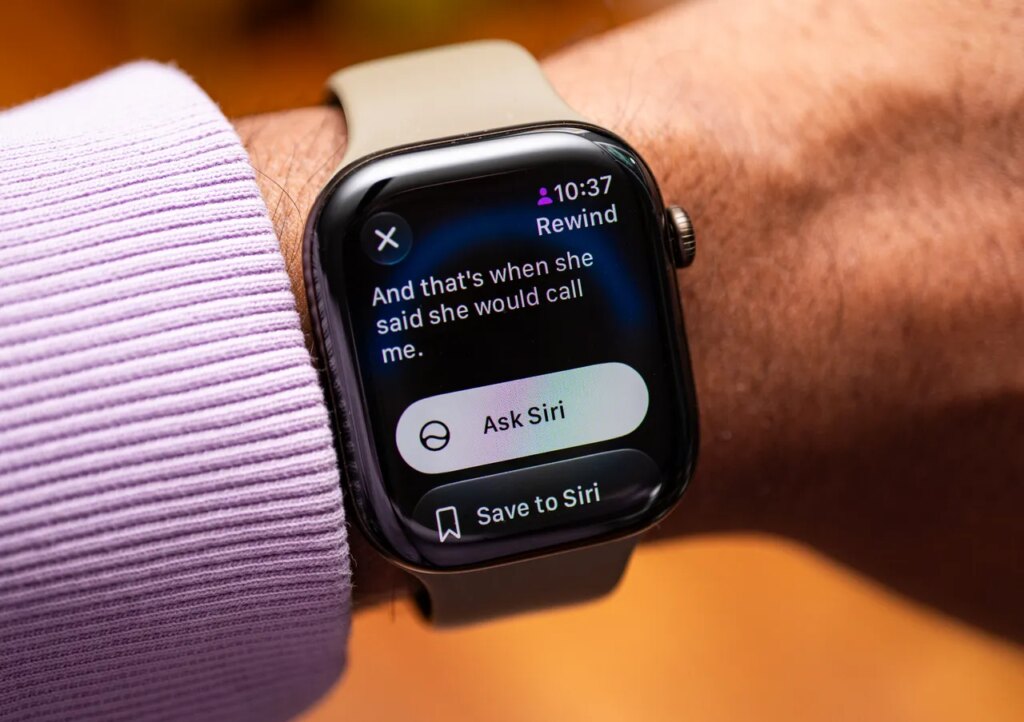
Then I remembered: Wait, I can ask Siri to remind me! At a traffic light, I double-tapped the digital crown on the Apple Watch, and Siri’s new Live Rewind feature spun back the clock 15 seconds and showed me a transcript of what my wife said.
I sheepishly interrupted her to show her the transcript. “Look!” Her reply? “Why wouldn’t you just ask me to repeat myself?” She shrugged at this new Apple Watch capability and continued talking.
A few days later, I was chatting with my brother on my stoop. Once again, I lost focus for a few seconds and remembered to ask Siri to help me recall what my brother said moments ago. But this time, before I excitedly showed my brother the Apple Watch screen, I preemptively said, “Yeah, I know I could just ask you to repeat yourself.” I got a perplexed look back.
Live Rewind, one of Apple’s new Audio Intelligence features on its latest Apple Watches, is designed to give you a transcript of the last 15 seconds of a conversation. It’s in public beta in watchOS 27.3, but is expected to launch officially before the year’s end.
Coming alongside it is another new capability called Siri Recap: Give the assistant permission to listen to your environment—you can set schedules or have it trigger when you reach the office—and you’ll see a “Recap” in the Siri app at the end of the day. It’ll show you summaries of conversations and list out important details that people said. It’s very similar to AI notetakers, many of which run on dedicated hardware devices.
The power here is that it all happens on your Apple Watch, the same device you wear everywhere to track your fitness, monitor health, and check notifications. That ubiquity is exactly what makes privacy advocates uneasy—they say features like these normalize ambient surveillance, much like smart glasses, undermining the privacy of bystanders who don’t consent to being recorded.
“One of the concerns that we have with things like the Apple Watch is we don’t know what the watch is picking up on,” Reem Suleiman, senior campaign director at the nonprofit digital rights advocacy group Fight for the Future, tells WIRED. “Just because the device wearer is the one opting in to use the feature, you’re not getting consent from everybody who you walk around.”
Apple has spent a great deal of effort explaining how the system works and how the company plans to maintain the privacy of its users and the people around them. First, these features are opt-in, and they are limited to the latest Apple Watch Series 12 or Apple Watch Ultra 4. They also require an iPhone 16 or newer with iOS 27 and Apple Intelligence. These features are not available for users under 18, and they currently work only in English.
For Live Rewind, the audio is processed on-device and cannot be accessed. When you activate it, a small chime plays from the Apple Watch that serves as a warning for folks nearby. Text disappears unless you choose to save it to Siri. For Recaps, Siri keeps them factual, doesn’t identify speakers, and also omits content the system deems sensitive. If you don’t save a Recap, it’ll self-delete in seven days. Apple uses its Private Cloud Compute processing system for the data, which is never stored or logged on its servers. Data stored in the Siri app is end-to-end encrypted when syncing with iCloud.
Even if you’re happy with Apple’s privacy focus, I haven’t found these capabilities tremendously useful over the past week. Live Rewind works well in moderately quiet environments, but the transcript can quickly turn into inaccurate gibberish when there’s a lot of background noise.
Activating it in front of the person you’re chatting with feels awkward. It comes across like pulling out your smartphone when someone’s trying to talk to you—a little rude and distracting. Instead of keeping screens out of sight—a big digital detox trend—you’re introducing one in the middle of a human conversation. I brought the topic up with my wife again, and she echoed some of those feelings, saying it felt like a feature that would stunt a person’s social skills. Instead of asking someone to repeat themself, they’re bringing an Apple Watch into the mix to fill in the gaps.
I am not saying it can’t be helpful. When it works, it feels like a superpower. Maybe there are certain situations where you don’t want to interrupt a group conversation and ask someone to repeat themself. Right now, though, there’s the problem of remembering that this feature exists and remembering to use it. I have also found the 15-second rule a little too short, and it resulted in me missing parts of the conversation.
Recap has been a little more helpful. For testing purposes, I’ve set Siri to capture recaps all day, every day, but I like that you can create a custom schedule or have it trigger when you arrive at a specific location, like the office. You can manually turn Siri Recap on or off in the Apple Watch’s Control Center. Most impressive is that, despite having Recap enabled constantly, I haven’t seen a meaningful dip in battery life. I’ve continued charging the Apple Watch Series 12 after a day and a half.
One of the more perplexing things was opening the Siri app to look at my recaps and finding a bunch of conversations I had no recollection of having. Turns out, Siri was recording media I was watching, like on YouTube or Instagram. This is a problem I encountered with AI notetakers, like the Amazon-owned Bee AI wearable, which claimed to be working on “liveness detection” to solve it. Its latest hardware shipped with a feature where it doesn’t record a conversation if it doesn’t detect the wearer’s voice within a set period. Hopefully, Apple can figure out a solution. For now, you can edit or delete these recaps.
One day, I forgot to record an interview (though I took notes), and I knew the person said something that I hadn’t written down. I headed over to Siri and found exactly what I was looking for—paraphrased, but there. That said, the Recaps aren’t designed to be detailed summaries and action plans from your meetings or conversations, unlike dedicated AI notetakers. They’re meant to jog your memory. At times, I wish Siri were more detailed, but if that’s what you’re after, you’ll have to invest in a third-party device.
Recap can be helpful for work meetings, but I haven’t personally found it all that compelling in my personal life. Looking back at what it has picked up over conversations with friends and family, the only thing I feel is: Yep, those conversations happened. A friend was talking about their woodworking hobby—they can’t use oil-based polyurethane as a finish in the winter months as it stays tacky. Siri logged this in such a matter-of-fact way, but when I revisited the conversation in the recap, I didn’t find it helpful, useful, or interesting. (No offense, friend!) It’s just nuggets of life.
Apple has pulled off impressive feats with these features, capturing these moments in a way that feels a little more privacy-preserving than competitors, without tanking the already limited battery life of its smartwatches. But socially, we’re still figuring out what it means to walk around with always-on passive recorders. For now, I’m happy to stick with my wife’s advice and ask: “Come again?”
The post The Apple Watch’s Live Rewind Can Record and Rewind Spoken Conversations. It’s Pretty Awkward appeared first on Wired.