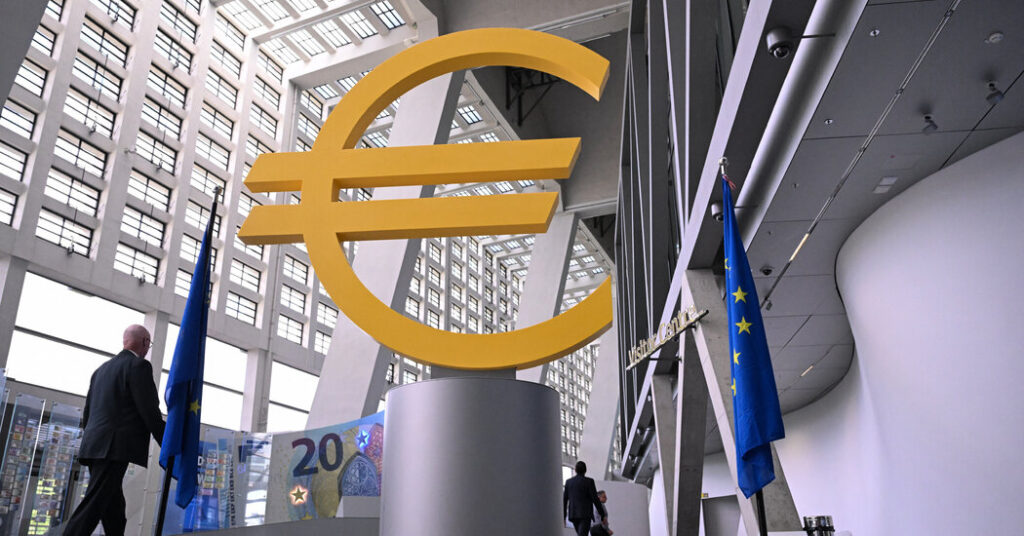
The European Central Bank raised interest rates on Thursday to the highest level in more than a year, as officials try to quell inflation driven by the war in the Middle East.
Policymakers at the bank, which sets rates for the 21 countries that use the euro, lifted their key rate a quarter point, to 2.5 percent. It was the second rate increase since the United States and Israel attacked Iran in February, starting a war that has sent global energy prices sharply higher.
This week the price of Brent crude, the international benchmark, climbed above $100 a barrel, and European natural gas prices are more than double what they were before the war.
The bank also said that inflation would be moderately higher than it previously expected next year but that economic growth would be stronger than their earlier forecast because of better-than-expected economic resilience.
“The outlook remains highly uncertain,” the bank said in a statement on Thursday, adding that the rate-setting council “remains well positioned to navigate the uncertainty caused by the conflict.”
The world’s major central banks have come under pressure to respond to rising inflation with higher interest rates amid jitters in the bond market, where investors are alert to rising debt and widening deficits by some of the world’s richest nations. In recent weeks, government bond yields have risen to levels not seen in more than a decade.
Next week, policymakers at the Federal Reserve, the Bank of England and the Bank of Japan will meet to set interest rates. In the United States, traders have increased bets that the Fed will lift rates this year, potentially as soon as next week. In Japan, officials are widely expected to increase rates next week. In Britain, traders are betting on a rate increase by the end of the year.
The inflation rate in the eurozone climbed to 3.3 percent in August, the fastest pace of price growth in nearly three years. It was mostly caused by higher energy prices, which have kept inflation above the central bank’s 2 percent target for most of this year.
The bank forecast inflation would average 3 percent this year and slow to 2.5 percent next year but policymakers have said recently that there was huge uncertainty about war and its impact on the economy.
The unpredictable nature of the conflict could cause energy prices to rise faster. While the European economy has so far proved surprisingly resilient to the energy shock, there are growing concerns about the coming winter. The continent has relatively low levels of gas storage for this time of year and it could be very expensive to warm homes and run industrial businesses if lots more gas needs to be bought at high prices.
The eurozone economy grew 0.6 percent in the second quarter of the year, compared with the previous quarter. The bank said the economy would grow 0.9 percent this year and 1.4 percent in 2027, both modest upgrade from forecasts made in June.
Although the E.C.B. rate increase announced on Thursday was widely expected, investors are hunting for clues about where the bank will go next. Traders are betting that it will keep rates steady for much of the rest of the year and then raise them twice by the middle of 2027.
But some economists are skeptical that rates will need to rise much further than where they are now. One reason is that policymakers say there is limited evidence that inflation is becoming deeply embedded in the economy, particularly through higher wages.
At 2.5 percent, interest rates are at the top end of the so-called neutral range, where policy neither boosts or suppresses the economy, analysts say. And so, the bar to raise interest rates further is quite high. From here, higher rates would more actively tamp down on economic activity to slow inflation.
The post European Central Bank Raises Rates in Bid to Quell Inflation appeared first on New York Times.