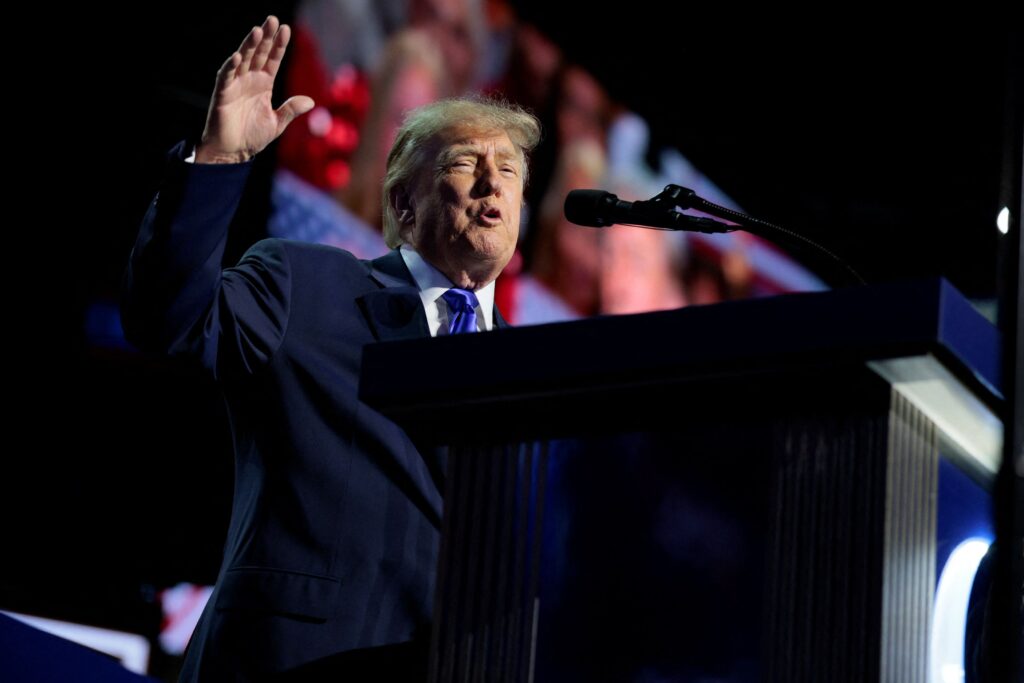
President Donald Trump has pledged a $5,000 dividend to every American adult if Republicans retain control of Congress in November’s midterm elections, prompting questions about how the benefit would work, whether it is legal and where the funds would come from.
Payments from the “Trump dividend” pledge would have to be spent in the United States, he told the Republican Party’s midterm convention in Dallas, without offering further detail.
Trump has proposed payouts before, though not tied to an election result, and two previous nationwide payouts never materialized.
Here’s what we know.
What Trump is proposing
In his speech, Trump said he will “issue a dividend to every adult citizen in the United States of America for $5,000” if Republicans win both the House of Representatives and the Senate, “very much like a successful company will do a cash distribution to its shareholders.”
He said the dividend was possible because of “our tremendous economic success” but did not specify how it would be funded.
He said the “only condition” on the payment is that it is spent in the U.S. “We don’t want you going to Canada to spend the money. We don’t want you going to China, to Germany,” Trump added.
He compared the payment to last year’s $1,776 “warrior dividend” to service members. He also lauded his “Trump accounts,”an investment account under which children born between Jan. 1, 2025, and Dec. 31, 2028, are eligible for a $1,000 one-time deposit.
The White House did not immediately elaborate on how the plan would work.
After the speech, Vice President JD Vance told Fox News that the payout was for “the American middle class.”
“What the president is talking about is a dividend for American workers,” he said, adding that the country was “taking in an extraordinary amount of revenue” because Trump is “standing up to both foreign companies, but also foreign countries.”
Payouts could face challenges
The payments, which could cost in excess of $1 trillion, could require congressional approval. Sen Bernie Moreno (R-Ohio) said on X that he will “get a bill ready” to get the dividend “passed immediately” after the election.
But the plan could face opposition over its potential effect on the national debt, which surpassed $40 trillion last month, and on inflation.
Maya MacGuineas, president of the Committee for a Responsible Federal Budget, a nonpartisan think tank in Washington, said the dividends would add $1.2 trillion to the budget in a single year.
“If the goal is to increase borrowing, drive up interest rates, weaken the longer-run economy, explode the debt, push up inflation and leave our children further indebted — this will do it,” she said in an email Thursday.
“With Americans grappling with real affordability concerns and bond markets all but pleading for fiscal restraint, now is not the time to make outlandish promises that blow up the budget.”
It is also unclear whether the payments would be legal. Some critics have suggested Trump’s plan could be viewed as an attempt to influence voting, which is prohibited under federal law, though other commentators have suggested it is more akin to a campaign promise.
Asked in his interview with Fox News about criticism that the proposal was a bribe for votes or would add to the national debt, Vance said he didn’t think it was a “controversial idea.”
Trump has promised similar payments before
Previous broad, nationwide rebates floated by Trump have not panned out. In February 2025, he touted the idea of sending Americans a “dividend” based on the savings he expected the U.S. DOGE Service to achieve, and in November, he proposed a $2,000 dividend funded by tariffs the U.S. imposed on nearly every country. Neither materialized.
Trump launched the “Trump accounts” for eligible children in July and the $1,776 “warrior dividend” bonus for service members in December.
Previous administrations have also come up with similar payouts. Trump in 2020, and then the Biden administration in 2021, offered individual payments as part of stimulus packages during the coronavirus pandemic. Neither was contingent on voter action.
The post What to know about Trump’s proposed $5,000 payouts appeared first on Washington Post.