Rafael Vela Gonzalez was a few steps away from the front door of his Silver Lake home when two Immigration and Customs Enforcement agents grabbed him in early January.
The 66-year-old, originally from El Salvador, had been in the U.S. since he was a teenager. His boyish grin was a fixture in his tight-knit neighborhood for more than three decades.
Neighbors always waved at Vela Gonzalez as he walked his German shepherd, Chico. He retired as a handyman a few years ago but passed the time caring for his aging partner, Vivian Lee Arguello, and doing odd jobs around the neighborhood to make ends meet.
He built the baby crib that welcomed a couple’s first child. He painted bedrooms, took charge of the block’s recycling efforts and fixed countless plumbing problems.
Now, after nearly eight months in ICE detention, Vela Gonzalez can barely stand, his loved ones say.
A mysterious rash has spread across his legs, and blood oozes from the sores. He doesn’t know what caused it, but his feet are so swollen he struggles to walk. He complained of stomach pain for weeks, until he collapsed in his cell in June, said his lawyer, Barbara Darnell, and spent nearly a week in the hospital.
“The biggest fear for a lot of the family is that he was just either going to disappear or he was going to get sick in there and die,” said Ashley Cabrera, 23, a loved one whom Vela Gonzalez calls his niece. “He keeps complaining about these health concerns and the facility doesn’t care.”
The Adelanto ICE Processing Center has, for years, been accused of substandard living conditions. Detainees have reported worm-like creatures in their drinking water, launched hunger strikes, and signed onto class-action lawsuits in recent months, decrying poor food, sanitation and medical care.
A federal judge in mid-July sided with detainees, who argued their constitutional and disability rights were being violated, and ordered the government overhaul conditions at the center.
A Department of Homeland Security spokesperson said all immigrants receive comprehensive medical care when they enter ICE custody, including medical, dental and mental health services as available.
Similar complaints have been filed against detention centers nationwide. Thirty-three people died in ICE custody in 2025, according to agency data, triple the deaths from the year prior. Four detainees have died in Adelanto since September.
Lee Arguello fears Vela Gonzalez will suffer the same fate.
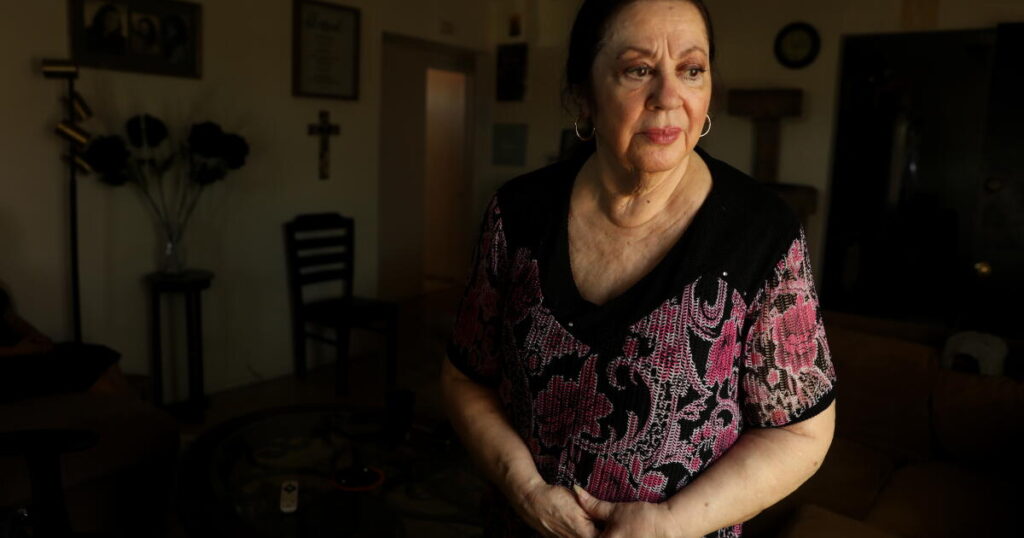
The 81-year-old and Vela Gonzalez have been together for more than 30 years, since she first hired him to do some carpentry in her home. She relied on him for nearly everything, from maintaining the house to tracking her medicine and cooking meals.
The pair never married because Lee Arguello wasn’t able to divorce her former husband, who took off decades ago, she said.
Lee Arguello, a U.S. citizen born in Los Angeles, now struggles to live without Vela Gonzalez. The housework piled up, the yard is overgrown, her expenses have risen and she can’t keep up with her health now that he is gone.
“He tells me … that he’s looking forward to coming home, and I hate to disappoint him and tell him that he might not come home. So I don’t say anything,” Lee Arguello said. “It’s heartbreaking.”
That day in January, Lee Arguello was on her couch in the living room, just steps away from the front door, when she heard Vela Gonzalez’s piercing scream.
“Vivian!” he said, his voice barely audible above the barks of his dog, Chico.
Lee Arguello’s mobility issues make it difficult to walk without assistance. By the time she made it to the door, Vela Gonzalez was being dragged down the street. The guilt eats at her, she said.
“I couldn’t do anything to help him,” Lee Arguello said. “It’s so, so difficult not knowing what’s going to happen.”
Video of the January incident went viral, and landed on Cabrera’s Instagram feed before Lee Arguello was able to call her.
Cabrera watched in horror as the man she’d called an uncle for nearly two decades was detained.
Vela Gonzalez was dragged down the concrete steps and pushed to the ground by two agents, before a third agent emerged to handcuff him, according to video footage reviewed by The Times. Another video angle shows agents holding him by the collar as they walk him down the street.
Vela Gonzalez has few blood relatives in the U.S., but formed a chosen family over his time in the country.
Cabrera and her family met him nearly two decades ago through church and he quickly became friends with Cabrera’s mom.
Since then, Vela Gonzalez has rarely missed a family event, she said. At some point along the way, she started calling him uncle.
“We’re just trying to help Rafael as much as we can, trying to get him to a safe place,” Cabrera said.
Close relatives of Cabrera and Vela Gonzalez initially assumed ICE would clear up the issue. Vela Gonzalez always believed he had legal status, said Darnell, his attorney.
He arrived in the U.S. at age 19, just over two years after he was forced to join the Salvadoran army at the outbreak of the nation’s brutal civil war. He received death threats, and his nephews were murdered, his lawyer said.
Vela Gonzalez arrived in time to qualify for the Immigration Reform and Control Act of 1986, which provided nearly three million undocumented immigrants a path to citizenship. He applied for amnesty then, and received a temporary green card, his lawyer said.
Homeland Security claimed the office sent a notice advising him to submit an application for a permanent green card, as the temporary card expired in 1997, Darnell said. Vela Gonzalez never received the notice and didn’t know he had to apply for permanent status, she said.
Vela Gonzalez carried the temporary green card in his wallet for nearly five decades. When he lost his wallet in 2023, he submitted an application to get the card replaced, which his attorney suspects put him on ICE’s radar. The application was denied in April 2025.
He was detained during a targeted operation, the Homeland Security spokesperson said, and will remain in custody pending removal proceedings.
Word of Vela Gonzalez‘s detention quickly spread and soon after, the video had landed in a group chat for residents of the area.
Neighbors were outraged, said Vincent Brook, a retired college professor who’s lived in the neighborhood for 48 years. The community was already outspoken against ICE, but hadn’t felt the impacts first-hand until Vela Gonzalez was taken.
“This happening in our own community, it added fuel to the fire, you know?” Brook said. “Anybody I spoke with was enraged about it.”
Around 30 community members gathered for a vigil organized by Brook 10 days after Vela Gonzalez was taken. His loved ones set up a GoFundMe, which raised nearly $50,000 in a matter of days.
“He’s lived a lifetime of being there for his neighbors,” Cabrera said.
Vela Gonzalez and Lee Arguello spoke daily after he was detained. When two days passed without a call from him in June, she knew something was wrong.
Vela Gonzalez complained for weeks of stomach pain and his legs were only getting more swollen.
“With me, he tries to appear normal, but I could tell he wasn’t the same,” Lee Arguello said.
She called the detention center and was told Vela Gonzalez was taken to the hospital.
The center refused to give her and Darnell any information on his health status or whereabouts, citing HIPAA laws, Darnell said. Loved ones eventually heard from Vela Gonzalez’s roommate, who said he collapsed in his cell right after a court hearing.
“They were literally hiding him from us,” Cabrera said. “He’s telling them every day that he wants medical attention and they’re not giving it … and then he randomly disappears with no communication.”
Vela Gonzalez was hospitalized for acute bronchitis and sepsis from June 17 to June 22, a Homeland Security spokesperson said. He’s receiving ongoing treatment for psoriasis.
“When circumstances require notification to a detainee’s attorney, ICE follows applicable notification policies and procedures,” the spokesperson said.
His lawyer and partner say Vela Gonzalez looks like a shell of what he once was. He’s lost weight and his hair falls out in clumps. He had long maintained a clean-shaven appearance, but started growing out his beard in detention.
It’s now thick and reaches inches below his chin. He refuses to shave until he’s released, Cabrera said.
It shouldn’t be much longer now, he tells her.
But the trappings of his and Lee Arguello’s life are falling apart.
Overgrown foliage has invaded the front yard of the Silver Lake home that Vela Gonzalez used to maintain. The trash has piled up and the trinkets he has collected for their garden are gone — a bleak reminder of his absence, said Halley Albert, 30, a neighbor.
Vela Gonzalez’s request for bond was denied in July and the court deemed him a flight risk. Darnell appealed the decision in August, citing his decades in the country.
Chico, his German shepherd, was sent to a foster family in March and permanently rehomed last month. The dog was restless without his owner, and would look for men who resembled Vela Gonzalez on every walk, Cabrera said. The family couldn’t manage the dog’s care.
Chico had hardly left Vela Gonzalez’s side since the couple took him in about four years ago. He was devastated to hear he lost his dog.
As the months dragged on, Lee Arguello had to leave her longtime home and move in with a niece in Lynwood.
She’s decided to put her house up for sale. It’s not much of a home without Vela Gonzalez, and she needs money to continue supporting him, she said.
She’s since tracked down her ex-husband and the divorce is in process. One day soon, she said, she will finally get to marry Vela Gonzalez.
His charisma makes him friends everywhere he goes, she said, so she wasn’t surprised to hear he’d started to form bonds with fellow detainees. When they get out, he says, they plan to start a contracting business together.
“We’re going to get married, even if he’s detained,” Lee Arguello said. “My hope is he will not be deported, and he’ll come back and we’ll have a good life together.”
The post ICE dragged him from his doorstep in January. His elderly partner fears he’ll die in detention appeared first on Los Angeles Times.