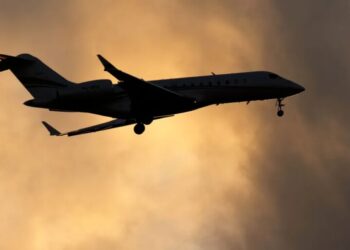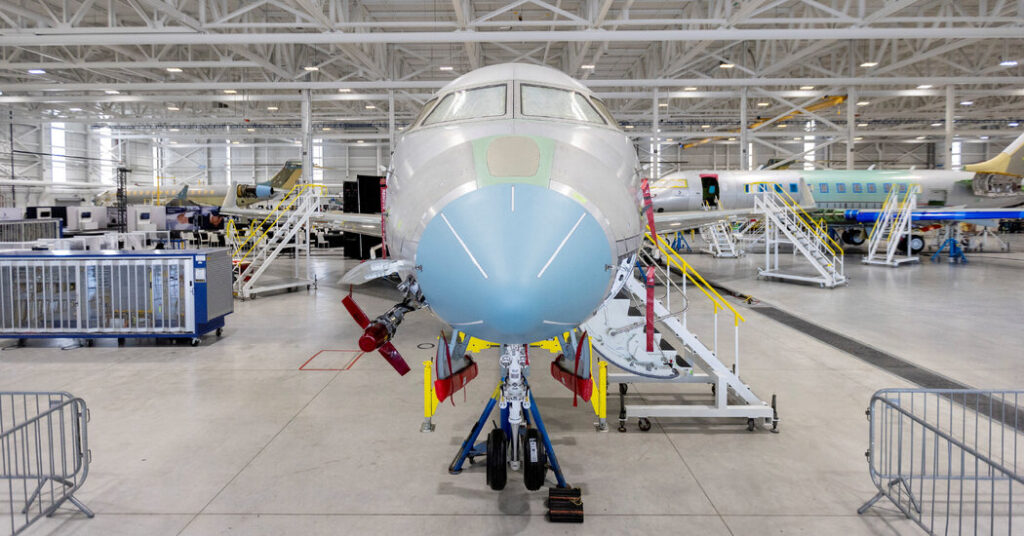
President Trump on Monday warned Bombardier, the Canadian manufacturer of business jets, that it would no longer be allowed to sell in the United States unless it made its aircraft there, escalating Washington’s trade dispute with Ottawa.
Mr. Trump has targeted the company before: He said in January that he might decertify some of Bombardier’s business jets as he threatened a steep tariff on aircraft manufactured in Canada, arguing that the country was restricting sales of aircraft made by Gulfstream Aerospace, an American rival.
During the first Trump administration, the Commerce Department imposed a nearly 300 percent tariff on new Bombardier passenger jets after Boeing, another U.S. competitor, accused it of using unfair government subsidies to underprice its planes.
Bombardier responded to Mr. Trump’s latest threat with a statement that did not mention the president but emphasized that it makes some parts for its planes at manufacturing sites in California and Texas. The company, headquartered in Montreal, added that it employs thousands of people in 20 U.S. states and that its supply chain includes 2,800 American companies.
Here’s what to know about Bombardier.
What does the company do?
In the 1920s, in a small garage in rural Quebec, a young inventor named Joseph-Armand Bombardier began making snow vehicles. He was later moved by personal tragedy: his 2-year-old son fell ill and died after deep snow and unplowed roads prevented them from reaching a hospital in time.
His company, founded in 1942, launched the Ski-Doo in the late 1950s and became the world’s top manufacturer of snowmobiles. Bombardier entered the rail industry in the 1970s, making subway cars for Montreal and New York City.
In 1986, Bombardier branched out into aviation by buying a top Canadian aerospace company, Canadair, and inherited its Challenger jets. It then acquired other aviation companies like Learjet, becoming a major manufacturer of popular regional planes like the CRJ series.
The company ended its passenger jet program after the 2017 dispute with Boeing and the Trump administration. Since selling its rail division in 2021, Bombardier has focused on producing private business jets like the Challenger and Global lines.
Who uses its planes?
Bombardier has customers around the world, but the U.S. market is its biggest. Of its global fleet of more than 5,200 aircraft, roughly half are in service in the United States, according to Cirium, an aviation data firm.
Many of its U.S. customers are companies and individuals using Bombardier-made business jets for private travel. Its commercial aircraft remain in service with U.S. airlines including Endeavor Air, a Delta Air Lines subsidiary; PSA Airlines, an American Airlines subsidiary; SkyWest, which flies routes for American, Delta, United Airlines and Alaska Airlines; and GoJet, which flies for United.
Bombardier’s business jets are purchased by militaries and defense agencies in more than 50 countries, including the United States. The U.S. Air Force and Army use aircraft made by Bombardier and modified for specialized surveillance and intelligence missions.
About 55 percent of Bombardier’s $9.6 billion in revenues in 2025 came from the United States, according to the company.
In a social media post on Monday, Mr. Trump said of the company: “If they want our Market, they must build here, and stop treating America like a ‘piggybank.’”
What is its history with the Trump administration?
Boeing filed a federal complaint in 2017 claiming that Bombardier had violated American trade rules because subsidies from the Canadian government had allowed it to sell its CSeries commercial aircraft to Delta at below market prices.
The jets were part of Bombardier’s ambitious push into commercial aviation and a direct challenge to its larger rivals, Boeing and Airbus, though the aircraft faced delays, cost overruns and low demand. Boeing’s complaint was unusual in part because it did not make a direct competitor to the 100- to 150-seat aircraft.
The Commerce Department, under the first Trump administration, sided with Boeing and proposed a nearly 300 percent tariff on the jets.
But the decision backfired: Bombardier handed majority control of the CSeries program to Airbus, Boeing’s European rival, for zero cash, allowing the planes to be assembled at Airbus’s plant in Alabama to evade U.S. duties. The series was rebranded as the A220 and Bombardier exited commercial aviation entirely.
In 2018, the U.S. International Trade Commission unanimously rejected the tariff, a verdict greeted in Canada with relief. Boeing did not appeal the ruling.
Mr. Trump reignited the dispute with Bombardier in January, threatening to decertify its Global Express business jets and impose a 50 percent tariff on its Canadian-made aircraft unless Canada certified several American Gulfstream jets.
The models that had not been certified at the time were approved the next month, and the measures threatened in January ultimately did not take effect.
Has it been in other U.S. trade disputes?
In 1982, the Reagan administration accused Canada of violating international trade agreements by providing unfair subsidies to finance Bombardier’s bid to build subway trains for New York City.
Facing severe financial penalties, the Metropolitan Transportation Authority made a concession, freezing all foreign-made rail car purchases for three years.
The Bombardier contract stood. In 1999, the company signed another contract with the M.T.A. to replace commuter trains on the Long Island Rail Road. Many of those train cars remain in use today.
The post Canadian Jet Maker Is Target in Trump’s Trade War appeared first on New York Times.