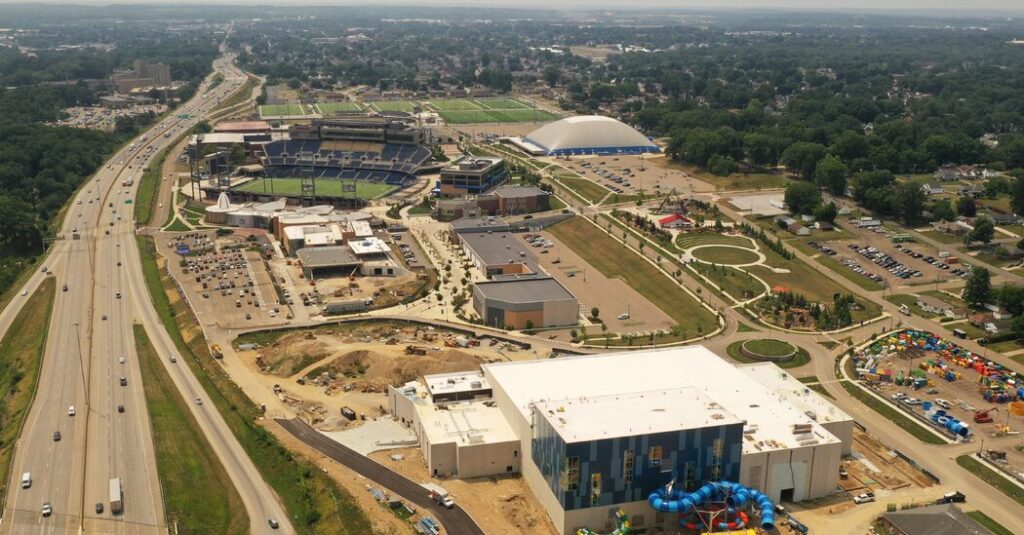
Ryan Spurgeon grew up half a mile from the Pro Football Hall of Fame, and, like many residents of Canton, Ohio, he felt proud whenever he passed by. The National Football League was founded in Canton, and its museum kept the city on the map even as factories shuttered and the population shrank. Every August, thousands of fans pour in for Enshrinement, when the greatest stars are inducted into the Hall and the N.F.L. plays an exhibition game.
So when the president of the Hall unveiled plans in 2014 to build an entertainment district next to it, which he trumpeted as a “Disneyland for football,” Mr. Spurgeon and many of his neighbors were excited. The Hall of Fame Village would include a refurbished stadium, youth fields, an N.F.L.-themed activity center, a hotel, shops and housing, including for former players. In 2020, Mr. Spurgeon was so hopeful about its prospects that he bought about $5,000 in shares issued by the developer’s parent company.
But after an initial burst of building, the project’s losses mounted and construction stalled. Visible from nearby Interstate 77 were piles of dirt and a half-finished indoor water park that some locals began calling the world’s largest birdhouse. Swimming in debt, the company went private. Mr. Spurgeon got back pennies on the dollar for his shares.
“I guess I had pipe dreams growing up with the Hall of Fame in my backyard,” said Mr. Spurgeon, 40, a superintendent of an aluminum fabrication plant. “I won’t give them another cent of my money. Every time I drive by, I give it the finger.”
The Village was supposed to transform Canton, a city of 70,000 about 60 miles south of Cleveland. A 2015 study commissioned by the Hall and local business leaders predicted it would generate as many as 13,000 jobs and more than $300 million in new tax revenue.
But the development, most of which was expected to be finished by 2018, has been troubled since its inception. It has gone through multiple project leaders whose plans have often fizzled. Local and state officials have doled out tens of millions of dollars in subsidies, even as the project fell into a deeper financial hole.
As the N.F.L.’s biggest names make their annual descent on Canton this week to celebrate the induction of quarterback Drew Brees and others into the Hall, they will sit near key elements of the unfinished development — a site that has become a sore point among residents who supported it because they thought it had the N.F.L.’s backing.
The N.F.L. commissioner, Roger Goodell, who sits on the board of the nonprofit museum, had talked up the prospects of the for-profit Hall of Fame Village, and in 2019, the league’s owners approved a $10 million investment for it. The N.F.L.’s name gave many residents the belief that it was worthy of taxpayer support — and in the case of Mr. Spurgeon and others, some of their personal savings. Then, the N.F.L. backed away. It never announced the reversal.
A league spokesman, Brian McCarthy, said the N.F.L. pulled its financial commitment because certain milestones were not reached. He declined to comment further.
The development may yet reach the finish line. So far, athletic fields, a sports training facility, an office building and a strip of stores have been built, and the 23,000-seat stadium and a downtown hotel have been upgraded. With tens of millions of dollars in fresh private investments and new partners from the group that built the Titletown development in Green Bay, Wis., work on two other critical parts has resumed this year. Project leaders say the “Gameday Bay Waterpark” is now 70 percent complete, and a new 180-room hotel is expected to open in 2028, more than a decade after its original groundbreaking.
But so far the project has fallen short of its wildly optimistic vision. Before the company went private in January, it reported having around $300 million in debt, with more than $100 million of it coming due by year end. Project leaders declined to share the current price tag of the development but through the years they have cited figures that were nearly double the original $476 million estimate. The Village has never turned a profit and generated only $5 million in revenue in the third quarter last year, including the Enshrinement festivities, according to a company financial statement.
“It gave false hope to a lot of people in the community,” said Frank Morris, a city councilman who consistently opposed public assistance for the project. “Our people are tired of being the Hall of Fame city. They just want police, fire, no potholes and a nice, clean environment.”
Early Optimism, and N.F.L. Support
In 2014, David Baker, the Hall’s new president, and Stuart Lichter, a major developer in Ohio, pitched an entertainment district around the Hall that would give museum visitors a place to grab a meal, take their children or spend the night.
“My vision was, how can we legitimately build something that people would want to invest in,” Mr. Baker said in a recent interview, “and how do we leverage the N.F.L. brand?”
Jerry Jones of the Dallas Cowboys, one of several team owners on the Hall’s board, said he invited Mr. Baker to use the league’s name as part of his sales pitch.
Mr. Baker did that partly by encouraging Mr. Goodell to publicly back the Village. Mr. Goodell talked up the league’s support to the local newspaper and helped recruit an influential sports investment banker. Mr. Baker’s Hall of Fame bio page quoted Mr. Goodell saying the Village would be “one of the most spectacular things that I’ve ever seen.”
Mr. Baker and Mr. Lichter also solicited money from the city, county and state, through loans, grants and tax credits. Additional taxes are collected in a specially created Tourism Development District, with a portion going to the development.
Quickly, though, the plans fell behind schedule and construction costs rose. The developers prioritized refurbishing Canton’s aging stadium because, Mr. Baker said, they wanted to make sure the exhibition game wasn’t moved elsewhere. But fixing it was a major expense — about $150 million — and the stadium, which hosts only a few big events a year, generated little new revenue.
The stadium, which hosted the Arizona Cardinals and Carolina Panthers on Thursday, was completed in 2017. But by the next year, construction had been halted on other parts of the development.
‘Nothing They Were Doing Was Working’
That’s when Village leadership hired Michael Crawford, a former Disney executive who led the development of the company’s resort in Shanghai.
He pushed a resort and entertainment concept that included rides and a sports betting parlor. He compared the Pro Football Hall of Fame to Disney’s “Cinderella Castle.”
Over the next several years, he and Mr. Lichter tried to raise money, sometimes grasping at fleeting business trends. They created a new firm, the Hall of Fame Resort & Entertainment Company, which went public in July 2020, but fell nearly $100 million short of the capital it set out to raise; the stock tanked. The sportsbook never opened. Digital tokens known as NFTs were created, but few were sold.
They attracted at least $100 million through the federal EB-5 visa program, which allows international investors to apply for green cards. In an April 2020 webinar pitching the project to these potential investors, Mr. Crawford cited the N.F.L.’s $10 million investment, which he said would “come as we go public.” He also showed a slide that quoted Mr. Goodell calling the Hall of Fame “the most relevant asset” in the league’s portfolio. (Mr. Crawford did not respond to a request for comment.)
“Nothing they were doing was working, and I was amazed at the amount of capital they were burning through,” said Chris Drose, a short seller for Bleecker Street Research who bet against the Hall of Fame Resort & Entertainment Company’s stock in 2020 and 2021. “They were trying to piggyback on the N.F.L.’s reputation. They were grasping at straws.”
Mr. Baker, who was earlier sidelined from the Village project, stepped down as president of the Hall in October 2021.
Around this time, the N.F.L. chose not to move forward with its $10 million commitment to the Village. A big reason, Mr. Jones of the Cowboys said in an interview, was that the project’s vision had changed. “A theme park is a totally different thing than what our interest is at the N.F.L. regarding the Hall of Fame,” he said. “We are not in that themed, Disney-type business.”
The youth sports complex, one key component of the original plans, opened in 2022, and the Village claims it attracts hundreds of thousands of visitors annually. But to raise capital coming out of the pandemic, the Village sold a majority stake in this venture, and also mortgaged the water park site.
A naming rights deal with Johnson Controls fell apart and a senior care facility for former players was quietly scrapped. Retail tenants closed up shop. In late 2024, several companies had liens for millions of dollars in unpaid work. Construction on the site all but halted again. Mr. Crawford left in May 2025.
The company considered filing for bankruptcy but could not afford the filing costs, according to an S.E.C. disclosure. An affiliate of Mr. Lichter’s real-estate group acquired the company and took it private, buying the remaining shares for less than 10 percent of their debut price.
In January, the company announced a “restart” for the project with a new leadership group. Michael Cantor, managing director for Sterling Project Development, which led the Titletown project in Green Bay, said he wanted to re-emphasize a “football-first mantra.”
They have removed a Ferris wheel and other rides, and will emphasize community spaces and follow an “appropriately” sized retail strategy, Mr. Cantor said. (He declined to share financial projections.)
He added that he was focused on delivering this latest vision, not on what went wrong. “You can’t really turn back the clock,” he said.
Skepticism Over New Plan
The view from the highway is changing again. The water park is no longer covered in black plastic and some of its colorful slides once piled in a parking lot have been installed. Supporters of the Village remain optimistic the development will ultimately benefit Canton.
“I know this has been hard, and I really believe it’s going to have a big reward,” said Don Taylor, chief executive of Welty Enterprises, a construction manager for the Village. Welty was owed millions of dollars for work on the project, but converted that into equity to become partners. “We believe we are putting our money where our mouth is, that the project’s going to be successful.”
Yet hurt lingers among residents whose ties to the Hall date back to its founding through a civic fund-raising campaign in the 1960s. Lori Lombardi, who lived in her family’s longtime home bordering the Village, was initially excited about the plans. She sold her house to the developer in 2017 for what she said was a fair price, joining dozens of her neighbors. But she thought the land would become more than a parking lot.
“You put all these people out of their homes for what?” she said. “Just finish what you started.”
Some residents have asked city officials for a forensic audit of the subsidies given to the development. William V. Sherer II, Canton’s mayor, said an audit was not needed because the Village is making its loan payments.
The city council voted last fall to extend some of the tax financing for the development, which Mr. Sherer hoped would prevent the project from going bankrupt. No new city money was committed to the project, he added.
Richard Sacco, a city councilman, said he believed the city had propped up the development for long enough.
“When they came down here and sold us on the project, they said they had the money,” Mr. Sacco said. “Now we can just pray we get something back.”
The post How an N.F.L.-Backed Plan to Revitalize Canton, Ohio, Faltered appeared first on New York Times.