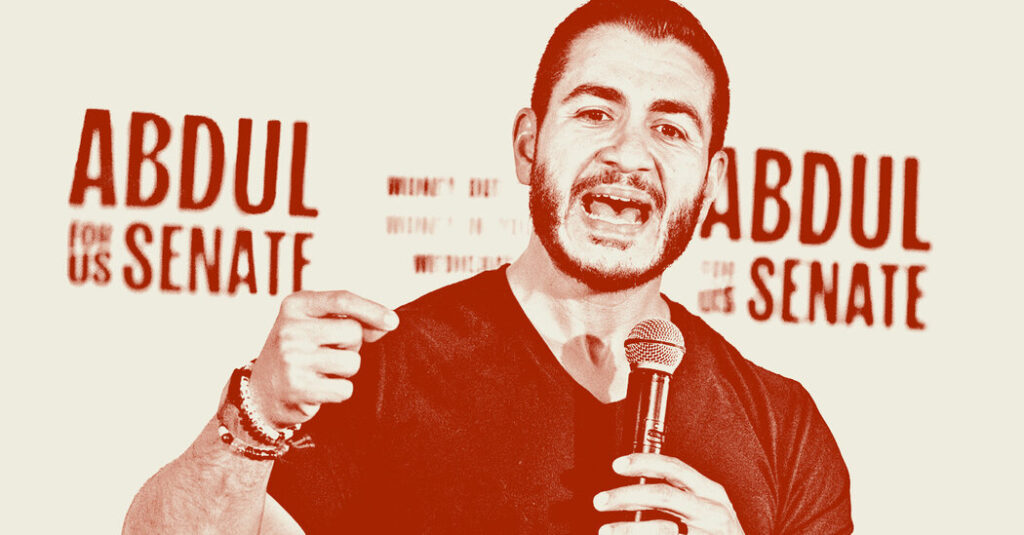
Based on the Democratic primary results in Michigan, a big question looms over the party: Can it turn this enthusiasm into a midterm win? The national politics writer Michelle Cottle joins the columnist Jamelle Bouie and the Opinion politics editor Michael Duffy to debrief what happened in Michigan, what Democrats can learn from the tight race and what Abdul El-Sayed’s victory might mean for the midterms.
Below is a transcript of an episode of “The Opinions.” We recommend listening to it in its original form for the full effect. You can do so using the player above or on the NYTimes app, Apple, Spotify, Amazon Music, YouTube, iHeartRadio or wherever you get your podcasts.
The transcript has been lightly edited for length and clarity.
Michelle Cottle: Give me a word that sums up this midterm cycle for you and why. Jamelle?
Jamelle Bouie: A word.
Cottle: A word.
Bouie: A single word. I don’t know if I have a single word. I mean, I actually think it’s been a little less exciting than people think, but this is a cop-out. Interesting. It’s been an interesting election cycle.
Cottle: I’ll allow it. Michael?
Michael Duffy: Dynamic. I need two words — lift and drag. Lift and drag. The lift is obvious. The Democrats are showing up, in primaries, in numbers greater than anyone expected in states like Texas and North Carolina, and Michigan. And that’s a measure of some enthusiasm that I think qualifies as lift.
And drag is just the man in the White House. A Republican consultant refers to him as “the anchor.” He is a weight on all that they’re trying to do. So lift and drag. Sorry, I need two. I’m a beginner.
Cottle: That’s OK. Poetic license is what we’re all about. My friends, these insights are coming to you from my regular co-conspirator, columnist Jamelle Bouie, and from our brilliant Opinion colleague, politics editor Michael Duffy, who is making his round-table debut.
I’m Michelle Cottle, obsessive coverer of national politics, and I’m going to go with a midterm word — ulcer-inducing — which really needs no explanation, but it does give us, I think, the perfect segue into our top topic of discussion this week: the Michigan primaries and the ongoing fight for the soul of the Democratic Party.
So obviously, this is not a new fight. We’ve had insurgent progressives and moderate pragmatists locked in a tug of war for years. This cycle, it’s gotten red hot, and it’s bubbling up in some battleground areas you might not have expected. This most definitely includes Michigan, where the Democratic primary for U.S. Senate came down to a brutal, expensive brawl between the left’s Abdul El-Sayed and the center’s Haley Stevens, and it ended this week with El-Sayed squeaking out a one-point victory.
Now, Michael, you spent an awful lot of time talking with folks in Michigan while working on The Choice, which for those unfamiliar, is basically Opinions’ voter guide to some of this cycle’s key races. How surprised are you that the race wound up so close?
Duffy: Well, Michelle, I’m no oracle. I, like you, watched El-Sayed on the stump and in debates and in interviews, and you couldn’t help but be amazed by his energy and his charisma, and I can see why people thought it was going to be a stampede. We did hear, all the time, when we were talking to people for The Choice, about a sort of crying out for change that he offered.
But I have to admit, going into the final week, I thought Stevens was going to pull it out. Chiefly because primary voters in Michigan are whiter and older and more moderate than Democrats generally — and she’s their kind of people. And the worse the polls seemed to get for Stevens, the more center she got.
She kind of dug further in, and I thought, she must know what she’s doing. As it happened, as you say, El-Sayed marshaled incredible, incredible margins in places like Ann Arbor and Grand Rapids, and got enough in Detroit that he could pull it out. But the significance is the one you mentioned, which is that progressive populists have been winning in blue places like New York and New Jersey and Colorado, but they haven’t really, until this week, won in a purple state or swing state like Michigan, and that is a huge deal.
One more note about Michigan that’s important, I think, is that Michigan Democrats have a habit of rejecting their party’s choice and its ideas about how to win. Bernie Sanders beat Hillary Clinton there in 2016; 100,000 Democrats voted against Joe Biden just two years ago. And of course, if you go back to the medieval times, where I began, in 1988, Jesse Jackson wiped the floor with Michael Dukakis in that year.
So they have a habit of doing this to their party’s — the establishment’s — choice. And this was part of that tradition.
Cottle: So Jamelle, you said last week that for Democratic voters right now, fight, expressions of anger are maybe more important than policy or ideological splits. How did this factor in, specifically in what you saw in Michigan?
Bouie: I mean, my read of Michigan is that that’s very much part of what drove El-Sayed’s rise, in the sense that he was someone who represented a more aggressive posture. And it’s interesting. I think, when a lot of people talk about this, it’s always in terms of policy and ideology.
And one of my touchstones is that ordinary voters don’t actually know that much about either policy or ideology. They don’t really have strong views either. What they have are a set of senses, a set of suppositions, a set of intuitions for which policy stances can either validate those or tell them that the candidate is off base, right?
And so, like El-Sayed being for Medicare for all, right? What that says to a voter is: “This is a guy who wants to do big things,” or, “This is a guy who’s aligned with these particular people,” or “This is a guy who just isn’t presenting himself like a typical Democrat.” And that’s the thing that matters. The policy stance is like a proxy for all these other things that people can’t, or may not necessarily be able to articulate, but they feel. I’d say the same is true for his stance on Israel, his opposition to military aid for Israel, his pro-Palestinian politics.
There are plenty of voters who, I think, feel very sincerely and seriously about that, and El-Sayed does as well. But I think for a lot of voters, it’s a kind of, “Oh, this guy sees with his own two eyes what I see,” and it becomes a proxy for, “I can trust his judgment,” right? “He saw the videos from Gaza. He came to the view that I came to: I can trust his judgment.”
And so, I think all of those things are happening simultaneously, and help explain why it is that El-Sayed was able to mount this really impressive challenge to Stevens, who just had a ton of money. I mean, El-Sayed’s outspent by, like, an order of magnitude.
So he’s running a campaign for which he has much fewer resources and really does have to rely on his charisma, on hustle, just being out there in a way that I’m not sure Stevens necessarily had to until the end, right? And that, to me, it goes a long way to explaining what happened here.
It’s worth saying that Stevens nearly won. So, the combination of resources and the fact that she is, like, an established candidate — people know her, she’s a known quantity, and she has a discrete base, right? And one thing that’s interesting to me about all of this is what left-wing insurgent candidates in other similar states can take away from this particular race.
Because this is going to look much more like the kind of arena or the kind of battleground that left-wing insurgent candidates are going to face, if they’re going to try to really win in places other than a big city like New York, right? It’s going to look much more like Michigan than it is like New York City.
Cottle: All right, you brought up money. I want to talk about that just for a little bit. This wound up being the most expensive Democratic Senate primary race in history. More than $60 million poured into Stevens’s campaign, and more than half of that involved an issue that has become increasingly divisive in the Democratic Party — and that’s Israel.
The American Israel Public Affairs Committee and its affiliated groups dropped over $30 million in Stevens’s campaign. And money’s generally considered the lifeblood of politics, but increasingly, there’s a growing sense that AIPAC money is toxic in Democratic races.
So Jamelle, given Tuesday’s results — which include former D.S.A. House member Cori Bush’s failed attempt to take back her seat from Wesley Bell, a moderate Dem who was supported in the primary by AIPAC — where do you think this particular dynamic stands?
Bouie: I think that among political elites, Israel’s divisive. But if you look at Democratic voters and polls of Democratic voters, large majorities agree that we should stop giving military aid to Israel. In a lot of ways, El-Sayed represents where actually the typical Democratic voter is, and the Democratic establishment — and Democratic elites — are catching up to that.
But the ground, in terms of public opinion, has shifted really quickly, and I think that actually accounts for some of the disorientation that establishment Democrats clearly feel. This happened very fast, in a matter of two years, and it’s taken time for people in the leadership class, I guess, to adjust.
And I’d say that, with regards to AIPAC — I mean, AIPAC has become a bit of a boogeyman here. Honestly, I think the big issue is that AIPAC supports Republicans too, right? And so, it’s like you have this well-resourced political action group that will spend millions of dollars either to defeat more left-wing Democrats or to defeat Democrats in the general election.
And you can do one but not the other, you know what I mean? If you don’t want to be so toxic to Democratic voters, you can do one, right? You can be like, “OK, we are on this side of an intraparty factional battle.” But then you can’t also be like, “And then we’re going to defeat the winner of the factional battle, or we’re going to try to, in the general election.” I think that really makes people very upset, when it seems that it’s all in bad faith. I’ll put it that way.
Cottle: So Michael, did you have money thoughts, either on AIPAC in particular or just more generally on the eye-popping amount spent here?
Duffy: Well, the key number here is 9-to-1. Stevens outspent El-Sayed by a huge lopsided proportion. And normally, you might see a 2-to-1 outspend, or a 3-to-1 outspend, but you almost never — I’m not sure I’ve ever seen a 9-to-1 ratio. And it’s like that old saying: When someone says it’s not about the money, it’s about the money.
I think the thing that was powerful for El-Sayed, about money, is all the things it represented. Whether AIPAC spent $30 million or $30, El-Sayed was able to turn Stevens into a tool of special interests.
Audio clip of Abdul El-Sayed: When you’re bought off by D.T.E. and BlueCross and Big Pharma and Big Tech and AIPAC, don’t be surprised that there’s a pro quo that comes with that quid. That money doesn’t just fall off trees. Sixty million dollars from outside organizations in this race didn’t just come from nowhere.
That dovetailed with his larger complaint that he made over and over during the campaign, about the Democratic Party being in the pocket of corporations or unseen special interests, and they were way too willing to go along to get along — far too complacent about money politics.
And that was a very animating cocktail for Democratic primary voters. And we should note also here that Stevens’s defense against this stuff — and Jamelle’s right — was almost nonexistent. She almost seemed to own it. She didn’t even fight back. She didn’t say, “I’m not a tool, I’m not captured.” I think he kept using the word “bought.” He wrapped her into a larger shroud of unseen interests that were really guiding, ruining politics.
But I think there’s even one more thing at stake here, or at work, that is important, that isn’t really about foreign policy or Israel or anything like it. And that is when he went after not just military aid to Israel, but all aid to Israel. He was tapping into what, I think, a lot of Americans — particularly Democrats — feel is a sense of misplaced priorities. Why are we spending on this when we could be spending on that? And he said — he had this great line: Why are we buying bombs and tanks for other countries’ wars instead of rebuilding schools?
And you don’t have to be an expert on foreign policy or the Middle East — and most people aren’t, as Jamelle notes — to say, “Hey, yeah, that sounds right to me.” And when neighborhoods and roads and bridges and schools are falling apart, that is an extremely resonant angle. And he made the most of it.
Cottle: I’m fascinated by that exact kind of dynamic, because this is something that Republicans have been doing frequently in the Donald Trump years, the whole: Why are we going to do military adventurism even, and spend over there? Why are we worrying about them, when we should be worrying about the white working class back here at home?
And then you also look at all these polls over the years, which show that American voters tend to have a very inflated sense of how much money is actually spent on foreign aid, and I cannot remember the specifics, but they think it’s exponentially more than what we actually spend on a regular basis.
So I do think it’s interesting that this has crept into the Democratic Party as well and taken hold, whether it’s Israel that drove it or some larger force. And I do think this is going to be a real problem, because young people in particular are really fired up about this. It’s not surprising to me that Stevens was favored by older voters, and younger voters were more responsive with El-Sayed.
Duffy: I was going to say one more thing about the Israel piece in this race, and that is — it was a taboo topic in Washington. No one could talk about this. He just kept signaling over and over: I’m going to go on offense and stay there, I’m going to stay on my front foot. And that really was a signal, I think, to voters that this is someone who isn’t scared of a fight, isn’t cowed by power, and is willing to take on the Trump White House and all of its extra-constitutional stuff.
So I just think his choice of targets here was also strategic.
Bouie: Yeah. I want to just add one more note to that. It was entirely possible for Stevens to win this race. And to me, one of the things that just stuck out was how flat-footed she was. Setting aside all substantive things — Michelle’s heard me say this a bunch — some candidates kind of have the juice and some don’t. And watching the two of them, you’re like, “El-Sayed, that’s a guy with the juice.” That’s a guy who is sharp and attentive and able to respond to dynamic political conditions very quickly and assertively, and Stevens just couldn’t.
And I think voters pick up on that. If voters can pick up on anything, it’s that. They pick up on that immediately.
Cottle: So, once upon a time, my position was that presidential races were just completely different because Americans vote for boyfriends, not candidates. But I think social media has actually changed that, so it’s actually moving down the food chain. Who can do the viral hit? Who can do the Zohran Mamdani and his man-on-the-street interviews? Who looks good on camera? Who has charisma? I think that is taking root ever farther down the ballot, and I do think that it was one of Stevens’s problems — she was much flatter than he was. And it’s always been my position that — like you, Jamelle — the policy differences, I can’t find voters, usually, who can tell me the policy differences between the candidates and their party on the trail.
So I think this is something that we’re going to be looking at for a while, for better or for worse.
Bouie: This is a very me thing to say: It’s very 19th century. This is how politics used to be. You know, a guy like Abraham Lincoln impressed people not because he was erudite, but because he was 6-foot-4. He was a giant, strange-looking man, who also happened to be an erudite, interesting guy.
But the importance of presence, of rhetorical skill, of attention grabbing — these are classic, old-fashioned political skills, and I actually think it’s a good thing that it’s coming back. People are recognizing the importance of being able to perform politics as much as being able to be a good legislator. You need to be able to do both, but I think Democrats in particular have lost, or forgotten, the importance of political performance.
Cottle: We’re going to be learning how the various demographic groups voted for a while yet, but one of the big political divides that we’ve been looking at — not just in Michigan — is between college-educated and non-college-educated voters. Michael, how were you seeing this split in the Michigan race?
Duffy: El-Sayed ran as a classic liberal. He did well in these big college towns, like Ann Arbor, Kalamazoo, Lansing. These are homes of large universities or colleges. It’s interesting. He’s the first Democrat, in something like nine years, to win the whole state without winning any of the three counties around Detroit — Macomb, Oakland or Wayne. That’s really unusual and a really different path to victory. So he had a broad base.
She did well among — as you would expect — Black voters and white voters in Detroit. But it was a different path to getting to a win than what we have seen in Michigan for a decade at least.
Cottle: So I want us to look a little bit forward here, and talk about what El-Sayed needs now to do to unify the party after this bruising primary. And Jamelle knows this — I’m of the mind that, OK, you shouldn’t necessarily freak out about tough primaries. I know political types do but I think it’s good for the party if you can then turn it around and bring them back together. And the one thing I want to say before I ask you guys to take this over is, because El-Sayed had a tough, scary close — I mean, he went into Election Day cocky. They were thinking they were going to blow this out, and that was nowhere near what happened. So I’m hoping that they will take this and develop a little bit of modesty, or understand that they have a lot of work to do. And so, I’m hoping we’re looking at a little bit of course correction going forward, specifically in response to how close this was.
But Jamelle, how optimistic are you that he can get this done?
Bouie: I’m pretty optimistic. In the immediate aftermath, like the next morning, both El-Sayed and Stevens issued very conciliatory statements that were basically like, “Primary is over, hard-fought.” You know, El-Sayed’s like: Thank you for the support, thank you for the win. Stevens is like: Looking forward to assisting the nominee in November. And they both seem to recognize that the primary is over, right? And the actual battle is to beat the Republican. It’s not to engage in this factional infighting.
I think you’re right to suggest that this narrow win for El-Sayed might be the best possible outcome for him because it serves as a very important reminder that first, he doesn’t represent some overwhelming part of the party coalition in the state. He represents nearly half of it, and she represents nearly half of it.
And so, he needs to do the work to bring these two halves together, and to provide a unified front going forward. And my sense is that he would’ve done that anyway, but this really impresses upon him the necessity to do this. And I think it might tamp down on any inclination, any inkling of wanting to do a dance in the end zone. It’s like, this was a close win, and so don’t spike the ball. Welcome your opponent back in the fold and then move forward.
So my sense is that the background conditions of this year’s election are favorable to Democrats. And so, it’s not like they don’t need to do any work. They still have to work hard for it. You’ve still got to hustle. But I don’t think there’s going to be a big split in the Democratic coalition in the fall.
Cottle: Michael?
Duffy: Well, and then there’s Mike Rogers, the Republican he’s going to face — and you can’t count Rogers out. This is a man who just two years ago, I think, nearly beat the Democratic rock star, Elissa Slotkin. He lost by maybe 20,000 votes. The Republicans have always already pledged to spend $45 or $50 million on this state, and that number will quadruple. This’ll be a very closely fought race.
My guess is that when this race began, Rogers hoped he’d face El-Sayed instead of Stevens, but I’m guessing now they aren’t thinking that. That this is a different candidate, and a much more mature and practiced and experienced guy, who’s proven himself to be extremely fast on his feet. It’s received wisdom among some Michigan Democrats that Mike Rogers can be beat, because they’ve beat him before, but that strikes me as overconfidence.
And in The Choice, one of our panelists was a Lansing state senator named Sarah Anthony, and she’d been watching Rogers for 20 years and talked about him in the series as an extremely formidable and capable campaigner, who could go to a farm in the morning and a U.A.W. site at lunch and end up at a hunt club in the evening.
Now, he’s a lot Trumpier than he was when he was in Congress for 15 years, but you just cannot take anything for granted against him. So they have a lot of reasons, as Jamelle said, to start from scratch and pretend they’re behind from the beginning.
Cottle: How much do we think that voters there were thinking about electability in the fall? I mean, that’s always a complicated calculation.
Duffy: I think one of the reasons Stevens did so well — and you can see this in some of the comments — is that people were concerned that perhaps she would be a better candidate in the fall than he would be. But it’s hard to know.
Cottle: Yeah, I think the grand experiment that was going on here — which will obviously have an impact going into 2028, based on what happens in November — is, as Jamelle says, all the fundamentals are going in Democrats’ direction, especially with Trump being just wildly unpopular. So I think that there’s this sense that the time is OK to play around a little bit and not worry so dramatically about, you know, just building the most generic Democrat who can reach the broadest coalition.
But that makes a lot of Democrats nervous; that you’ll wind up with someone who winds up too extreme to appeal to something beyond the base. And I think that Michigan’s Senate race is maybe the kind of exhibit A in all of this, and everybody’s going to be watching it really closely.
Duffy: And let’s not forget one more thing, which is that this is a late primary, August 4. Voting starts in Michigan for fall. They’ve made a decision to put this thing so late that they’ve made their unification problems a little harder. It was interesting that Mallory McMorrow was on the podium with El-Sayed after he won. But they are aware that there is a clock and they have to move fast.
Cottle: So one of the things that Republicans are looking at is: The president is wildly unpopular. Rogers is a Trump ally. How do we think he is going to thread this needle going forward?
Duffy: Rogers has been on both sides of Trump. When he first ran, he was a fairly conventional, middle-of-the-road, almost-Bush Republican — strong on national defense. And he posed a challenge for Democrats, because he was fairly centrist in his early incarnations. But after Trump took office, and particularly the second time, he’s become Trumpier and has said things that are much more extreme, and that gives Democrats an opening to attack him that they didn’t have before.
My hunch is that Rogers will come after El-Sayed on foreign policy, very much on the Middle East and Israel. And don’t forget, there’s a lot of support for Trump in Michigan. He’s won the state twice. So I expect that the White House will pour tons of money into it. I expect Trump will be all over this race. Trump’s made it clear he thinks El-Sayed’s a communist. We’re going to hear a lot of that.
Cottle: Oh, yeah. Right out of the gate in Nevada, he’s talking about how this isn’t democratic socialism or socialism that the party’s pushing, how it’s pure communism. He made some fairly vulgar statements about El-Sayed.
Audio clip of Donald Trump: He hates Jews and he hates Israel. Abdul El-Sayed. Can you believe this?
He is going forward with what we have termed “the hate election.” It’s like: “This is not about me. This is about the other team being crazy and trying to ruin America.” So I think you’re totally right on that.
Duffy: And I think if Rogers has a problem, it’s going to be separating himself from some of that stuff with the voters who are not sure about which way to go.
Cottle: All right. Before we move on to recommendations, I have a slightly different big picture question for you guys. So even as the Democrats are slugging it out over the direction of their party, we are seeing growing dissatisfaction with both parties nationwide. More and more voters are choosing to disaffiliate. Young voters in particular just have no use for political parties in many cases.
And so, one way that the Democrats are starting to respond to this is by backing independents in tough red state races. So the Senate contest in Nebraska — the state party has gone all in on independent Dan Osborn. I checked out his campaign a couple of weeks ago. Something similar is happening in states like Idaho, South Dakota and a little bit in Montana, even though the state Dems are still kind of split in that race. What do y’all think about this development?
Bouie: I mean, my only thought is that it’s just a reminder of how our party system really constrains people’s choices in a way that is unsatisfactory, you know? If the U.S. still had electoral fusion in most states, and this wouldn’t necessarily be an issue, but someone could run as an independent or an independent party, and the Democrats could just nominate that guy too, so he’s on both ballot lines or she’s on both ballot lines, and problem solved.
But what this says to me is that, you know, in places where the Democratic Party, just its brand is in the tank, and there aren’t viable candidates necessarily, in part because of the brand, there’s still political diversity, right? There’s still voters who want a different choice. And so, I think there ought to be real thought given to how we can provide those voters a different choice other than, “Oh, you have to choose one of the two.” But that’s my takeaway.
Cottle: Michael?
Duffy: Well, I just think it’s a frustration that’s being felt by Democrats in states where there just aren’t many Democrats. In states like Nebraska, South Dakota, here in Montana, Idaho — it’s two-to-one, and there’s really no path to statewide office at the moment as a Democrat. The brand — it’s not just that the brand is toxic, there just aren’t enough Democrats who are here.
And so, to me, this is one of those old American things. There’s more than one way to skin a cat, and I think that the Democrats are asking themselves the question. It’s not clear how they’re going to answer, that any of these independents are going to win. But how much do you want to take back control of a chamber, and how much, in the way of positions and ideologies, are you willing to give up in order to take it and to keep Republicans out of control? That’s really the question that is going on. The fact that there are four states that are doing this is astonishing to me. It’s an amazing development.
Cottle: Joe Manchin popped up — the former Democratic senator from West Virginia — a few days ago, and he rolled out this entire group, whose entire purpose is to recruit independents to run so that people have a different choice. And he said that this is not about forming a third party.
He doesn’t intend to get back into the game, but he has looked around and said: OK, we need to shake things up a bit. He’s looking to scale this thing. I have no idea if they can make any progress, but I do think it’s worth a shot.
Bouie: I mean, my critique of this though, is that if you want to elevate independent candidates, then you have to give people a way to vote without spoiling. You have to let people be able to cast a ballot, knowing that their second choice — or if they’re maybe better aligned, they’re 10 percent more aligned with the independent than the Democrat — you want people to be able to say, “I can vote for the independent without dooming the Democrat.” That’s why people like ranked-choice ——
Cottle: This is our P.S.A. for ranked-choice voting, once more.
Bouie: You have to be able to get rid of the spoiler effect. And I would say — this is like me putting a political science hat on — that if you really want meaningful competition, you cannot just have independent candidates. You have to have viable new parties.
You have to have an actual party organization that can have its own ballot line and can compete. And so, any political reform option that doesn’t foreground — and this is funny because Americans hate parties. Americans have always hated political parties, but you can’t have a functional democracy without them. And if you want there to be more political competition, you really have to be thinking, “How can I incentivize the creation of new parties?” Ranked choice doesn’t really do that. Fusion does. I’m going to make another plug for fusion. Fusion voting does.
But you have to do that. Spoiler problem, new party problem — those are the problems you have to solve. Solve those problems, and you can get more nontraditional candidates in there, right? You can get non-Democrats and non-Republicans in there. You could even have situations in states where maybe not every Republican voter wants to support the MAGA Republican.
You could have some other Republican Party faction on the ballot line that they can vote for. Like there’s a lot you can do here, if you begin to tweak the rules a little. But if you don’t tweak the rules, then no amount of independent candidates is really going to change the basic calculation.
Cottle: And with that, I would like to shift us now to everyone’s favorite part of the game: recommendations. Michael, first-timers go first.
What have you got for us?
Duffy: OK, so this podcast has been excellent in the last few weeks, talking about what is going to be required to curtail or end the war with Iran. And so, my recommendation is “Road to Surrender” by Evan Thomas. The book came out a couple years ago, but it details, in extraordinary ways, how the forces and leaders in Tokyo in Japan had to overcome folks who kept wanting to fight, in order to bring World War II to a close.
Many in the U.S. chain of command assumed they would have to drop many more bombs than just two on Japan, and were fully prepared to do so. The Air Force dropped the second weapon without even telling President Harry S. Truman, and though Hiroshima and Nagasaki were sold to the American public as military targets, they weren’t really. They were chosen for effect.
And everybody in Washington wavered back and forth, even in the final days about whether to keep fighting. In Japan, the situation was even worse. In fact, there was a coup in the Imperial Palace after the second bomb had been dropped. So over and over, he just explains how difficult it is inside any government, even one that knows its existence is at risk, to stop fighting, and that, of course, has powerful lessons for us. So that’s my recommendation, “Road to Surrender” by Evan Thomas.
Cottle: All right, Jamelle?
Bouie: Just because that was a great recommendation, and I want to encourage people to read more about late 19th- and early 20th-century Japan, I’m going to recommend “Hirohito and the Making of Modern Japan,” a biography of the Emperor Hirohito by Herbert Bix. It helps you understand the rise of Imperial Japan and its development.
And Hirohito’s almost like a caretaker emperor. It really gets into his direct involvement in the decisions that would eventually produce Japan’s war with the United States in the 1940s. So it’s a great biography, I highly recommend it, and I think it’s a good companion to Michael’s recommendation.
Cottle: OK, well I feel, then, that it is incumbent upon me to go down market. So I’m going to recommend the Hulu show “Furious,” but with a big caveat. So this is a crime drama that’s based loosely, I think, on the 1987 film “Black Widow,” which was all about this woman who would marry rich husbands and then kill them.
This is a shift on that, but it is still, you have a female serial killer on the loose. The show itself is solid. The F.B.I. agent tracking her is played by Emmy Rossum, and she is brilliant. She doesn’t have to do anything. She can just sit there and she is charismatic. Every word out of her mouth is fantastic. Highly recommend once you’re through reading about Japan. So that’s it.
Duffy: Is she better than Debra Winger in the original?
Cottle: I don’t want to talk bad about the ’80s. I’m a child of the ’80s, so I have nostalgia value, but yeah, I’m sorry. There’s no comparison.
So go forth, get your serial killers, get your war stories, and we’re going to land this plane. Guys, thank you so much. We’ve solved the world’s problems for another week. Let’s do it again soon.
Duffy: Thanks, Michelle.
Bouie: Thank you so much.
Thoughts? Email us at [email protected].
This episode of “The Opinions” was produced by Derek Arthur and Rochelle Widdowson. It was edited by Kaari Pitkin. Mixing by Isaac Jones. Video editing by Bradnon Belk-Yee. The postproduction manager is Mike Puretz. Original music by Pat McCusker. Fact-checking by Kim Freda and Kate Sinclair. Audience strategy by Shannon Busta and Kristina Samulewski. The director of Opinion Video is Jonah M. Kessel. The deputy director of Opinion Shows is Alison Bruzek. The director of Opinion Shows is Annie-Rose Strasser.
The Times is committed to publishing a diversity of letters to the editor. We’d like to hear what you think about this or any of our articles. Here are some tips. And here’s our email: [email protected].
Follow the New York Times Opinion section on Facebook, Instagram, TikTok, Bluesky, WhatsApp and Threads.
The post Hello, Democrats? Are You Listening? appeared first on New York Times.