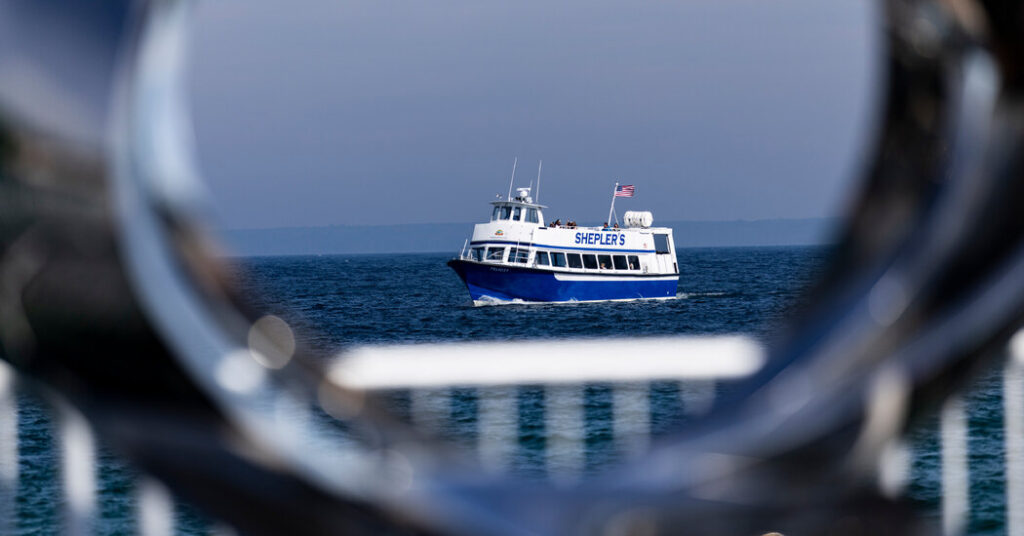
For a place with only 600 or so permanent residents, Mackinac Island, Mich., looms large in the Upper Midwestern consciousness.
The carless island in Lake Huron epitomizes the Great Lakes, and pretty much everyone in the region knows about it. Many carry fond childhood memories of riding horse-drawn taxis past Victorian-era cottages and fudge shops or of bicycling among the evergreens.
But part of Mackinac’s charm for more than a century — the ferry ride from the mainland — is now in doubt, a potential casualty of the sort of politics and court fights that vacationers are seeking refuge from.
Without another way to transport large numbers of visitors, people on Mackinac are asking whether the ferry operator’s threat to cut off service next year is a negotiating tactic or an existential danger. In fact, the hyperlocal question of access to one tiny island is monumental enough in this region that it’s wound its way up to the federal courts and even the State Capitol.
“They’ve got us in a noose,” said State Senator John Damoose, a Republican whose district includes Mackinac. “This is a fundamental problem: To think that there is a part of the state of Michigan that a single private business might be able to literally cut off access to.”
Mackinac — for the uninitiated, the last syllable sounds like “gnaw,” not “knack” — is one-of-a-kind.
The island, which is also incorporated as a city, is all but empty during the winters. But once the ice melts and the tulips bloom, it swells in population as summer visitors arrive by the boatload.
Those guests fill the independent hotels overlooking the water and watch freighters pass under the Mackinac Bridge. They climb the hill to tour Fort Mackinac, a Revolutionary War-era military outpost. They even tolerate the smell of horse dung on Main Street.
For years, three ferry companies took passengers to the island from two mainland cities. But consolidation left all the ferries under the ownership of a single out-of-state corporation, Hoffmann Marine.
When that company moved to raise prices in late 2024, the city government sought to intervene and reject the higher fares. Things went downhill from there.
This spring, the company threatened to cut off service for next year, accusing city leaders of making “service to the island untenable and unsustainable.”
As the argument spread into a federal courtroom and the State Capitol, a dispute over boat prices became something deeper — a debate about the role of government, the sanctity of the free market and to whom a Midwestern treasure ultimately belongs.
“I wouldn’t ever threaten my customers and say, ‘If you don’t shop here, I’m going to close down in the winter,’” said Andrew Doud, a fourth-generation owner of Doud’s Market, a grocery store on Mackinac.
This tourist season looks like any other on the island. School groups and stroller-pushing parents fill the ferries. Seasonal workers from all over the world pedal to their jobs at restaurants and souvenir shops. And at the bottom of the hill by the Grand Hotel, police officers keep an eye out for reckless bike riders.
But uncertainty about 2027 has dampened the mood. Hotel managers described guests quizzing them about the ferry dispute or not committing to bookings for future years. The ferry operators were facing some of the same questions.
“Our employees, too, they wonder: Are they going to have a job?” said Jenny Gezella, the president of Hoffmann Marine.
The dispute is a tangled, multifaceted mess.
There are contracts between the city and the ferry operators that are set to expire next year.
There is a federal-court case in which the ferry operators have challenged the city’s ability to regulate fares, and in which the city has claimed that Hoffmann’s control of the market is an illegal monopoly.
And there is a new state law, signed by Gov. Gretchen Whitmer and opposed by municipal officials on the mainland, that clears the way for Mackinac Island to regulate all costs associated with a ferry ride, including parking.
At the heart of the dispute is how much it should cost to get to Mackinac, and who should decide that price. As it stands, a round-trip boat ride for one adult costs around $40. Add in parking ($15 to $75 a day) and costs for bringing a bike on the boat ($21), and the total price tag can quickly add up.
Todd Callewaert, an owner of several businesses on Mackinac, said he worried about keeping the island affordable for a family on a budget. If they spend $200 to ride the ferry, he asked, “where’s your money to spend when they get here?”
Hoffmann countered that its price increases had been below the rate of inflation, and said its ability to run a successful business was being threatened by the island’s regulatory efforts.
Ms. Whitmer, a Democrat whose official summer residence is on Mackinac, came down on the side of the island government. When she signed the bill, which passed the Legislature with bipartisan support, she said tourists “shouldn’t have to face additional costs just to enjoy one of our state’s most beautiful places.”
Still, ferry service next summer remains an open question.
Officials, including Attorney General Dana Nessel, have urged a compromise, lest one of the Midwest’s most celebrated destinations be cut off. Court filings indicate that the two sides have engaged in settlement negotiations, though no deal has been announced.
Judge Robert J. Jonker, who is hearing the federal lawsuit, wrote recently that the ferry companies and the city “have a common interest in reliable and reasonable ferry service to over a million tourists each season.”
“One would hope,” the judge added, “that common interest is enough to forge a sensible resolution.”
The post The Messy Dispute Over Fares That Could Cut Off Mackinac Island appeared first on New York Times.