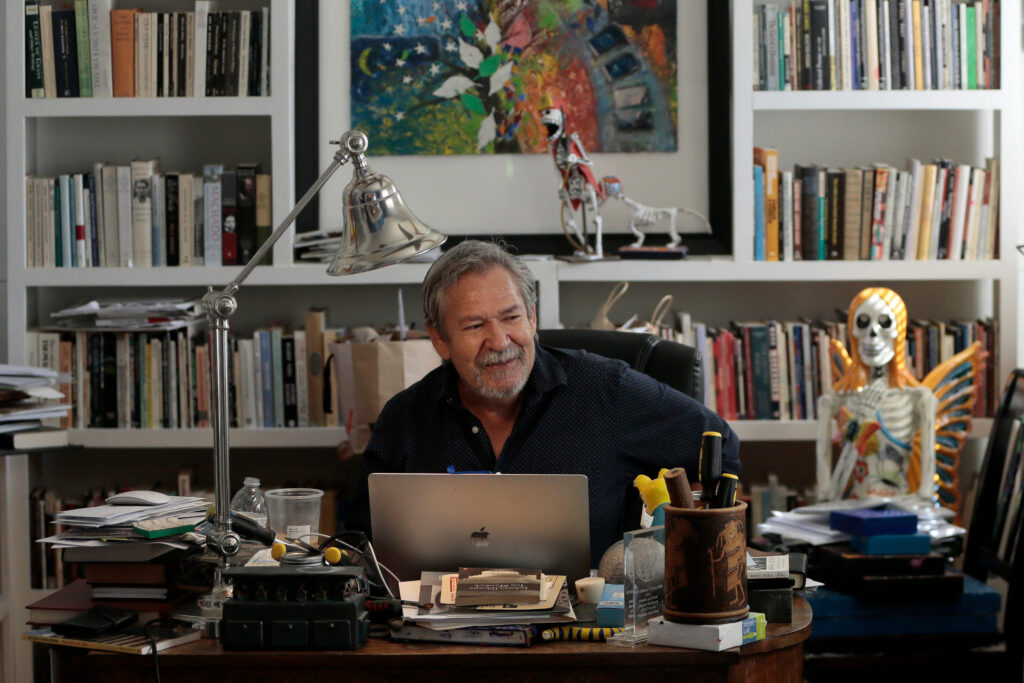
Ever since he was a boy, picking onions and working on roofs to help support his family, Benjamin Alire Sáenz had the uncanny feeling that he was living in two worlds, not one.
Mr. Sáenz spent nearly his entire life on la frontera, or the borderlands. Raised on a farm outside Las Cruces, New Mexico, he eventually settled in El Paso, 40 miles to the south, where he won widespread acclaim as a poet and novelist, writing books that used the U.S.-Mexico border as a backdrop for tender explorations of love, redemption and the human condition.
All of his work, from his bilingual children’s books to his 500-page debut novel, “Carry Me Like Water,” was “a poetry of witness,” he said, offering him a chance to reflect on his experiences and the world in which he lived.
It was also a literature of resurrection. Mr. Sáenz often said that writing saved his life, helping him navigate a chaotic, unsettled period in which he went into treatment for alcohol and drug use, came to terms with his sexuality, filed for divorce from his wife of 15 years and, at age 54, came out as gay.
“I am a living, functioning paradox,” he said. “I have always known who I was, and yet I have many moments when I have been a stranger unto myself.”
A Notable Life
This article is part of A Notable Life, an obituary feature telling the stories of remarkable people every Saturday. Read more from the series here:
Preserving and exposing the human form, he courted controversy with ‘Body Worlds’
After eight seasons in the NFL, Pro Bowler Tre’ Johnson found a new calling as a teacher
Touring with the 5th Dimension, he had a mic in one hand and his camera in the other
Mr. Sáenz’s self-revelation served as a catalyst for two books, both published in 2012, that transformed his career: the short-story collection “Everything Begins and Ends at the Kentucky Club,” which made him the first Latino to win the PEN/Faulkner Award for Fiction, and the young-adult novel “Aristotle and Dante Discover the Secrets of the Universe,” which sold more than 1 million copies and was translated into 30 languages. The novel became a touchstone for readers who embraced its story of queer love, acceptance and belonging.
“Those books were written only because I came to terms with who I was,” Mr. Sáenz told Time magazine, which selected “Aristotle and Dante” for its 2021 list of the 100 greatest young-adult books. He felt “too Mexican for Americans, not Mexican enough for Mexicans,” he said, and had a similar feeling after coming out: “I’m not gay enough for some people, and I’m too gay for other people.”
Writing offered a form of healing, as well as a sense of direction. As he explained to Texas Monthly, “The only time I’m not lost is when I’m writing.”
Mr. Sáenz, who served as a Catholic priest before discovering his vocation as a writer, died July 28 at 71. His death, in El Paso, was confirmed by a spokesman for Simon & Schuster Children’s Publishing, who said Mr. Sáenz died “after a long illness.”
“Benjamin had a remarkable gift for making you fall in love with the characters he wrote about, because he saw them as real people with a full and rich humanity,” his editor Kendra Levin said in a tribute.
He also stood apart because of his “boldness in going for the emotional jugular,” said his friend and colleague Daniel Chacón, chair of the creative writing department at the University of Texas at El Paso.
“There’s this joke we had, other Chicano writers and I, that American poets can’t use words like heart or soul because it’s too sentimental. Ben didn’t care about that,” Chacón said. “He was bold enough to be as sentimental as he wanted to be, as sentimental as he felt, and he didn’t hold back. He got away with it in a way nobody else could.”
Grieving a loved one? Tell us what made them special.
The Post is publishing reader-submitted obituaries as part of a new series, What We Remember, about everyday but extraordinary people.
The first installment included a poetry-loving lawyer and a mom who had all the time in the world.
Mr. Sáenz started out as a poet, winning an American Book Award in 1992 for his debut collection, “Calendar of Dust,” an examination of death and renewal along the border. He found a wider audience through his fiction, including novels and stories that he populated with desperate teens and heartbroken loners. His “Kentucky Club” collection centered on a Prohibition-era bar in Ciudad Juárez, a few blocks south of the Rio Grande and the bridge to El Paso, where men gather to swap stories over margaritas and beer.
“You write with what you know and with all your heart,” Mr. Sáenz told El Paso Inc. Magazine. “And that means sometimes writing about the anger that resides within you and all the imperfections. All my characters are so fragile and wounded and hurt and angry, and struggle to be decent when all the world has tried to make them hard and indecent.”
Many of his books traced the bonds between family and friends, and the longing that results when politics or prejudice get in the way of love. In his children’s book “A Gift From Papá Diego,” he told the story of a boy in Texas who dreams of becoming a superhero so that he can fly across the border to visit his grandfather in Mexico. In “Aristotle and Dante,” he chronicled the relationship between two Mexican American teenagers who meet at an El Paso pool in the 1980s, bond over their classical names and, overcoming a sense of shame and fear, fall in love.
The novel received top prizes for LGBTQ+ literature, even as it was banned by schools, libraries and the government of Belarus, which last year deemed it potentially “harmful to national interests,” presumably because of its gay themes. Mr. Sáenz was delighted to see the book adapted into a 2023 film, co-produced by “Hamilton” creator Lin-Manuel Miranda, and continued the story in a best-selling sequel, “Aristotle and Dante Dive Into the Waters of the World,” set during the AIDS crisis.
“I think we were born to tell our stories,” Aristotle, known as Ari, observes in the book. “After we died, our stories would survive. Maybe it was our stories that fed the universe the energy it needed to keep on giving life.”
The fourth of seven siblings, Mr. Sáenz was born outside Las Cruces on Aug. 16, 1954, and grew up in the nearby town of Mesilla. His family ran a small farm but lost the property when Mr. Sáenz was in the fourth grade. His father got a job as a cement finisher, and his mother cleaned homes and found work in factories.
Mr. Sáenz, who is survived by several of his siblings, stood apart in the family. He was drawn to the world of art and ideas, and grew increasingly isolated after he was sexually abused by a family member. He kept quiet about the assault for years.
“I don’t know what my life would have looked like if I had said something. I look back at that little boy and think about how brave he was,” Mr. Sáenz said in 2023, speaking at a TEDx event in El Paso. “Afraid and confused, the boy pushed me to find a world that was kinder than the world he lived in. That boy pushed me toward books.”
Mr. Sáenz found inspiration in literature as well as in the work of Catholic radicals such as Dorothy Day and Daniel Berrigan, whose pacifism and advocacy for the poor inspired him to enter St. Thomas Seminary in Denver. He received a bachelor’s degree in 1977, studied theology at the University of Louvain in Belgium and served as a parish priest in El Paso, only to leave the ministry after three years. “The robes were too heavy,” he joked.
Years later, he said he had struggled with serving as a spokesman for the church at a time when clergy were facing accusations of sexual abuse. He had written a novel in his free time, and while it was “beyond awful,” in his estimation, he decided to go back to school and reinvent himself as a writer. He earned a master’s degree in creative writing from UTEP and deepened his craft through a Wallace Stegner Fellowship at Stanford.
By 1992, he had returned to UTEP as a teacher, to the dismay of some of his mentors on the West Coast. They “told me I was making a huge mistake,” he said in his TEDx talk, “that I was ruining my career, and I was ruining my chances to have a good career, that I could not build that career on writing about the border. And that is precisely what I have done.”
Mr. Sáenz went on to become the chair of the creative writing department, championing the hiring of more diverse faculty members while helping shape what is now a bilingual MFA program, with classes taught in English and Spanish.
“What he brought to his teaching was the same thing he brought to his writing,” Chacón said. “When he was passionate, his students glowed.”
On the side, Mr. Saenz painted and opened a gallery, turning out pieces filled with flaming hearts, hummingbirds and prickly pear cacti. He retired from teaching in 2016 but continued to write, with his last completed young-adult novel, “When the World Was Happy,” coming out Sept. 29. The book tells the story of twin sisters after a school shooting, and was inspired in part by the death of Mr. Sáenz’s 13-year-old niece Amy Houser, who was fatally shot during a 1990 robbery at a Las Cruces bowling alley.
“There is never getting over such a tragedy. The days go on, the event grows distant — but there is no forgetting,” Mr. Sáenz wrote in an author’s note for the book. After the 2022 attack at Robb Elementary School in Uvalde, Texas, he was inspired “to write a book about how people survive and live through something as senseless as this.”
“I want to write about things that matter,” he added. “I want to write to move people. Writing taught me to love people. So writing this book is how I love.”
The post Exploring queer themes and Chicano life, he became a bard of the U.S.-Mexico border appeared first on Washington Post.