The United States and Iran on Monday effectively reverted to the state of open conflict that existed before they reached a cease-fire that was intended to reopen the Strait of Hormuz to commercial traffic and pave the way for a permanent peace deal.
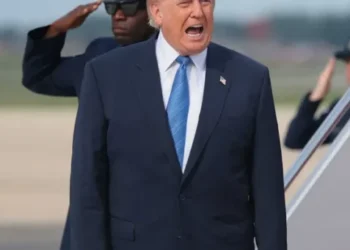
Hours after another exchange of fire between Iranian and American forces, President Trump said he was reinstating a naval blockade on Iranian ports and would charge a fee for protecting ships going through the contested strait.
“We are going to guard it, and we’re going to get paid for guarding it,” he said on Fox News.
Mr. Trump offered no details on how such an arrangement would work. In a social media post, he said that the United States “will be reimbursed, at the rate of 20% on all cargo shipped, for any and all costs necessary to do the job of providing safety and security to this very volatile section of the World.”
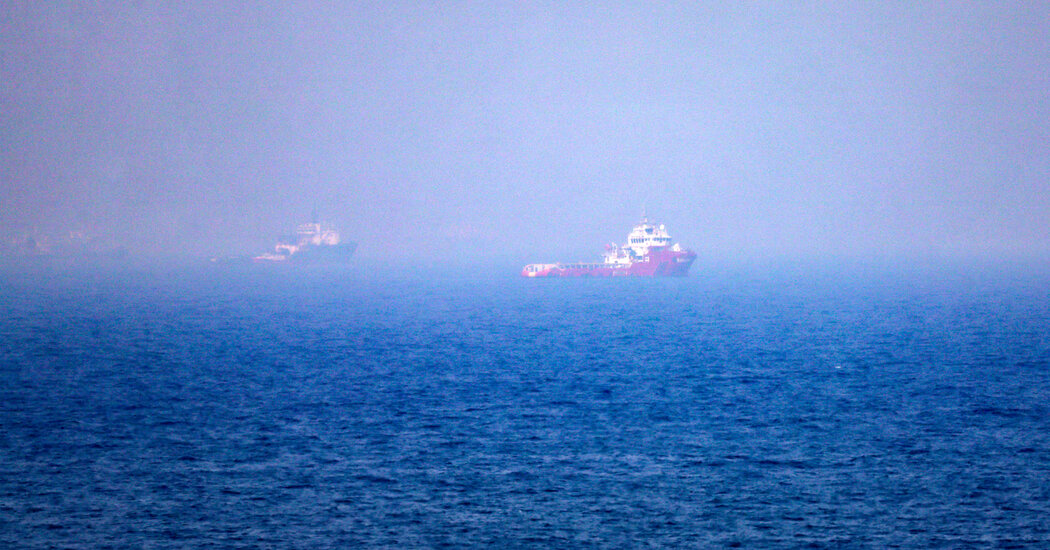
Iran, asserting its own claim to the strait, has repeatedly fired on commercial ships in the waterway, driving up global energy prices and prompting U.S. attacks on Iranian targets. Brent crude, the international benchmark, jumped to $83 a barrel on Monday, up from $76 on Friday.
Traffic in the strait, which normally carries a fifth of the world’s crude oil, plummeted after Iran’s latest strike hit a Cypriot-flagged container ship over the weekend. Just 14 ships passed through the waterway on Sunday in both directions, the fewest in a month, according to Kpler, a maritime data firm.
Mr. Trump’s plan to charge fees for protecting ships in the strait appeared to conflict with Secretary of State Marco Rubio’s statement last month that “no country is allowed to charge tolls or fees on an international waterway.”
The International Maritime Organization, which is part of the United Nations, said on Monday that it had reaffirmed that passage through the strait “should remain free of any tolls and charges,” in accordance with international law and the organization’s founding treaty.
Mr. Trump had initially imposed a blockade on ships entering and leaving Iranian ports in May, as part of a plan to weaken Iran’s economy and force the country to make concessions at the negotiating table. He then lifted the blockade last month after Iran and the United States agreed to a truce.
U.S. Central Command, which oversees American forces in the Middle East, said the military would resume enforcing the blockade on Tuesday.
A spokesman for Iran’s military command, Ali Bagheri Kani, warned regional leaders that “any cooperation with the U.S. or logistical support for its invading military will be regarded as an act of war against Iran’s sovereignty and national security.”
“Should the conflict expand, the flames of war will engulf all countries in the region,” he said in a statement published by Iran’s state broadcaster.
The statement was part of a surge in threats from Iranian hard-liners.
Earlier on Monday, Mr. Kani said it was “the right of the Iranian nation” to avenge the death of Ayatollah Ali Khamenei, the supreme leader who was killed by an Israeli airstrike in late February. He was buried last week after millions of people took part in a funeral procession. Some of the mourners had carried portraits depicting Mr. Trump and Vice President JD Vance behind cross hairs. Many waved red banners inscribed with a call to revenge.
Congress has directed Mr. Trump to end the war unless he receives congressional approval to continue it, but the White House has argued that the president is acting within his constitutional authority as commander in chief. In a letter sent to congressional leaders on Friday, which was obtained by The New York Times on Monday, Mr. Trump notified Congress that fighting in Iran had resumed.
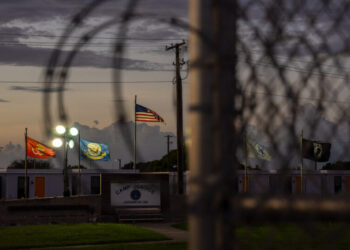
Iran’s military said early Monday that it had launched another barrage of attacks aimed at American military assets in Jordan, Bahrain, Kuwait and Oman, all of which have been repeatedly targeted by Iranian fire.
Hours later,
Before those strikes, the U.S. military said it had struck dozens of targets in Iran, including air-defense systems, coastal radar sites, missile and drone sites and small boats. It said the attacks were aimed at stymying Iran’s ability to threaten ships in the Strait of Hormuz.
Iran’s state broadcaster said a water pumping station in the southwestern province of Khuzestan had been hit, killing a worker and shutting down the plant. The managing director of Khuzestan’s water and power authority told Iranian state media that the plant was crucial to agricultural irrigation systems in the region.
Tensions have also been spiking between the Iran-backed Houthi militia in Yemen and Saudi Arabia, a U.S. ally, threatening to open another front in the Middle East.
The Houthis on Monday accused Saudi Arabia of bombing Yemen’s main international airport. That attack appeared to be an attempt to prevent an Iranian plane from landing in the Houthi-controlled capital of Yemen, Sana.
After the bombing, the Houthis fired ballistic missiles toward Saudi Arabia, a Saudi military coalition said. The coalition said that Saudi air defenses had “dealt with” the threat.
Neither the Houthis nor the Saudi coalition immediately confirmed the other party’s claims.
Hans Grundberg, the United Nations special envoy for Yemen, said he was “deeply concerned about the risk of wider escalation” and was in contact with the parties involved.
“We are urging them to de-escalate and refrain from any actions that would risk a new cycle of violence in Yemen,” he said.
The Saudi-led military coalition, which backs Yemen’s government, had been mired in a brutal war with the Houthis for nearly a decade, until a truce in 2022.
Separately, the British government said on Monday that it was taking action against the Islamic Revolutionary Guards Corps of Iran and an affiliated group, which it said the Guards Corps had “almost certainly directed” to attack Jewish sites across Europe.
The government said both would be among the first groups designated as threats under a new law that seeks to crack down on hostile foreign proxies operating in Britain.
The British government said the affiliated group, called the Islamic Movement of Companions of the Right, had claimed responsibility for seven attacks in Britain, including an arson attack in March against ambulances belonging to a Jewish volunteer emergency service in London.
If the designations are approved by Parliament later this week, anyone conducting acts of sabotage, including arson, on behalf of the groups could face life in prison, the British government said. The police and intelligence agencies would also gain more power to investigate the groups, the government said.
“We will never let Britain be a playground for states who want to spread fear, division and violence on our streets,” Prime Minister Keir Starmer of Britain said in a statement.
Reporting was contributed by Jenny Gross, Gregory Schmidt, Robert Jimison, Shuaib Almosawa, Vivian Nereim, Adam Goldman, Edward Wong, Michael Crowley and Lara Jakes.
The post Trump Reimposes Naval Blockade, as U.S. and Iran Escalate Strikes appeared first on New York Times.