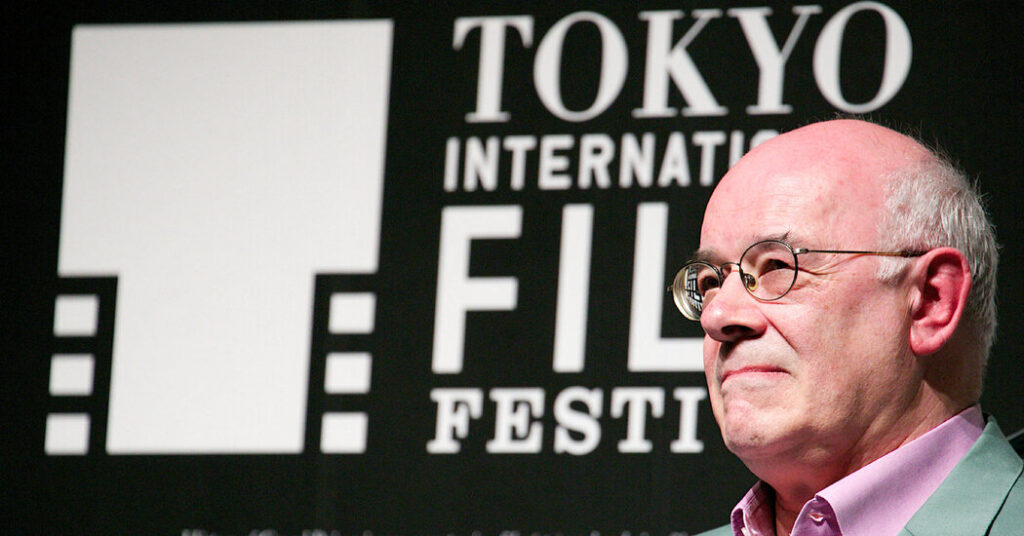
Tony Rayns, a British film critic and festival programmer who championed East Asian cinema, helping to introduce English-speaking audiences to important directors like Wong Kar-wai, Jia Zhangke and Bong Joon Ho, died this month at his home in London. He was 77.
He had fallen down a staircase soon after returning from a film festival in Bologna, Italy, and his body was discovered on July 7, his sister, Stephanie Gowman, said.
Beginning in the late 1970s, Mr. Rayns traveled to film schools and festivals in Asia, befriending young directors who had not yet ventured beyond their homelands. He brought their work to Western showcases, consulted with them about their careers and in some cases wrote English subtitles for their movies. His commitment to the region’s cinema led him to become conversant in Mandarin Chinese, Korean and Japanese.
As the programmer of East Asian films for the Vancouver International Film Festival in 1994, Mr. Rayns showed Mr. Bong’s work for the first time in North America: his student short film “Incoherence.” (Mr. Rayns also proofread the subtitles.)
Mr. Bong went on to write and direct films that have been celebrated in the West; “Parasite” (2019) won the Palme d’Or at the Cannes Film Festival and four Academy Awards, including best picture. Last year, The New York Times named it the best movie of the 21st century out of a list of 100.
“Tony left a direct mark on some of my films, especially ‘Memories of Murder’ and ‘Snowpiercer,’” Mr. Bong told Sight and Sound magazine after Mr. Rayns’s death. “In a way, he shaped much of my life as a filmmaker. He was someone who never stopped reminding me how to love cinema, and how never to lose my sense of cinematic adventure.”
The No. 4 film on The Times’s list of the century’s best — Mr. Wong’s “In the Mood For Love” (2000), a contemporary classic of repressed desire — included subtitles by Mr. Rayns.
After Mr. Rayns’s death, Mr. Wong wrote in a social media post: “He guided festivals, shepherded audiences and preserved what might so easily have been lost: the nuance, the wit, the silence between words. He rendered the foreign familiar without ever stripping it of its soul.”
In the 1980s and ’90s, Mr. Rayns often traveled some six months a year in search of new talent. In 1996, he helped found the Busan International Film Festival in South Korea, which has become one of the world’s largest showcases of Asian film.
He introduced many of his discoveries at the Vancouver festival, where he curated its East Asian program, “Dragons and Tigers,” from 1989 to 2016.
“All of this great talent got discovered thanks to Tony’s scouting,” Alan Franey, a former longtime director of the festival, said in an interview.
Mr. Jia, another director Mr. Rayns helped bring to Western audiences and advised early in his career, was described last year by The Times’s chief film critic, Manohla Dargis, as “one of our greatest living filmmakers.”
He and Mr. Rayns became friends when Mr. Jia was still making underground films in China in the 1990s. He went on to international critical success with works like “Platform” (2000) and “Caught by the Tides” (2024).
In a social media post in the form of a message to Mr. Rayns after his death, Mr. Jia wrote, “In the 28 years we knew each other, I was always the one turning to you for help — whether it was subtitles for my films or questions I needed your guidance on.”
“My work couldn’t have happened without you, and yet I often neglected you,” Mr. Jia added. “You traveled alone, watched films alone, made your home everywhere, smoked alone, worried alone.”
Mr. Rayns, who founded a student film club in secondary school, began his career writing for cinephile publications such as Sight and Sound, Cahiers du Cinéma and Film Comment. He wrote reviews for Time Out London and edited a 1976 book on the German filmmaker Rainer Werner Fassbinder.
In the mid-1970s, his writing about Hong Kong martial arts movies caught the eye of the organizers of the first Hong Kong International Film Festival, in 1977, who invited Mr. Rayns to attend — partly to set him straight about some naïve statements he had made in his pieces.
“They thought it would not be a bad idea to give me a firsthand exposure to Hong Kong so that I would make fewer mistakes,” Mr. Rayns said in a 2013 interview with Festivalists, an independent film website. “And everything went from there really.”
His passion for East Asian film expanded to the scenes emerging in Thailand, Taiwan and the Philippines. Before they were well known, Mr. Rayns championed Lino Brocka of the Philippines (“Manila in the Claws of Light,” 1975), Edward Yang of Taiwan (“Yi Yi,” 2000) and Apichatpong Weerasethakul of Thailand (“Uncle Boonmee Who Can Recall His Past Lives,” 2010).
Antony Keith Graham Rayns was born on Sept. 20, 1948, in Oxford, England, the eldest of three children of Donald and Zelma (Osmond-Jones) Rayns. His parents ran a photography studio in Oxford.
The family eventually moved to the city of Norwich, in eastern England, when his father was hired as an executive by a wholesale grocery business. After winning a scholarship to Cambridge, Mr. Rayns graduated with an honors degree in English.
A gay man, Mr. Rayns did not marry. His sister, Ms. Gowman, is his only immediate survivor. His brother, Nicholas, died in 2013.
Mr. Rayns also contributed audio commentaries to DVD releases — including Akira Kurosawa’s “Seven Samurai,” Mr. Wong’s “Chungking Express” and “Parasite” — for the Criterion Collection and other film buff labels.
For the DVD of “Parasite, Mr. Rayns was joined by Mr. Bong in a conversation that plays as the film runs.
During the first scene of the movie, about a poor family that slowly takes over the home and lives of a rich family in Seoul, Mr. Rayns points out connections to earlier Bong films. A fumigation for insects reminds him of a fumigation scene in “Barking Dogs Never Bite” (2000), and a photograph of a character in a track and field competition reminds him of the archery practiced by a character in “The Host” (2006).
“There are some ideas that keep coming back in your films,” Mr. Rayns says.
Mr. Bong replies, “Tony, you are the man who knew too much.”
The post Tony Rayns, Who Helped Bring Asian Film to the World, Dies at 77 appeared first on New York Times.