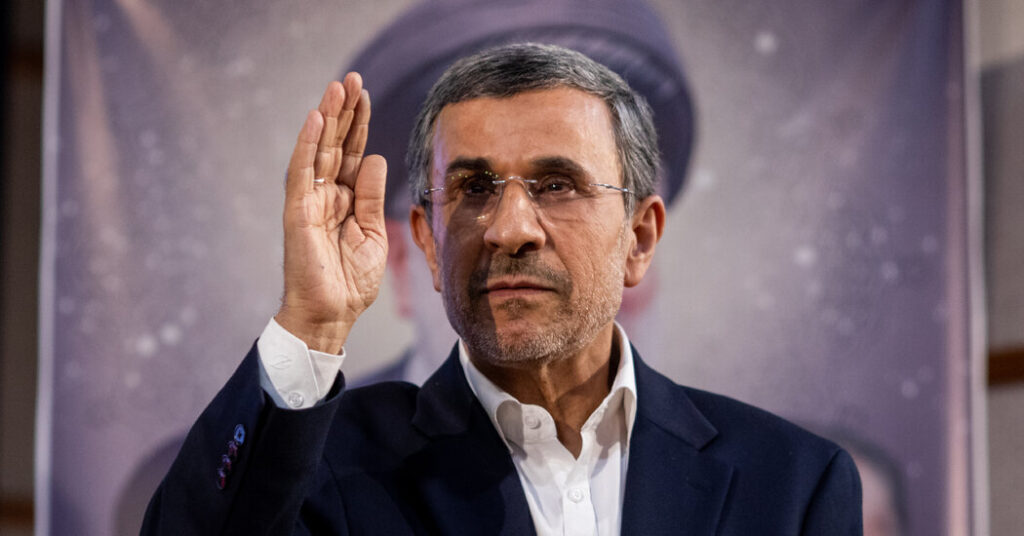
A few months ago, a team of my colleagues learned about a seemingly crazy plan. The man who had been groomed by Israel and the United States to take over as the leader in Iran after the war was one of the most hard-line, anti-American, anti-Israel presidents of Iran in recent memory: Mahmoud Ahmadinejad.
Remember Ahmadinejad? The one who, when he was president from 2005-13, regularly called for the end of Israel? The Holocaust denier? Yes, that Ahmadinejad.
The plan failed. But those same colleagues are back this week with another investigation that gives us more details about the plan and sheds light on just how the U.S. and Israel came to see it as plausible. Today I write about the remarkable inside story of Israel’s yearslong operation to cultivate Ahmadinejad.
Israel’s unlikely man in Tehran
The details of the plan to install Ahmadinejad as Iran’s next leader are like something out of a spy novel. A rendezvous at a Budapest university, during which the former Iranian president had to shake off his own security detail. An Israeli airstrike to free him from house arrest, followed by a frantic drive in a Mossad car to a secret safe house. (And some possible Botox use.)
The surprising nature of Israel’s decision to build a regime-change plan around this man is hard to overstate. He was once hostile in the extreme to the countries proposing to install him as Iran’s new leader. He also oversaw the acceleration of Iran’s nuclear program, as well as the state’s bloody crackdown on the Green Movement, which arose to protest his disputed re-election over a candidate viewed as a reformer.
This was the man who would lead and stabilize a divided country in the aftermath of war?
The premise would never actually be tested. Ahmadinejad himself ultimately grew disillusioned about the Israeli attempt to return him to power, and at some point he left the safe house, under circumstances that are still unclear.
But as my colleagues’ reporting shows, there was some logic behind this plan. In addition to the remarkable details of how Israel sought to recruit the former president, they also learned more about why Israel sought to recruit him. What they found was that over the course of the past decade or so, Ahmadinejad’s relationship to the Iranian state had changed, in ways that might make him a potential asset to Israel, a country he’d once proclaimed a mortal enemy.
From hard-liner to pragmatist?
The thing Israeli and American officials were looking for in a future Iranian leader was pragmatism — someone willing to do business with Israel and the U.S. And Ahmadinejad had already shown he was willing to compromise on his hard-line ideology in the service of a return to power.
He was ambitious, and his ambition had been thwarted.
After leaving office, Ahmadinejad began clashing with the regime. He was repeatedly disqualified from running for president and eventually concluded he could not ascend to power as long as the current system remained in place.
Amid all this, his public persona began to shift. He toned down his anti-Israel rhetoric. Suddenly he was giving interviews and posting about Iranian pop music on social media. He started criticizing the Iranian security forces for their brutality and accused the ruling class of corruption.
He also changed his appearance: Tailored suits replaced the hallmark beige windbreaker. He learned English and groomed his beard. He held lengthy public meetings with aggrieved voters and, on occasion, helped them navigate the government bureaucracy.
In Iran, many greeted this transformation with cynicism, my colleagues found — an attempt to burnish his populist credentials and distance himself from ruling officials.
But Israel and the U.S. were taking notice. Ahmadinejad’s resentment toward Ayatollah Khamenei and other senior Iranian figures seemed to be growing. He professed his admiration for President Trump, to whom he sent letters and referred to as “a man of action.”
If he were ever to return to the presidency, Ahmadinejad told those around him, Iran would recognize Israel and normalize relations as part of the Abraham Accords.
A miscalculation
Israel set in motion the plan to topple the current regime and install Ahmadinejad during the first days of the war. But, as my colleagues put it, “little of the plan played out as the Israelis had hoped.”
The U.S. and Israel misjudged the Iranian regime’s resilience. It has not collapsed in the face of a war that has killed many of its top leaders. They also misjudged the commitment of Ahmadinejad, who ultimately abandoned the plan, for reasons we don’t yet fully understand.
My colleague Julian Barnes, one of the authors of the investigation, pointed out just how deeply Israel managed to penetrate Iran. “Recruiting a former president into Israel’s regime-change plan is by any account an amazing intelligence success,” he said. “And yet the whole plan collapsed just as it was being executed.”
According to my colleagues, Iranian intelligence eventually began piecing together the story of Ahmadinejad’s contact with Israel. Until last week, the former president hadn’t been seen in public since late February.
Then, last Monday, he made a brief, surprise appearance as part of Ayatollah Khamenei’s funeral procession. But he seemed to be heavily guarded.
“Videos of the procession,” my colleagues reported, “showed Mr. Ahmadinejad, wearing a heavy jacket in the 90-degree heat, with a surgical mask pulled down to his chin.
“Mr. Ahmadinejad stood with his head down, not speaking, flanked on all sides by what appeared to be security guards.”
More news on Iran:
-
Trump said that he was reinstating a naval blockade on Iranian ports and would charge a fee for protecting ships passing through the Strait of Hormuz.
-
Britain linked Iran’s Islamic Revolutionary Guards Corps to a wave of attacks against Jews across Europe.
MORE TOP NEWS
-
A fire in a Bangkok bar that killed 28 people may have spread quickly because of cheap insulation foam used to soundproof the venue. Video showed people fleeing as flames burst out.
-
Emmanuel Macron declared that Europeans were ready to defend their continent “with blood, if necessary” at a meeting intended to show support for Ukraine.
-
An open letter signed by nearly 200 economists and tech leaders, including 15 Nobel laureates, warned that the economic effects of A.I. had been underplayed.
-
Initial estimates suggest that the recent heat waves in Europe caused thousands of excess deaths across Britain, France and Germany.
-
The Iran-backed Houthi militia in Yemen accused Saudi Arabia of bombing Yemen’s main international airport.
-
Hungary’s Parliament approved a measure that would oust the country’s president, an ally of the former prime minister, Viktor Orban.
-
The E.U. moved one step closer toward a law that would ban children from social media. The “Hard Fork” podcast co-host Casey Newton discusses what happened when Australia imposed a similar ban. Watch the video.
WHAT ELSE IS HAPPENING
-
A biopic about Jair Bolsonaro, Brazil’s former president, upended his son Flávio’s presidential hopes.
-
Sam Neill, the New Zealand actor best known for portraying an adventurous paleontologist in the “Jurassic Park” series, died at 78. (For a delightful anecdote involving Neill and Princess Diana at the movie’s premiere, click here.)
TOP OF THE WORLD
The most clicked link in your newsletter yesterday was a recipe for pizza dough.
WORLD CUP
The unfurling: You’ve probably seen the large flags that adorn the pitch before matches. Preparing them takes days. Meet the people who make it happen.
Glorious chaos: Argentina versus England is much more than a football match. It’s a ferocious and deep-rooted rivalry that transcends the sport.
New system: The tournament’s final four are FIFA’s top-ranked teams. Is this a coincidence? Not exactly.
As the 2026 World Cup nears its end, we want to hear about some of your favorite moments, on and off the pitch. Send us an email for a chance to be featured in The World.
SWEET SURPRISE OF THE DAY
Space sugar
For the first time, scientists have spotted sugar molecules in interstellar space, according to a new paper published yesterday. Researchers found that a pattern of radio frequencies emitted from a nebula near the center of the Milky Way matched up with that of a sugar called erythrulose. It’s found on Earth in raspberries. Sugar is needed to form RNA and DNA, so the discovery could help explain how life arose on Earth.
MORNING READ
Western countries expelled hundreds of Russian spies after Moscow’s invasion of Ukraine in 2022. Since then, dozens of those banished spies have turned up in an unexpected place: Japan.
At the heart of the operation is a secretive Russian military intelligence unit known as the 20th Directorate. A Times investigation pieced together how the 20th Directorate operates and the crucial role it plays in supporting the war. Posing as diplomats or businesspeople, its officers buy or steal battlefield technology and smuggle it into Russia. Read more about the Russian spies operating out of a Tokyo high-rise.
AROUND THE WORLD
Please do touch the museum items
Most museums have a cardinal rule: No touching. But at the V&A East Storehouse in London, that rule doesn’t always apply.
Visitors can roam the aisles looking at stored items from the Victoria and Albert Museum, Britain’s leading institution for applied and decorative arts, or they can use its Order an Object service to book some one-on-one time with things like vintage garments and ancient musical instruments (even David Bowie’s guitar).
The idea has proved wildly popular. Over 660,000 people visited the Storehouse in its first year. Many visitors are creators looking for inspiration from the past. See what some of them ordered and why.
RECOMMENDATIONS
Watch: On “Popcast,” our music critic picks the best verse on a classic Jay-Z album.
Craft: An artist shares how he makes an Icelandic poppy from basic supplies.
Ponder: A writer explores why characters in so many new novels insist upon eating each other.
Sweat: Working out on a sandy beach is not only fun but also brings extra fitness benefits.
RECIPE
It’s Bastille Day, as good an excuse as any to cook something French and buttery. Sole meunière, the classic dish that made Julia Child fall in love with France, features the simple flavors of fresh fish, butter, lemon and parsley. Serve it with baguette, and, naturellement, a glass of cold Champagne.
WHERE IS THIS?
Where is this street?
TIME TO PLAY
Here are today’s Spelling Bee, Mini Crossword, Wordle and Sudoku. Find all our games here.
That’s it for today. See you tomorrow! — Katrin
We welcome your feedback. Send us your suggestions at [email protected].
The post Israel’s Regime-Change Plan for Iran appeared first on New York Times.