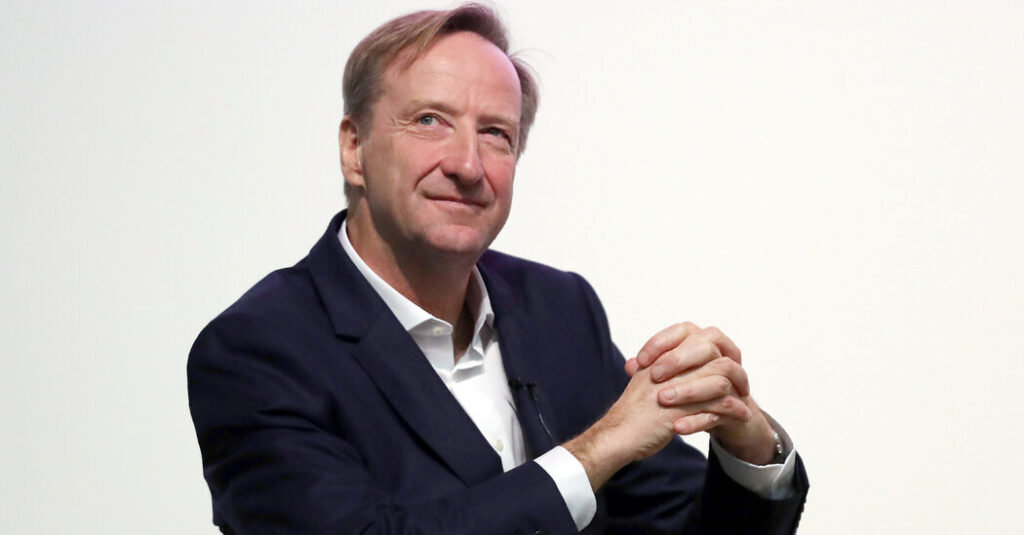
Alex Younger, an urbane but steely career intelligence officer who from 2014 to 2020 led Britain’s espionage agency, MI6, where he promoted the use of technology while confronting rising threats from Islamic State terrorism and a revanchist Russia, has died. He was 62.
Blaise Metreweli, the current head of MI6, said the cause was cancer. No further details were immediately available.
For six years, Mr. Younger was Britain’s top international spy, sitting at the apex of the country’s overseas intelligence gathering operations, attending its National Security Council and advising three prime ministers. British spy chiefs typically hold the top job for five years, and Mr. Younger’s slightly extended tenure made him the longest-serving head of MI6 in half a century.
From his office overlooking the River Thames, where he was known as “C” (after the first chief of MI6, Mansfield Smith-Cumming), Mr. Younger confronted a range of threats, including international terrorism and an emboldened Russia.
Despite his impeccable establishment background and patrician demeanor, he sought to demystify the work of MI6, also known as the Secret Intelligence Service, or S.I.S., and to broaden recruitment by an organization popularized by fictional British spies like James Bond and John le Carré’s George Smiley.
“We break the rules, certainly. We do not break the law,” Mr. Younger wrote in a letter to The Economist in 2017 in which he questioned the portrayal of agents. Real British intelligence officers were armed with the values of liberal democracy rather than a license to kill, he argued, and his agency, he said in one interview, was made up of “ordinary people doing extraordinary things.”
Alexander William Younger was born in London on July 4, 1963, to Nicholas and Mary (Edge) Younger.
He attended the University of St. Andrews in Scotland, where he studied economics and computer science. After graduating in the mid-1980s, he joined the British Army and attended Sandhurst, Britain’s officer-training academy. He later described it as “a fantastic experience,” while admitting that was probably not how it felt at the time.
“I was a notoriously languid character in those days, and it was an extraordinary change,” he said. Self-discipline, he added, was “not something I think I possessed in abundance before I went through that experience.”
Similarly formative, he said, was taking command of a platoon of 30 soldiers in his early 20s. As an officer in the elite Scots Guards regiment, Mr. Younger was posted to the British Army of the Rhine, serving near the border of Communist East Germany.
To his disappointment, by the time the Berlin Wall fell in 1989 he had been assigned to Northern Ireland, where the British military was embroiled in the decades-long sectarian conflict known as the Troubles.
After the Army, where he rose to the rank of captain, Mr. Younger answered an advertisement for a job with the Halo Trust, a charity in Afghanistan that focused on mine clearance; he was the only applicant and was hired.
In 1991, Mr. Younger received what was colloquially known as a “tap on the shoulder” — an informal invitation to join MI6.
“The opportunity came to me, and if I’m honest, I prevaricated because I understood some of the things it would involve, and the moral and personal responsibilities,” he told Angelina Jolie in an interview for Time magazine in 2020.
Nonetheless, he signed up with the agency. One of his first assignments was to penetrate a group that was intent, he said, on genocide in the western Balkans.
“I had to find my way to the heart of that organization and obtain secret information,” Mr. Younger recalled in a speech at his alma mater in 2018. “It took me to places I never thought I would visit, often traveling under a false identity. It involved many nights drinking obscure homemade alcohol, piecing together the intentions of the parties to that conflict.”
Despite his line of work — which took him to Vienna and Dubai, in the United Arab Emirates, among other places — Mr. Younger managed to have a personal life and, in 1993, he married Sarah Hopkins, an arts administrator who is now a project director at the National Gallery in London.
As head of MI6’s operations in Afghanistan after the 9/11 terror attacks, Mr. Younger cultivated a cordial relationship with President Hamid Karzai that required his softer skills.
Initially, Mr. Younger found himself in a losing battle with his counterpart from the Central Intelligence Agency for Mr. Karzai’s attention. But he heard that the president put jam in his tea to ward off colds, and shipments of blackberry jam, made by Mr. Younger’s mother-in-law, helped to improve his access.
Mr. Younger subsequently returned to England, helping to lead MI6’s work on counterterrorism in the three years preceding the 2012 Olympic Games in London, according to his brief official biography.
When told that he was in the running for the top job at MI6, it came as a surprise, he said. Internally, the promotion of a career intelligence officer was seen as a vote of confidence in the agency. Mr. Younger certainly professed an approach that would have been welcome.
“Economy of effort — a principle of war — has been something that has very much informed my approach to leadership,” he said, adding that trusting others enabled him to delegate. His best bosses had let him do what he wanted and backed him up if things went wrong, he added.
In Mr. Younger’s view, one common weakness of leaders was to conflate seniority with knowledge, when “the people who really understand what’s happening are the people with the least power.”
Mr. Younger’s tenure as MI6 chief was extended beyond the traditional five years to cover Britain’s exit from the European Union. Despite the political turmoil unfolding in the country, he said that he had strengthened relations with his counterparts in Europe and the United States because the activities of Islamic State reinforced the need for international cooperation.
The threat posed by Russia came into sharper focus in 2018, when a woman died in Salisbury, England, after being given a discarded bottle of perfume that contained the nerve agent used to poison the former Russian spy Sergei Skripal and his daughter Yulia.
In 2019, Mr. Younger was knighted by Queen Elizabeth II. The same year, his 22-year-old son, Sam, was killed in a car crash on a private Scottish estate.
Survivors include his wife, another son and a daughter.
After leaving MI6, Mr. Younger joined the investment bank Goldman Sachs as an adviser and spoke publicly about the growing dangers to global security. The West, he acknowledged, had failed to focus on geopolitical competition, believing incorrectly that it had “won that argument.”
As for his decades of work in the shadows, Mr. Younger told one interviewer that he was “very, very proud to have participated in some frankly extraordinarily cool operations,” before adding: “But I can’t tell you about any of them.”
Stephen Castle is a London correspondent of The Times, writing widely about Britain, its politics and the country’s relationship with Europe.
The post Alex Younger, Former Head of Britain’s MI6, Dies at 62 appeared first on New York Times.