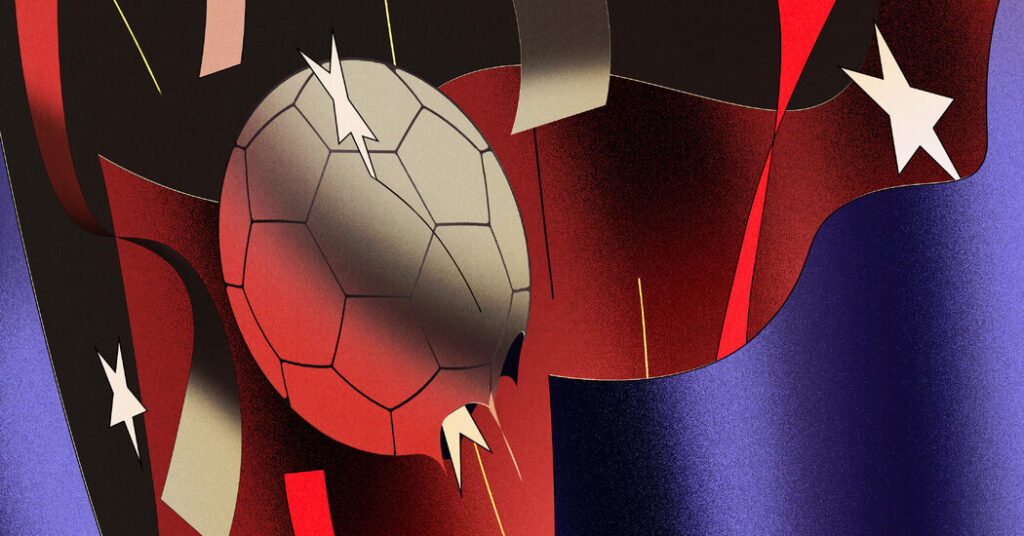
They used to call the World Cup, unequivocally, the planet’s biggest sporting event. But it is about to start, right here in North America, and no one much seems to care. Thousands of tickets remain unsold, and just weeks ago, others were being resold well below their official price. In cities around the United States, air traffic isn’t materializing, and hotels that had counted on millions of dollars in additional revenue are watching it trickle instead. FIFA has had to cancel block reservations of rooms, and there’s talk of a global boycott as a kind of protest against President Trump — his wars, his border policies, his imperial vulgarity. When the games actually begin, interest will surely surge. But at the moment it seems as if there is less anticipation than there was for this past weekend’s club soccer Champions League final between Arsenal and Paris Saint-Germain. And I actually do think this might be telling us something, beyond the world of sports, about the global landscape of politics and culture.
In the States, the indifference might not be surprising, even though the event is being played mostly on U.S. soil. The U.S. team is more talented than in the past but hasn’t looked impressive for years. Soccer is still a growth sport rather than a dominant one in this country, and many Americans aren’t exactly feeling the flush of simplistic patriotism these days. On top of which, the tickets have been priced punishingly high.
What is more striking to me is the muted interest of the rest of the world, which every four years for decades seemed almost to pause for a month to engage in a truly global but appealingly low-stakes performance of tribal nationalism. These days the World Cup no longer seems to tower over the rest of the sporting universe quite so much, with club soccer building a new global ubiquity over the past dozen years or so — if not quite displacing the World Cup at the top of the soccer pecking order, then at least taking a place right beside it.
What makes this shift so striking is that it has happened alongside a rising tide of political nationalism around the world, which you might think would produce a great surge in soccer nationalism, too. Instead, the age of global populism has coincided with intense interest in the biggest club teams — for-hire rosters assembled largely from international talent by megacorporations boasting jersey sponsorships from foreign conglomerates. Those teams made up of local prodigies wearing their national colors and playing their hearts out for love of country? They still matter to fans, of course. But no one could even pretend to illustrate the age of global populism by talking about the intensity of popular feeling about national teams.
Perhaps this is because, if international soccer once channeled nationalistic passions toward athletic competition, in an age of actual nationalism we may need less of an outlet for those feelings. Or it could be because, as Franklin Foer suggested might be the case a couple of decades ago in “How Soccer Explains the World,” the tribalism of club soccer was a natural check on feelings of nationalism — and itself a form of resistance to globalism. Or maybe it’s simply because club soccer runs for most of the year, instead of for one month every four, with games played weekly and sometimes more often. How much soccer can fans absorb? How many opportunities for cathexis do they need?”
But this pattern nevertheless feels like a puzzle to me. This is perhaps in part because one of the descriptions of the new age of populism during its early days noted that it was powered by people who felt abandoned by their nations’ elites, who had through wealth and cosmopolitanism graduated into a kind of global business sphere — almost the way local soccer stars would graduate to bigger clubs and leave behind their roots.
That is also a pretty good description of how globalization changed club soccer itself. Beginning in the 1990s, and then accelerating strongly in the 2000s and 2010s, the leading leagues (chiefly the English Premier League and Spain’s La Liga) and the leading clubs (Real Madrid, Manchester United and Barcelona, for instance) began stocking their rosters with global talent and then serving it back to global audiences via rapidly expanding cable and satellite television. This has been a phenomenally successful business proposition, but the cultural fallout feels a little stranger — with, for instance, New York’s Uganda-born, ethnically Indian mayor celebrating Arsenal’s Premier League championship and its race through the Champions League at least as intensely as he has the Knicks’ run to the N.B.A. finals, and Barstool Sports’ Massachusetts-born gadfly-bro Dave Portnoy celebrating Tottenham’s avoiding a relegation disaster on the season’s final day with as much passion as he tends to show for the Patriots or the Red Sox. When it comes to club soccer, fandom is now pretty global — which is to say, in many cases pretty arbitrary.
In theory, national teams should offer a different appeal, one that is less arbitrary. And a way for those who feel their countries have been drained of patriotism and national identity to enact their fantasy of replenishing those feelings. In the time of Marine Le Pen, you might expect French football fans to be especially animated about Les Bleus, for instance, rather than raging about criticism from the team’s Black star Kylian Mbappé. In Britain’s Reform era, you might expect a kind of national revival of the proud hooliganism of earlier, less globalized eras. You might see that hooliganism on the streets of Tommy Robinson’s “Unite the Kingdom” rallies, but when it comes to soccer London seems more worked up about Arsenal than about the Lions. The Oasis reunion tour might prove a bigger event for national unity than the World Cup.
Why would this be? One simple answer is just that club soccer has gotten too big and too important to too many people, sometimes demonstrating play at a much higher level than international competition can offer. Others have argued that FIFA’s 2015 corruption scandal had taken a toll, that the organization’s off-putting president has steered FIFA in the wrong direction or that the recent run of host sites — Russia, Qatar, the United States — has come with a cost. And because national teams rarely play together, with players from many different leagues sometimes parachuting in for a weekend to play a World Cup qualifier, the spectacle itself feels a bit drained of meaning — a bit more corporate, thin, pallid.
But I think it’s possible to see something deeper at work, too. Take the episode in France, in which Mbappé ignited a right-wing furor when he suggested he was worried about the rise of Le Pen’s National Rally party and what it meant for the future of the nation. Whenever athletes talk politics, it risks a backlash — think of Laura Ingraham’s “Shut up and dribble,” for instance, or for that matter the recent anguish over the Giants quarterback Jaxson Dart’s introducing President Trump at a political rally. But here we had an even more irreconcilable conflict, in which the face of the country’s national team declared that one of its major parties seemed to have no place for him in its vision of France, at least as he saw it — and then that party’s leaders responded by illustrating the point, treating him even more as a traitorous interloper and a kind of undeserving vessel for their national pride.
This kind of conflict is no longer so unusual, with the rosters of national teams now drawn from various diasporas and internal pockets of recent migration and less closely resembling the blood-and-soil fantasies of unapologetic right-wingers. This is the kind of development that might compel Barack Obama to celebrate France’s victory in the 2018 World Cup but which may offer a different kind of meaning for, let’s say, those hoping to reassert the centrality of ethnicity for national identity.
And that may tell us something about the broader phenomenon, too. Namely, that what we identify as nationalism in global affairs might be better described as a form of parochialism, with populists making particular claims not about the nation per se so much as the ways it should be reformed — presumably toward some reactionary ideal, its contours often more local than genuinely national. In this reading, globalization hasn’t just generated a backlash among those who resent deindustrialization, capital flight and the stateless lives of the world’s billionaires. It has also made the nation itself seem like a somewhat untrustworthy unit of political and social organization to many people on the right. For them, what might once have served as a source of patriotism and pride now produces feelings of resentment and regret. Not that liberals aren’t queasy about nationalism these days, either. For all of us, rooting for Arsenal or P.S.G. might now be more appealing precisely because it’s essentially meaningless.
The post Why Does No One Care About the World Cup This Year? appeared first on New York Times.