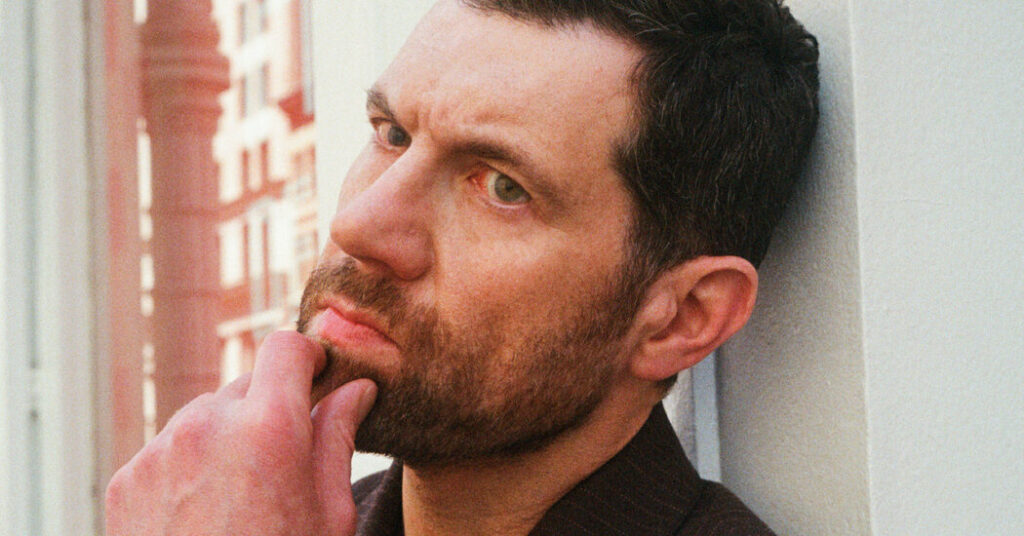
One of the most memorable moments in comedy this century came when Billy Eichner, microphone in hand, charged onto the field after the end of Super Bowl XLVI in 2012 to interrogate members of the victorious New York Giants about Madonna’s performance during the halftime show. Airing on “Conan,” this represented the New York alt-cabaret scene of the aughts imposing its will on the most mainstream, macho cultural event of the year.
Eichner, who describes his sensibility as “equal parts Streisand and SummerSlam,” carved out his own pop cultural niche with man-on-the-street comedy. In the persona of a preposterously intense New Yorker who cares altogether too much about his own cultural opinions, he shot hilarious short videos first presented in live shows, then on the TV series “Billy on the Street”; they now live comfortably on platforms like TikTok, where they still circulate widely.
He stopped regularly doing this character in 2019 to focus on acting. He has played roles in shows like “Parks and Recreation” and done voice work for the remake of “The Lion King” remake. His most ambitious project was writing (with Nicholas Stoller) and starring in “Bros” (2022), the first major studio romantic comedy starring two gay men. It received good reviews but disappointed at the box office (earning roughly $15 million total). Since then, Eichner has been less visible in the culture, but that is about to change.
At 47, he has moved from Los Angeles back to his hometown, New York, played Ned Weeks in a reading of “The Normal Heart,” directed by Tony Kushner, and just released an audio memoir, “Billy on Billy,” that looks back on his pop culture-obsessed childhood in Queens, his route from studying theater at Northwestern to breaking out via short videos of yelling at strangers. He even cut a new “Billy on the Street” clip to promote the book, which reveals Eichner in a quieter, more reflective register, offering incisive cultural criticism (his analysis of Madonna is especially worthwhile) and some soul-searching about his reactions to the response to “Bros.”
I talked to him in an office at Ars Nova, a chic theater in Hell’s Kitchen, where he was host of a regular talk show called “Creation Nation” two decades ago featuring the earliest versions of what would become “Billy on the Street.”
Why write a memoir now?
No. 1: They offered. My version of writer’s block is not that I don’t have ideas. It’s that I have too many. I can think of 50 different premises for a potential TV show or movie, and then the next day talk myself out of them. So if someone comes with an offer, that focuses me. I speak to a lot of writers, and most agree it’s very hard to write without a deadline. It’s nearly impossible.
Why an audio-only book?
What excited me was that people could listen to my real voice and not my “Billy on the Street” voice, and hear that I am a multidimensional, grounded, vulnerable, normal human being.
You write a lot about the entertainment of your youth: Broadway shows, movies, Madonna.
Writing this book meant getting reacquainted with the childlike wonder I had for culture. You get jaded. It becomes about career moves and strategy. I always had a critical eye, but it was also romantic, my relationship to culture, and I’ve lost that a little bit, unfortunately, because you grow up, and life is complicated.
You write that after “Bros,” it “took years to feel excited to create again.”
When I say to create again, I mean to write again. It made me indecisive, and I always struggle with that, even on a good day. So when that happened, which was obviously disappointing, it just took me a minute to get up on my feet again.
The movie got good reviews. It’s clear you are proud of it. Many movies, especially Hollywood comedies, aren’t blockbusters opening weekend. So why is it obvious it was disappointing?
I’m still human, and I was sad. I love the movie from a creative standpoint. I don’t think I failed in that regard at all. I’m quite proud of it. But there was so much hype and buildup and it was such a big part of my life for years that when the dreamy scenario — where it makes the money it’s supposed to make and propels me to other offers and roles, which happens with commercial success — when that didn’t happen, it took a lot out of me. It’s very personal. I’m not just out there like winging it.
I haven’t written very much because of that. It’s a lonely experience in a way. I have a great therapist and amazing friends. I always knew I’m OK, ultimately. I’m not someone who sits in bed all day with the lights turned off. I get up and keep going. But it almost felt like the end of a relationship, like a romantic relationship. That’s how it felt.
In the book, you describe gay men as the movie’s harshest critics.
It’s just a fact. That’s what happened. But I think that’s a product of social media, having rewired our brains to react immediately and jump in the comments and all that stuff. I expected a little bit of that, having always been a gay man and known exactly how gay men are. It didn’t really come as a surprise. The extent of it, considering the movie was well received by critics and people who saw it in advance of the box office, surprised me a little. But I know exactly where those types of reactions and feelings come from. I love gay men. I love my people, even when they don’t react well to me or my work.
One thing that might surprise some fans is that the book is very emotional. Is that a side of yourself you felt you didn’t always express?
I didn’t set out to be vulnerable. It was a natural extension of telling stories about my parents and childhood. I never got the chance to thank them [He tears up]. I get emotional. I’m sorry. At an event last night, I started crying and the audience went, “awww,” and then I told them to shut up. It got a big laugh.
You write very movingly about connecting emotionally with your parents through art.
There are so many stories in the book about us going to movies and plays and musicals and concerts. That’s a real through-line. Not every movie is great, you know, but it’s almost more about the going together.
You have a wonderful section about “Schindler’s List” and “Six Degrees of Separation” opening around the same time and what it meant that you chose to go see “Six Degrees” first.
“Six Degrees” felt more New York to me. But this is what I mean about the going together. I remember standing in line for “Six Degrees,” and my mother was very chatty, always made conversation with everyone around us, and she starts talking to this middle-aged woman and mentions that I love the performing arts and the theater and I’m taking singing lessons. My mom was a real yenta in the traditional sense, and I mean that in a flattering way. The woman says: “My daughter is a segment producer on ‘Good Morning America’” and my ears immediately perked up. She said, “She doesn’t make a lot of money, but she loves the lifestyle.”
I remember that. This was 1993. It’s a long time ago. We never spoke to her before or since. It was just a woman we met in line at the movie theater. And on the drive home, I remember my dad muttering under his breath hours later: “Doesn’t make a lot of money but loves the lifestyle!” as if he’s rolling his eyes. That seemed ridiculous to him. And it did not seem ridiculous to me.
In writing about ending “Billy on the Street,” you bring up the brilliant Joan Rivers documentary “A Piece of Work” (2010).
There’s a scene where she cries and says they’ll never take me seriously as an actress. This woman was in her 70s, a massively successful, iconic, groundbreaking comedian. Globally. And I loved her. She was the first standup I ever saw. Seeing her say that really resonated with me because this was when “Billy on the Street” is starting to take off and it’s a very narrow, one-dimensional persona. I went to acting school and grew up going to see plays. I heard Joan say that and thought: I don’t want to let that happen to me. I’d rather sacrifice money and fame and whatever I might lose by not doing “Billy on the Street” all the time in order to give myself the bandwidth to be the artist I want to be.
You were reported to be working on a movie about Paul Lynde, the gay performer who became famous in the 1970s appearing on shows like “Hollywood Squares.” Is that still happening?
Yes. It took me a while to figure out my take on it, then all of a sudden, last year, I came up with something that I’m really excited about. So I’m diving back in again.
What drew you to him?
Someone offered.
Jason Zinoman is a critic at large for the Culture section of The Times and writes a column about comedy.
The post After a Box Office Letdown, a More Reflective Billy Eichner Is Back appeared first on New York Times.