Andri Luescher isn’t complaining. He’s just tired.
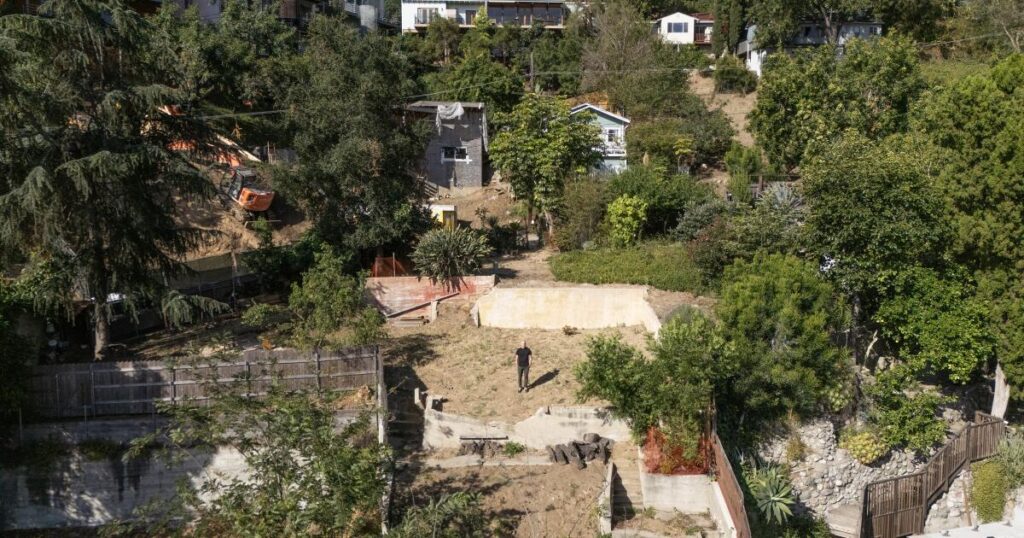
In 2022, the architect bought a small vacant lot in the hills of Mount Washington with plans to build a modest home for his family of four. He still hasn’t broken ground.
For the last few years, he’s been mired in a complex web of mounting fees and permit nightmares, getting punted back and forth between city departments like a fraying football. Before a single shovel hit the dirt, he spent $5,000 on reports documenting native trees on the property — all three of them. He paid $17,000 applying for exemptions so he doesn’t have to widen his future neighbors’ streets for them. And he sat through hours in public meetings where those same neighbors weigh in on what they like and don’t like about his project.
A 1,400-square-foot house, mind you. Three bedrooms. Two bathrooms.
The local homeowners’ group doesn’t seem to want it no matter what it is. The city does — at least in theory — but a quirky zoning rule makes it seem otherwise.
The bane of the project is the Mount Washington/Glassell Park Specific Plan. Adopted in 1993, the ordinance dictates development in the neighborhood in order to maintain its identity as a quiet, verdant retreat in the hills northeast of downtown L.A.
Specific plans are a crucial component of responsible development in L.A. The city has 52 of them in areas such as Crenshaw, Mulholland Scenic Parkway and Pacific Palisades, and they serve as a vital tool in an era of mansionization, where profit-hungry developers build bigger and bigger houses — sometimes so big that they’re in danger of sliding down hills and crushing the homes beneath them.
But in Luescher’s neighborhood, the plan was adopted to solve a problem that, in many ways, has since been solved. Years ago, the city adopted two streamlined ordinances that regulate hillside buildings: scaling back home sizes, protecting trees, setting design standards, etc.
But since the Mount Washington plan was adopted before those, it supersedes them.
“If I was building this house in the hills of Silver Lake or Echo Park, approval would take six months,” Luescher said. “But under this plan, it takes anywhere from two to five years.”
The plan itself isn’t even that restrictive, Luescher said. Smaller square footage, wider streets, protect trees, yada yada yada. The holdup is the process itself, and the myriad permits and approvals required from a litany of officials.
A typical project primarily goes through the Department of Building and Safety, so all of your permits and plans are checked by a single department. But since the Specific Plan throws another layer of zoning onto the property, review checks are scattered across multiple departments: Building and Safety, Planning, Bureau of Engineering, etc.
“Going into this, I was aware of how complicated the process is,” he said. “Everybody warned me. But I was still shocked.”
Here’s a breakdown of the things Luescher has done to get his home approved that had little to do with the house itself.
First up, trees.
Luescher’s lot is fairly standard at 5,400 square feet. But since the lot features three protected trees, including a live oak and a black walnut, he first had to hire a certified arborist to make a report identifying the trees he’ll need to safeguard during construction.
The 18-page report cost $2,600. However, by the time the report was ready, the city changed its tree-reporting format, rendering it useless. He paid the arborist $2,337 to draft a new one.
“It’s good to protect trees, but the report is telling you everything you already know,” Luescher said. “There are trees on the property, and you need to put an orange plastic fence around them during construction.”
After that, streets.
Stacking more homes on L.A.’s hillsides means that during emergencies, traffic clogs and emergency responders can’t get through. This played out during the Palisades fire, when bulldozers had to clear abandoned cars so firetrucks could drive past them.
As a result, L.A. forces developers to widen the streets of hillside properties to at least 20 feet. Luescher’s street is roughly 17 feet wide, so zoning law technically requires him to widen it by 3 feet not just along the property line, but also all the way down the hill, he said.
Obviously, widening streets that far isn’t feasible, since it would interfere with neighboring properties, so the city grants exemptions. However, in order to get an exemption, you need to get a determination from a zoning administrator. Luescher paid $17,422 for his hearing, which also granted an exemption under the California Environmental Quality Act and confirmed his compliance with the neighborhood’s specific plan.
“You go through a hearing just for the city to tell you that you don’t have to do this thing that no one ever does,” Luescher said.
He hired a civil engineer for $6,640 to draw up plans to widen the street in front of his property. Then, he submitted the plans to the Bureau of Engineering — their review cost him $14,393 — all before paying a contractor to actually widen the street, which he expects to cost $20,000 to $25,000, plus an extra $16,960 for inspection costs during construction.
“The work to widen the street costs less than the permit from the city to widen the street,” he said.
Next up, neighbors.
In 2001, a group of residents formed the Mount Washington Alliance as a response to a controversial development proposal. Today, the group serves as a nonprofit that preserves and protects the neighborhood’s character, but Luescher said it feels more like a gatekeeper.
“They make sure construction doesn’t disturb the neighborhood and want things to run through them,” he said. “Specific plans are popular because they slow down development.”
Luescher presented his plans in front of the neighborhood council’s architectural board, fielding questions from locals about his intentions. It wasn’t mandatory, but a city staffer told him it’s advantageous, since the neighborhood council can write a letter declaring whether they support the project or not. The letter has no legal standing, but the Planning Department takes it into account during the approval process, he said.
He said the whole thing felt strange, as if his future neighbors were already scrutinizing his floor plan.
Dominique Generaux, president of the Mount Washington Alliance, said the organization isn’t trying to slow development, but rather encourage safe development, adding that people in the neighborhood have died because of roads not being wide enough for emergency responders during a fire.
“We’re not an HOA. We don’t care if your house is pink or blue,” she said. “Developers buy land without knowing anything about the neighborhood, so we try to educate them.”
Adding to the complexity is the fact that the Mount Washington Specific Plan covers some things, but not all. For the parts it doesn’t regulate, such as certain yard setbacks, developers refer back to the Baseline Hillside Ordinance. So multiple zoning plans govern the property, and builders are constantly cross-referencing to see which ones they have to adhere to, pinballing between departments.
“With L.A. zoning code, the more you read, the less you understand,” Luescher said. “It’s been amended so many times with so many overlay zones that people don’t know what applies.”
For all of his permits, Luescher has spent $73,000 so far, and he expects that to rise to $90,000 by the time he breaks ground: $30,000 for general permits, and $60,000 for costs solely related to the Specific Plan. It’s a relatively small amount in the grand scheme of building costs in Southern California, but a tough number to swallow just for the bureaucratic part of building a 1,400-square-foot home.
The long, winding road also seems counter-intuitive when set against the backdrop of L.A.’s housing shortage. Small single-family homes in hilly neighborhoods are by no means the solution, but easing the permitting process would help houses get built quicker, Luescher said — especially considering that much of the undeveloped residential land left in L.A. is in the hilly neighborhoods where he’s planning to build.
It’ll be three to six months before he gets everything approved, he expects. After that, he’s hoping to finish the home by the end of 2027, bringing the total timeline to roughly five years.
“It’s Kafkaesque,” he said. “But in the end, it’ll be worth it.”
The post ‘Kafkaesque’: One man’s struggle to build a hillside home in L.A. appeared first on Los Angeles Times.