For more than a century, the area around the Lincoln Memorial Reflecting Pool has served as a staging ground for civic participation. With its grand scale but subdued character, it is a place where much of the meaning is made by the people using it: the millions of visitors who have descended upon “America’s Front Yard” for marches, tourism, and celebrations.
But in recent weeks, the western end of the National Mall has become a construction zone, the latest spectacle in President Trump’s effort to imprint his legacy on Washington, D.C., by renovating it. Workers in protective suits have completely drained the water and are now coating the concrete basin with a vivid blue, while tourists gawk at the tarped-off project rather than the monuments that the pool was designed to mirror.
In Trump’s view, the makeover, which he hopes to complete before the nation’s 250th birthday, on July 4, is coming along swimmingly. Last weekend, he shared photos of a sample test that crews conducted in the basin to inspect its reflective properties. “Looking really good,” Trump reported on Truth Social—and there’s a chance that the rushed project might turn out fine. In the photos, a shallow strip of water reflects puffy clouds and pale stone in striking blue detail. It was an improvement over an earlier rendering, in which the water looks like a blue you might see on a new Corolla.
Critics have called the partially painted pool “ridiculous” and tacky and have taken to posting pictures of the site from the sky near Ronald Reagan Washington National Airport. Supporters (and various government social-media accounts) have praised Trump for leading what they describe as a long-overdue beautification project of the nation’s capital. On Wednesday, Trump took a victory lap for his administration’s fix-up job on many fountains around D.C., writing on Truth Social, “The ‘Granddaddy’ of them all will be The Reflecting Pool.”
But whether the pool will ultimately enhance or diminish the National Mall is far more difficult to determine at this stage: How the paint job will look when the pool is fully filled, whether problems such as leakage and algae will return, and how the Trumpian glow-up will play against the rest of D.C.’s carefully restrained civic core are all unclear. The Mall is meant to symbolize the virtues of democratic governance and the separation of powers. Which is precisely why major aesthetic changes to Washington’s most prominent spaces have historically undergone round after round of public review.
Trump has prioritized his own ideas about how the city’s stately, low-slung landscape should look. It will be years before that vision is realized, and lawsuits or politics may halt parts of it. But already, he’s left a mark on the city: a work site where the White House East Wing used to be, a Mar-a-Lago-style patio over the former Rose Garden, signs with his name and banners with his face on buildings.
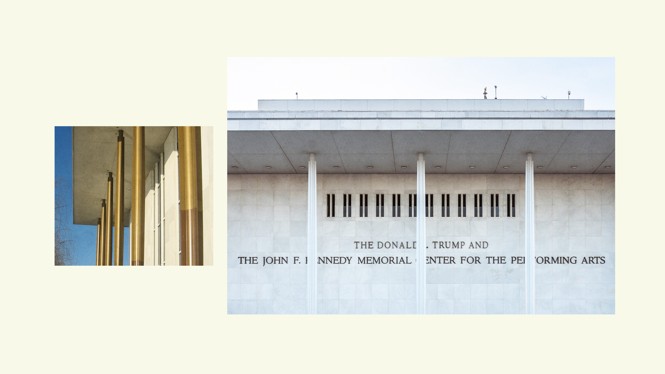
And paint. Last year, Trump had the exterior columns of the Kennedy Center changed from gold to white, and he is currently seeking approval to paint the Eisenhower Executive Office Building so that it matches the White House, its immediate neighbor. With the Reflecting Pool, he’s ordered up a giant blue rectangle. It would be among his first completed changes to Washington’s landscape and an emblem of his administration, one in which stewardship may come second to pageantry.
It isn’t easy to give Washington, D.C., a makeover.
Major changes to the city’s monumental core are supposed to face layers of review from federal entities including the National Park Service, the National Capital Planning Commission, and the Commission of Fine Arts. Trump allies lead both commissions, the latter of which is composed entirely of his appointees now. Both have allowed projects such as the White House ballroom to leapfrog the usual process. The East Wing was demolished in October, before the White House brought plans to the federal panels, which approved the project earlier this year.
Projects affecting federally designated historic landscapes also are subject to a Section 106 review process under the National Historic Preservation Act, which considers not only structural and environmental impacts but also potential changes to a site’s “feeling and association,” Charles Birnbaum, the president and CEO of the Cultural Landscape Foundation, which filed a lawsuit against the Interior Department last week to halt the changes to the Reflecting Pool, recently told me. Altogether, the reviews can take years and many of them involve public hearings, environmental assessments, and design revisions. But the Reflecting Pool has gone through the process before.
[Read: Trump’s giant face is everywhere]
From 2010 to 2012, the Obama administration spent more than $34 million to restore the pool’s structure, which was sinking into the marshland. The rehabilitation also included enhancements such as a new tinted bottom to improve the water’s reflectivity and a circulation-and-filtration system to prevent algae blooms in the shallow basin. Even with extensive planning and review, the project still fell short. Workers were clearing out the algae less than a month after the pool’s reopening.
To a president hoping to do some building in D.C., the lengthy reviews may feel like red tape. But despite the slowness, high costs, and failures that can result, federal reviews also serve as aesthetic checks on Washington’s symbolic spaces. The Mall was designed as a carefully choreographed civic experience in which the more than 2,000-foot-long Reflecting Pool serves as a vehicle for “conversation, commemoration, and civic gestures,” Birnbaum stressed. “It is all about movement,” he said. “You’re actually seeing your own reflection in conversation with the monuments, which are ever shifting as you move. They’re also ever shifting if the sunlight moves.”
Crucially, he said, the pool bottom’s dark-gray tone reflects two memorials—Washington and Lincoln—in a single unbroken image.
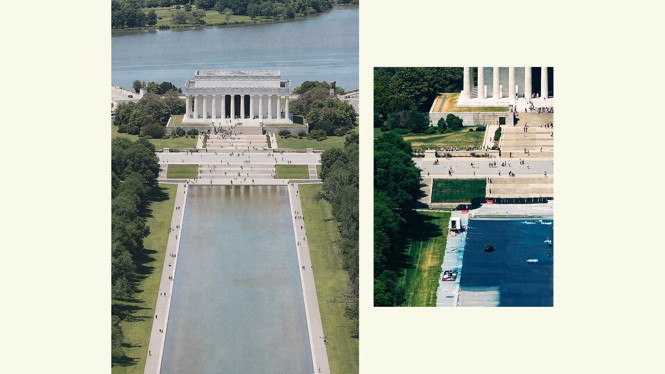
There’s nothing wrong with blue, a popular color for backyard pools. But in reflecting pools, color can alter the water feature’s effect—a delicate choice that inspires a passionate response from experts.
“The blue should be the goddamn sky. Not the bottom of the pool,” the landscape architect Laurie Olin told me recently as we observed crowds wandering the National Gallery of Art Sculpture Garden, close to the center of the National Mall. “It’s not meant to be calling attention to itself.” The sculpture garden—one of Olin’s most lauded projects—offers its own evidence. Patches of blue sky and slow-moving clouds shimmered across the rippling surface of the garden’s central fountain as visitors paused along the gravel path to admire the reflections. “What it takes to make things look simple quite often is an enormous effort,” he said.
Speaking to reporters last month during a White House event, Trump said he first floated a brighter idea for the basin. “‘What about turquoise, like in the Bahamas?’” Trump recalled asking a contractor. “He said, ‘Well, this is Washington, sir. We can give you turquoise, but why don’t you try—like, we have a color. It’s called American-flag blue.’” Trump has claimed that the project, which began in April, was prompted by a friend visiting from Germany who complained that the water looked filthy and disgusting. In an effort to move at “Trump speed” for the nation’s 250th anniversary, the president gave out a no-bid contract, an exemption meant for urgent situations, The New York Times reported.
[Read: The Trump Library symbolizes his presidency perfectly]
Trump further defended the move by claiming that bypassing a multiyear plan to rebuild the pool and hiring a swimming-pool contractor would be more cost efficient. He estimated that the work would cost about $1.8 million, but the Interior Department told the Times that it expected to pay $13.1 million. Trump said the coating would act as an industrial sealant to stop 16 million gallons of water from leaking each year, but according to the Times, staffers at the Interior Department have begun to notice bubbles, small holes, and inconsistent colors across the pool’s surface as the work continues.
The darkened color of the pool bottom will also make the water in the basin hotter in the summer, because it will absorb more heat, Olin said, potentially creating more algae and a film of scum.
After Trump took over the Kennedy Center last year, among the first physical changes he ordered up was the repainting of its roughly 200 gold-toned columns to “Site White.” Trump said the pillars, which were a defining feature of the architect Edward Durrell Stone’s design and resemble the strings of an instrument, were “fake looking.” Testifying in federal court last month, Kennedy Center Executive Director Matt Floca defended the decision. “It’s easy; painting is easy,” Floca said when asked why the institution prioritized repainting of the columns over other issues that Trump and its leadership said have left the center in tremendous disrepair.
The president’s more recent proposal to paint the historic Eisenhower Executive Office Building white has alarmed preservationists and architects. The building’s granite, slate, and cast-iron exterior were designed to weather over time and emphasize the natural texture of the stone. Painting such surfaces not only risks damaging the building physically by trapping moisture within porous materials, but also erases the architectural character of the structure itself, Olin said.
Landscape architects often invoke a philosophy known as “architecture parlante”—the idea that a building’s physical form quietly communicates its purpose and values, Olin said. In Washington, D.C., the stone, reflective water, and muted palettes are meant to project strength, permanence, authority, history, and restraint.
“One of the reasons why Washington is celebrated as such an exemplar and icon when it comes to city planning and landscape architecture and civic design is because of its visual and spatial bone structure,” Birnbaum said. “And the reality is all of these projects are impacting the visual and spatial structure of how we both move physically and also how our eye moves visually through these landscapes.”
Although landscape architecture has both practical and aesthetic aims, Olin said that spaces such as the National Mall are meant to uplift people emotionally and spiritually as much as they are meant to function practically and ecologically.
“They’re all equally important,” he said.
The challenge is balance. And a striking blue basin at the bottom of the Reflecting Pool could upset that equilibrium.
“It’s like a drug,” Olin said. “It’s trying to stimulate people artificially.”
The post Donald Trump’s Paint Jobs appeared first on The Atlantic.