One good book can lead to another.
My latest literary journey began when I followed Meriwether Lewis and William Clark’s expedition to the Pacific in Craig Fehrman’s “This Vast Enterprise: A New History of Lewis & Clark.”
Lewis, Clark and several of the 30 men with them kept detailed journals, and Fehrman has drunk deeply from them as well as from recollections of the Native American leaders they encountered along the way. I felt like I was sharing the vistas, smells, discomforts, injuries, terrors (grizzly bears!) and occasional joys of an expedition now over 200 years back.
One of the men, York, was enslaved by Clark. Clark doesn’t come off well: Fehrman vividly depicts his unquestioning sense of York as less than human despite the fact that York displays the same, if not more, smarts, mettle and bravery as the white men. Fehrman is especially good at recreating the state of mind of Sacagawea, the Native American woman they brought along as an interpreter and sometime guide, who gave birth to her son along the way, nursing and caring for an infant the rest of their journey.
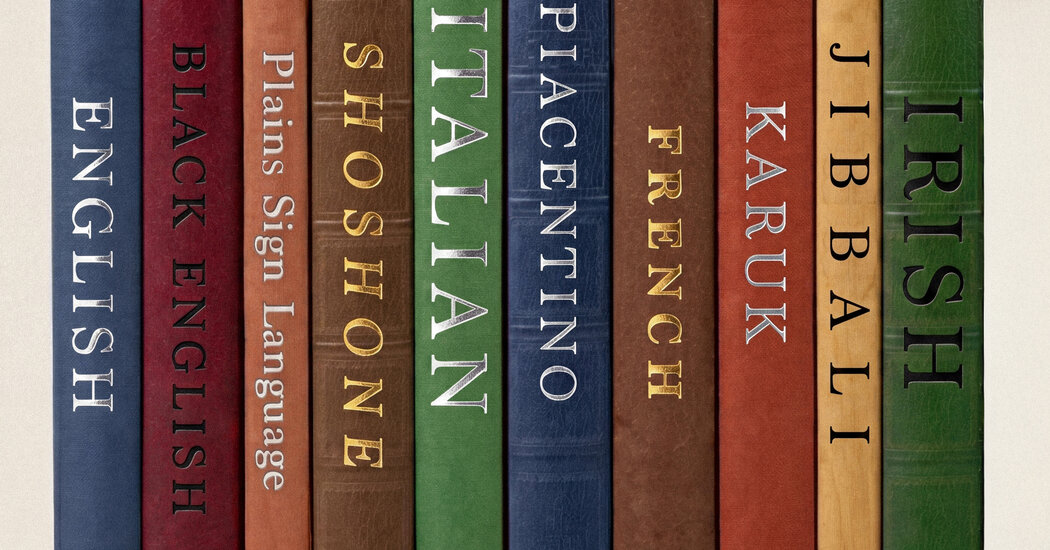
Language issues tantalize me. Because historical sources on Black English before the late 19th century are sparse, it is unfortunate that there is no way of knowing how York spoke. But we get a better sense of the Native Americans’ use of language. Sacagawea spoke no English. For nearly two years, she and the men usually communicated silently, with the Plains Sign Language used between many Native American tribes as well as by whites who needed to communicate with them.
Sacagawea’s native language was Shoshone. Fewer people speak the language now, and efforts are being made to keep it alive through classes and printed materials. Language revitalizations like this are the subject of the journalist Sophia Smith Galer’s “How to Kill a Language: Power, Resistance and the Race to Save Our Words.” Once a language is no longer being passed on to children, it is increasingly likely to go extinct. Galer visits and reports on nine languages that are in, or are threatened with, this situation.
Galer casts a bright light on the massive linguistic diversity that the world seems set to lose, with about 3,000 of the world’s 7,000 languages unlikely to see the next century. Often people don’t even know that the languages are, well, languages. Galer starts with her mother and grandmother, Italian immigrants raising her in England and speaking among themselves both Italian and what they call “the dialect.” They know no other name for it, but it is actually more like French, and Galer at first finds no information on it in print or online sources. In her grandmother’s home village in northern Italy, she learns that it is Piacentino, no more like standard Italian than Spanish. Like countless other “dialects” in Italy and beyond, it is not long for this world as a spoken language.
Every language that dies takes with it such fascinating stories. Galer notes that the Karuk language of Native Californians has at least 10 words for distinct varieties and uses of acorns and no one generic word “acorn.” In Jibbali, a relative of Arabic and Hebrew spoken in Oman, often some consonants are not actually pronounced but the tongue is placed as if they had been and you need to see it to know which word is being uttered. Understanding Jibbali requires watching as well as listening.
Shoshone has interesting elements like that, too. In the 1978 cult hit musical “On the Twentieth Century,” the lyricists Betty Comden and Adolph Green have a vainglorious theater producer dramatically bewailing that his creditors are like “angry birds pecking with their beaks.” I have always loved that overripeness — what else would the birds peck with, their tails? But then, all languages describe the world beyond what is necessary in some ways, and in Shoshone, it is normal to say something like “peck with its beak,” where the “with the beak” part is conveyed as a prefix to “peck.” It makes the verbs magnificently precise. You not only “bite with your mouth” and “kick with your foot,” but you can get more specific. We don’t have one word that means “break with your foot” — as in, breaking the glass at a Jewish wedding — but Shoshone does. There is even a word that means “jam yourself into a hole butt-first”!
I wish the people keeping Shoshone alive well. However, I’m sure they know that the version of their language they bring back from the brink will be different from the original. Usually, a language that was down for the count but comes back is slimmed down from the journey. Kids can learn a language of fearsome complexity, but when adults are doing a lot of the learning, they tend to iron out the irregularities and take shortcuts around the more pitiless intricacies. This has happened with the kind of Irish most people speak today, and other languages. I hope Shoshone can hold on to as many of those nifty prefixes as possible.
Yet these new versions of a language are very much real language, vibrant and nuanced as human speech always is. One way to know is that Modern English began in a similar way. Viking invaders starting in the eighth century learned Old English as adults, and there were so many of them that their way of talking was a lot of what kids heard around them and took on. In a largely illiterate, oral society with schooling and media all but nonexistent, this Duolingo version of Old English became what English actually was. I am writing in what began as broken English. This is why, for example, English is unique among Indo-European languages in Europe in that it doesn’t mark inanimate things with gender — too random for a busy Viking!
A beautiful demonstration of how streamlined language can still be nuanced and even sublime is, of all things, a Peanuts strip from 1969 in one of Fantagraphics’ volumes of the whole run of the strip that I have been sampling lately. Linus is on a high from the last-minute victory in a football game he just saw on television: “The fans and the players were so happy they were rolling on the ground and hugging each other and dancing and everything! It was fantastic!” Charlie Brown asks, “How did the other team feel?”
The look Charles Schulz captures on Linus’s face is so very real — the crinkly smile suggesting a surrendering kind of awe. Plus, he has his hands clasped over his belly as he holds the moment fast, facing forward away from Charlie Brown immersed in his inner reverie. Schulz captures demeanor and body language on a par with Vermeer or Velásquez here in a few strokes. That’s what English can do despite not having as many bells and whistles as Shoshone.
And as to Charlie Brown’s question, I now feel as if I know how the Lewis and Clark team felt, as well as how it feels to be one of the last speakers of a language. Fehrman and Galer both, like Schulz, scored a touchdown.
The post The Fascinating Stories of Dying Tongues appeared first on New York Times.