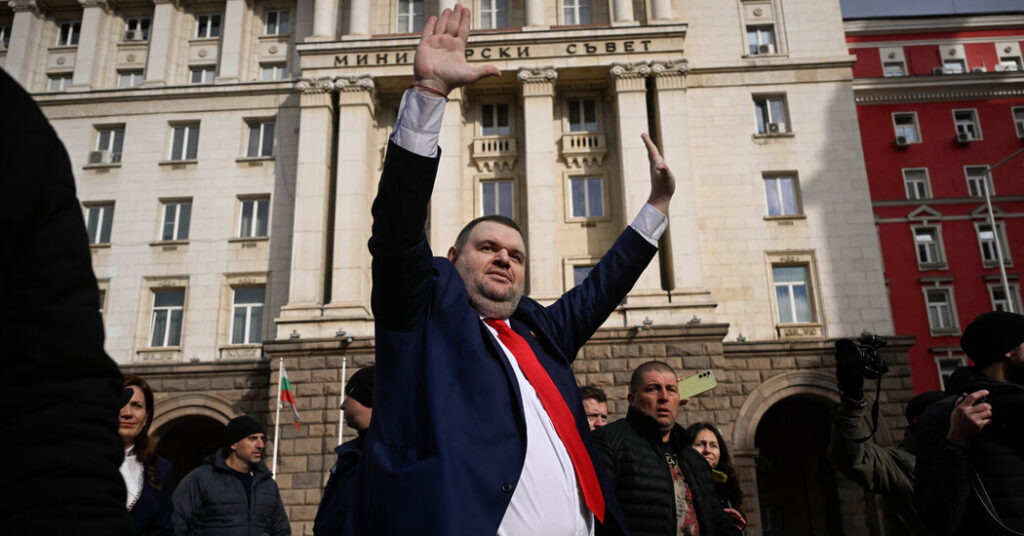
When mass protests brought down the government in Bulgaria, forcing fresh elections in April, the protesters’ greatest ire was directed at Delyan Peevski, the leader of a small political party but considered one of Bulgaria’s most powerful politicians.
A former media magnate whose name has been linked to multiple financial scandals over the years, Mr. Peevski is widely believed to have an outsize, behind-the-scenes influence over the media, the judiciary and the government.
Public frustration over the stranglehold of corruption in Bulgaria propelled Rumen Radev, a former fighter pilot and former president who formed a new coalition, Progressive Bulgaria, to a landslide victory in parliamentary elections.
Mr. Radev campaigned on a promise to dismantle the “oligarchy,” naming Mr. Peevski among his targets. In particular Mr. Radev criticized the collaboration between Mr. Peevski and Boyko Borissov, the leader of the former governing party.
The size of Mr. Radev’s victory has put Mr. Peevski on his back foot.
Mr. Peevski’s party lost eight seats in the National Assembly, although he retained his own seat and the immunity that goes with it.
Within days of the election, Borislav Sarafov, the acting prosecutor general, widely believed to be in Mr. Peevski’s pocket, resigned. Mr. Peevski, often pugnacious and uncouth, bit his tongue and offered polite congratulations to Mr. Radev.
The country is transfixed as to what will come next.
Whether Mr. Radev can indeed sideline, or even prosecute, Mr. Peevski now forms a fundamental test of his intentions as Bulgaria’s likely new prime minister and his will to follow through on his promise to clean up the way the country has been run.
Mr. Peevski, 45, is blamed by many for the country’s endemic corruption and faltering progress, and he has come to embody Bulgaria’s failure to establish the rule of law and what critics describe as a state captured by obscure and pernicious interests.
For more than a decade he has been the focus of protests by Bulgarians, the most recent of which was in December, when tens of thousands of people took to the streets to push out the government he supported.
In 2021 the United States sanctioned Mr. Peevski and two other Bulgarians under the Global Magnitsky Act, which allows U.S. penalties against foreign officials accused of human rights violations or corruption.
The sanctions announcement stated that Mr. Peevski, through a frontman who was also sanctioned, placed individuals in positions of authority, sometimes in exchange for a bribe or in order for them to embezzle funds and pay him bribes.
It accused Mr. Peevski of “using influence peddling and bribes to protect himself from public scrutiny and exert control over key institutions and sectors in Bulgarian society.”
The sanctions provoked Mr. Peevski to bring a complaint against American officials in a federal court in the District of Columbia in 2022. Britain then followed suit, sanctioning Mr. Peevski in 2023 for engaging in “serious corruption.”
Mr. Peevski has denied the accusations as baseless smears by his rivals. His party did not respond to requests for an interview.
His rise traces Bulgaria’s own recent history — its transition from Communism to becoming a full-fledged member of NATO and the European Union — and the missteps the country has taken along that path.
Delyan Peevski was 9 years old in 1989 when Communism fell in Bulgaria. He grew up in the Wild West period of the 1990s, when mafia groups thrived on the advent of capitalism. He showed a talent for making contacts and climbing the ladder through them. He jumped into the business world from the age of 18 and became a deputy minister at 21.
Mr. Peevski’s accumulation of power shows Bulgaria’s failure to dismantle the legacy of the former Communist state, allowing the old intelligence apparatus to meld with the Bulgarian mafia into an all-controlling influence, said Dimitar Keranov, a visiting fellow at the German Marshall Foundation of the United States in Berlin.
“Without dismantling the influence networks from the Communist era, you could not expect the democratic quality to be very high,” he said.
Mr. Peevski’s mother, Irena Krasteva became the head of a lottery fund and began to acquire a clutch of media companies in the fledgling democratic state. Mr. Peevski took the companies over in 2009.
That same year, he became a member of Parliament for the Movement for Rights and Freedoms, a party that ostensibly represented the Turkish minority in Bulgaria. Mr. Peevski is not of Turkish descent.
When he was appointed head of Bulgaria’s counterintelligence agency in 2013, many Bulgarians saw it as an example of shadowy business interests capturing the state.
Protests erupted. Mr. Peevski made little comment at the time but quickly resigned.
Placing his own people in high offices of the prosecution, judiciary and investigative agencies has been key to the expansion of Mr. Peevski’s political influence, said Velislav Velichkov, a lawyer who founded the Justice for All Initiative, a Bulgarian nonprofit group that works for judicial reform.
That has allowed his political party — first under its founder, Ahmed Dogan, and subsequently under Mr. Peevski — to wield influence for more than 20 years over the Supreme Judicial Council, which oversees the courts, Mr. Velichkov said.
It has also held sway over the office of the prosecutor general, which has the power to review cases and assign prosecutors to cases, he said, protecting Mr. Peevski and his associates from prosecutions.
One of the new government’s first tasks will be to overhaul those institutions, Alexander Pulev, a member of Mr. Radev’s economics team, said in an interview before the election.
Mr. Radev has ruled out any political deal with Mr. Peevski’s longstanding political ally, Mr. Borissov, a former mayor of Sofia, whose party led the government for the best part of 16 years.
Since 2009, Mr. Borissov has served three tours as prime minister and repeatedly played down allegations of corruption.
So it shocked many Bulgarians when he revealed the nature of the political arrangement between him and Mr. Peevski.
“I have known Delyan Peevski for 20 years and I know I can count on him,” Mr. Borissov told journalists in October. “I know that when I tell him something, he takes it into consideration, and I know that when he asks me for something, I do it.”
In a statement to The New York Times, Mr. Borissov said allegations of corrupt practices carried out by governments led by his party were untrue.
He added that no officials from Mr. Peevski’s party had ever served in his cabinet but that the fragmented nature of Bulgaria’s Parliament necessitated seeking votes from various parties.
“Important national goals sometimes require a compromise of parliamentary configurations,” he said.
Carlotta Gall is a senior correspondent, covering the war in Ukraine.
The post The Bulgarian Political Puppet Master No Election Seems Able to Remove appeared first on New York Times.