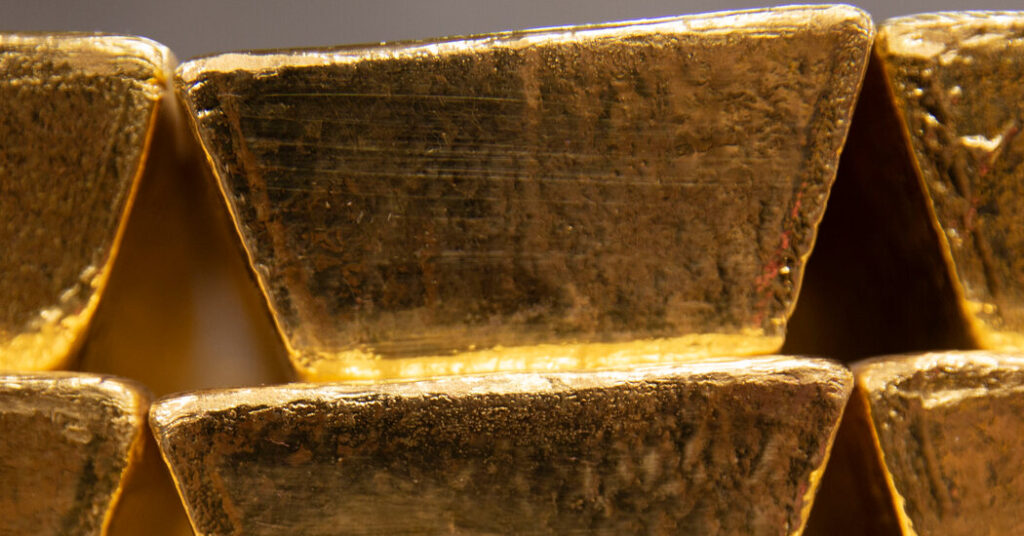
Central banks around the world have bulked up their reserves of gold, a safe but cumbersome investment that has been revived in popularity by intensifying geopolitical tensions and concerns over inflation.
This year, the price of gold exceeded $5,000 per troy ounce for the first time in history. One major reason prices have soared — doubling in a year and a half — is the demand from emerging economies: The central banks of Poland, Turkey, India and China have been some of the biggest buyers of gold in the past several years.
The shock to the global financial system from the war in the Middle East has underlined again how some central banks turn to gold during times of stress.
Central banks have continued to add to their holdings of gold since the conflict began in late February, including those in China, Poland, the Czech Republic and Uzbekistan, according to data from the World Gold Council. In March, China’s central bank bought more gold than it had in more than a year. Guatemala also bought gold in March, for the first time in about six months, the council said.
“Recent market developments, driven by the instability in the Middle East, have reinforced our view that instability has become the defining feature of the global economy,” Adam Glapinski, the governor of the National Bank of Poland, said in response to written questions. “I would reiterate the importance of diversifying foreign reserves and the role of gold as a strategic asset.”
Gold is seen as a good store of value when inflation rises, and it can usually be sold quickly when a country urgently needs cash. Crucially, it is harder for another country to interfere in a central bank’s stash with sanctions because gold is a physical object and not, like a bond or bank deposit, backed by a currency such as the dollar or euro.
The growing interest in gold began in earnest after Russia’s full-scale invasion of Ukraine in 2022. The United States and Europe responded with sanctions that froze Russia’s reserves overseas. That cut off the Russian central bank from about $300 billion in assets, mostly euros and dollars, and was a major escalation by Western governments, which were now using their currencies as a choke point.
Since then, gold holdings by central banks have increased rapidly. For three years, central banks added more than 1,000 metric tons of gold annually to their reserves. (A metric ton is equal to 2,205 pounds.) That was more than double the pace in 2021, according to the World Gold Council.
The war with Iran has shown how countries can use gold as a buffer against economic stress.
Turkey’s central bank has sold or lent more than 120 metric tons of gold from its vast reserves since the United States and Israel struck Iran on Feb. 28, according to central bank data. The sales were designed to help bolster the value of the Turkish lira, which has plummeted amid concerns about inflation and the country’s poor economic outlook. In general, central banks worry about weak currencies, which raise import prices and worsen inflation.
Gold had spent decades out of fashion. It has not been used as a peg in the global monetary system since the 1970s. Instead, countries built currency reserves, often in dollars or European currencies, to stabilize their economies in crises. But holding gold raises logistical issues for central banks, like where to store it and how to move it when it needs to be traded. It also doesn’t generate interest or dividends like bonds and stocks.
But because gold is, in many ways, effectively off the grid of the modern global financial system, countries can use it to shore up their autonomy.
Gold “is globally liquid, universally recognized, and — crucially — it does not represent anyone else’s liability,” said Mr. Glapinski, one of the loudest proponents of central banks’ increasing gold reserves. In March, the Polish central bank had a stock of 580 metric tons of gold, valued at about $85 billion, up from 228 metric tons in 2022.
The bank intends to increase its gold holdings to 700 metric tons to reflect “the relentless rise in economic strength and importance of our country over the past two decades,” Mr. Glapinski added.
Three years ago, the Czech National Bank decided to increase its gold reserves from an “almost negligible” amount of less than 10 metric tons, said Jan Kubicek, a board member of the central bank who oversees its reserves. By 2028, the bank aims to increase the amount of gold in its international reserves to 100 metric tons.
“Our predecessors decided that gold was no longer the asset to be held,” Mr. Kubicek said. “It was believed to be old fashioned and with many practical disadvantages.” Like some other central banks, the Czechs sold gold in the late 1990s, keeping a little only to make commemorative coins.
After the global financial crisis nearly two decades ago, the perception of gold among many central bankers started to change, Mr. Kubicek said. Central banks have been net buyers since 2010, according to the World Gold Council.
“We joined this group after the breakout of the Ukrainian war,” Mr. Kubicek said.
The price of gold has been more volatile than usual lately, in part because of the extraordinary run-up in price, which drew in a swarm of individual investors prone to rapid buying and selling. And though central banks have pulled back their purchases somewhat over the past year, analysts say they expect central banks to remain consistent buyers.
At the Czech central bank, for example, purchases follow a steady rhythm, rather than being entirely responsive to volatility in the market.
A survey of central banks conducted in the first three months of the year found that more than one-third planned to increase their gold holdings in the next year, and the rest said they would maintain their current allocations. The banks’ managers, surveyed by Central Banking Publications and HSBC, estimated that gold would reach a median of $5,250 per troy ounce by the end of the year, up from about $4,546 at the moment.
Whatever the conditions, said Krishan Gopaul, a senior analyst at the World Gold Council, “central banks have become a real pillar of demand in the gold market.”
Eshe Nelson is a Times reporter based in London, covering economics and business news.
The post Why Countries Are Stocking Up on Gold appeared first on New York Times.