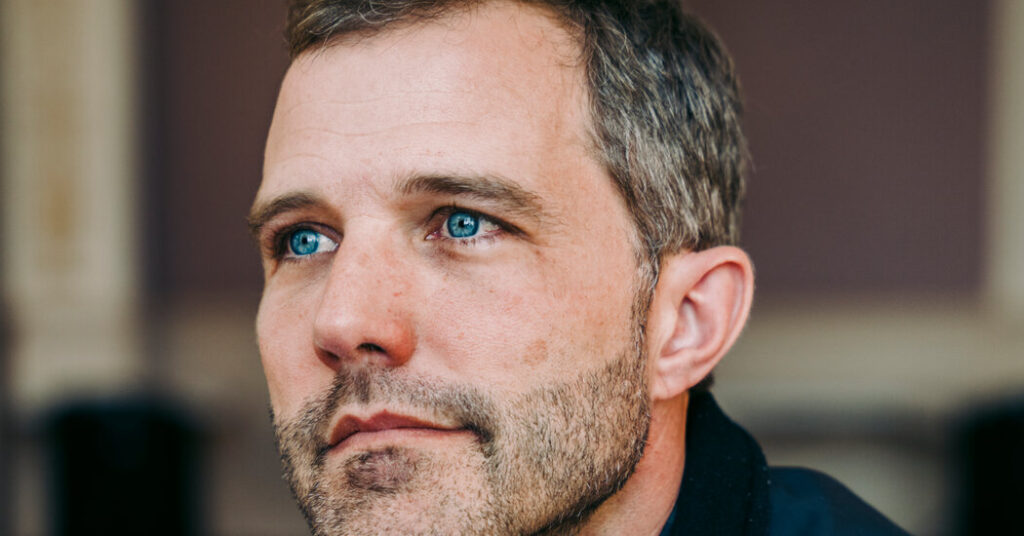
The carpenters and sheet-metal workers sitting inside a Montana union hall were Seth Bodnar’s kind of crowd: fed up with Democrats and Republicans.
Mr. Bodnar, an Iraq war veteran and former president of the University of Montana, had come to the old copper-mining town of Butte to pitch himself as an independent candidate for an open Senate seat in the state, as well as an antidote to the partisan warfare that has left many Americans disgusted with politics.
“I’m angry about the direction of this country,” Mr. Bodnar, 47, said. “We need a new approach.”
Any other year, a candidate like Mr. Bodnar, who lives in the liberal college town of Missoula, has never held elected office and has no party support, might have no shot in a vast rural state where Republicans control every statewide and federal elected office. But this year, people are angry at high prices and the war in Iran, and many are upset over the backroom machinations that Senator Steve Daines, a Republican, used when he dropped his re-election bid at the last minute in an attempt to clear the field for a handpicked successor, Kurt Alme.
Mr. Bodnar’s supporters say Montana, a state that prides itself on its independent streak, is ripe for a major disruption.
But critics on the left say just the opposite — Mr. Bodnar’s candidacy will turn a winnable two-way Senate race into a three-way mess that will divide moderate and liberal voters and hand a victory to Mr. Alme, a former U.S. attorney for Montana widely expected to become the Republican nominee.
While in Nebraska, another Republican state, Democrats decided to stay on the sidelines and quietly back the independent mechanic Dan Osborn as he makes a second Senate run, members of the party in Montana are promising a fight. The populist candidates competing in Montana’s Democratic primaries deride Mr. Bodnar as an interloper backed by Beltway consultants and out-of-state wealth.
Mr. Bodnar, a former Green Beret who commanded platoons in Iraq, studied at Oxford as a Rhodes scholar and worked at General Electric before spending eight years as the president of the University of Montana, does seem out of central casting. He hunts elk, mountain-bikes and has already raised more money — about $1.4 million in total — than his Republican and Democratic rivals.
Perhaps most importantly, in a state where President Trump won by 20 percentage points, Mr. Bodnar will not have a “D” beside his name. And his quest for a center-left-center-right coalition may be making headway.
Jon Tester, a former Democratic senator who lost his re-election campaign in 2024, has signaled his support, though without a formal endorsement, saying in a widely circulated text message that the Democratic brand had become electoral “poison” in Montana.
On the other side of the centerline, Marc Racicot, a moderate Republican governor of Montana during the 1990s, endorsed Mr. Bodnar in an interview, saying that he was best hope Montana had of electing someone who would be a check on the president and fight against unlimited, unregulated money in campaigns.
“The status quo has to be challenged,” Mr. Racicot said.
Mr. Bodnar is carrying that message to veterans groups, living rooms and union halls as he introduces himself to voters across the state and collects the 13,300 signatures he needs to get on the ballot.
He leads with his independent identity, saying he will not caucus with Republicans or Democrats, a problematic if not impossible position, since party leaders dole out committee assignments and other Senate positions. He pledges term limits and a ban on stock trading by members of Congress.
The country, he says, has lost something fundamental by sorting itself into ideologically divided blue cities and red rural areas, and warring social media tribes.
People are “being forced into these two camps, and being told, You have to hate your neighbor,” Mr. Bodnar said in an interview. “That’s not who Montanans are.”
A pragmatic Democratic Party might see all that as good enough, considering its recent electoral defeats, but Montana Democrats, while priding themselves on centrism, have a pugilistic streak.
Former Gov. Brian Schweitzer, a Democrat, said he had spent hours on the phone with Mr. Bodnar, urging him to run as a moderate Democrat who embraces Montana’s leave-me-alone cowboy libertarianism. Mr. Bodnar, after all, registered to vote as a Democrat in Connecticut in 2012 after leaving the Army, before registering as an independent in 2014.
“Bodnar explained to me, ‘I’m not completely a Democrat — I have other ideas,’” Mr. Schweitzer said. “I said: ‘Really! It sounds like a Democrat from Montana.’”
Mr. Bodnar’s rebuff has left some Democratic officials and candidates vying for the Democratic Senate nomination in attack mode. Reilly Neill, a former state representative, has tried to draw attention to a sex-discrimination lawsuit filed against the university during Mr. Bodnar’s tenure. The suit accused Mr. Bodnar of perpetuating a “good old boys’ club” atmosphere at the university, denying women promotions and derailing their careers. The university settled the lawsuit for $350,00 in 2024.
Mr. Bodnar called the claims meritless and said he had prioritized putting women into leadership roles.
Mr. Schweitzer pointed out that Montana has had a three-way race before. In 2022, a businessman named Gary Buchanan made an independent run for Congress in Montana’s conservative eastern district. Mr. Buchanan and the Democratic candidate each got about 20 percent of the vote. The Republican, Matt Rosendale, won with nearly 60 percent.
“Independent stuff just screws the thing up,” said Renelle Braaten, a Democratic voter in the railroad town of Havre, near the Canadian border.
What makes this election cycle different from the last two is the turmoil in Montana’s Republican Party. Mr. Bodnar has called the Mr. Daines’s eleventh-hour switcheroo a symptom of a political system that rewards insiders at the expense of average Americans. In the more politically divided western half of the state, the unexpected retirement of Representative Ryan Zinke, a Republican, might also energize Democrats in what might have otherwise been a sleepy House race.
Tad Seifert, 45, a sheet-metal worker in Butte, said he regretted his 2024 vote for President Trump given the war in Iran, the $5 milk and the manufacturing job losses in Montana. The country feels on the edge of disaster, he said, but after meeting Mr. Bodnar he came away ready to cast a vote for an independent.
“I have hope,” he said.
Jack Healy is based in Colorado and covers the west and southwest.
The post An Independent Senate Hopeful Tries to Scare Off Montana Democrats appeared first on New York Times.