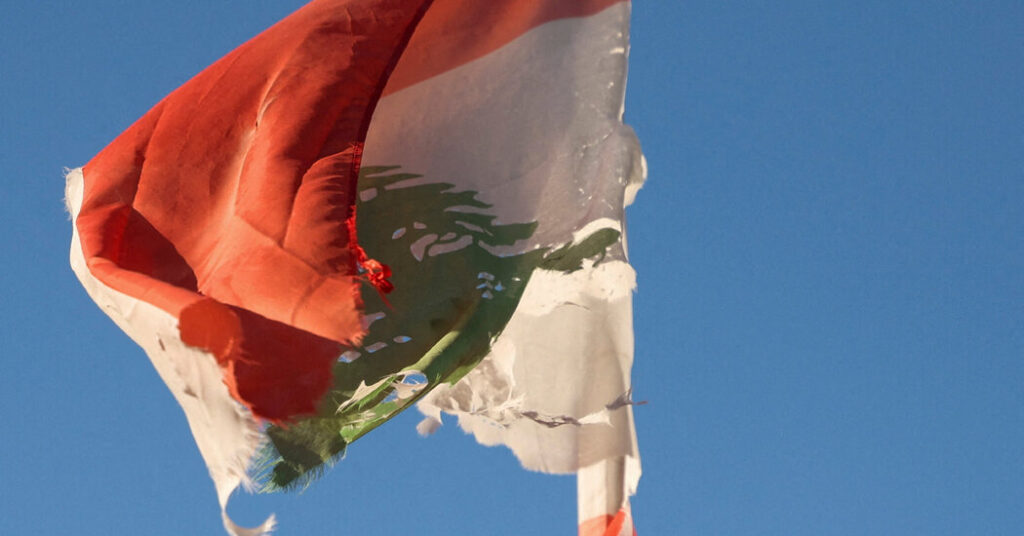
This week, a picture of an Israeli soldier desecrating a statue of Jesus in a Christian village in southern Lebanon has sparked an international furor. Israeli leaders have apologized for that act, but they have not expressed regret for the destruction of a mosque in a southern town last month, or its public school, or for the extreme violence they have unleashed on the nation of Lebanon over the past six weeks.
Despite the tenuous cease-fire between Lebanon and Israel that is now in place, Israel and Hezbollah have continued to exchange fire, while the Israeli Army has destroyed several Shiite villages along the border. The current cessation of hostilities follows a brutal Israeli assault that killed more than 2,300 people and displaced over a million from their homes. More than 350 Lebanese were killed in a shocking 10-minute aerial blitz on Beirut on April 8, hours after a cease-fire between Iran and the United States had been announced and was widely presumed to include Lebanon. Although many of the groups that make up Lebanon’s rich tapestry of religious diversity have been affected by Israel’s relentless bombing, the civilians most devastated are members of Lebanon’s Shiite community.
Israel claims it has been targeting Hezbollah, the political party and resistance movement rooted in Lebanon’s Shiite community. But its actions have gone well beyond attacking that group. It has repeated its Gaza doctrine of collective punishment. “Very soon, Dahiyeh” — the predominantly Shiite southern suburbs of Beirut, in which Hezbollah has maintained a strong presence — “will resemble Khan Younis,” boasted Bezalel Smotrich, Israel’s finance minister, in early March. During the war, Israel’s minister of defense said that Shiite residents would be specifically prohibited from returning to their homes in southern Lebanon until Israel achieved its military goals. Military officials pressed Druse and Christian leaders to force out their neighbors from Shiite communities who have sought refuge among them. And after devastating the southern suburbs of Beirut, an Israel Defense Forces spokesman explicitly threatened religiously “mixed” parts of the city. He claimed, without providing evidence, that Hezbollah had now moved to those areas.
Such an insidious and dangerous tactic wages war not just on the people, but also on the very nature of Lebanese society. Modern Lebanon embodies a long history of religious coexistence that goes back centuries. As in any socially diverse country, that pluralism is imperfect; it still struggles with sectarian tensions that both led to and are the legacy of the Lebanese civil war. Israel is exploiting these divides not just to vanquish Hezbollah, but also to expand at the expense of religiously diverse Lebanon.
Since its creation as a Christian-dominated state by France in 1920, Lebanon has maintained a sectarian system of government, in which representatives of each of the main religious communities are given a share of power. That system continued after independence: The powerful presidency is reserved for Maronite Christians, the prime minister for Sunni Muslims and the speaker of parliament for Shiite Muslims.
Before the Lebanese civil war in 1975, the Shiite population was largely marginalized, concentrated in the rural south of the country and the Bekaa Valley. They were not so much despised as neglected by Lebanon’s Christian and Sunni Muslim political elites. The creation of the Jewish state of Israel in 1948 came at the expense of hundreds of thousands of mostly Sunni Muslims as well as Christian Palestinians, who were uprooted or expelled from their homeland; many of them sought refuge in Lebanon.
Maronite elites feared that the largely Muslim Palestinian presence in the country would spur calls for democratizing Lebanon’s unequal system of governance. They also feared that the autonomous Palestine Liberation Organization — which made its headquarters in Beirut in 1971 and launched guerrilla raids from southern Lebanon to liberate its homeland — could destabilize the country. In 1975, these tensions exploded into all-out civil war, pitting predominantly Christian militias that wanted to uphold the sectarian system against their mostly Muslim and Palestinian rivals, who sought to reform or overthrow it.
Long before the P.L.O. was formed, Israel’s first prime minister, David Ben-Gurion, had identified southern Lebanon, including the Litani River, as territory that might be seized to expand the border of Israel into Lebanon.
When Israel invaded Lebanon in 1982, it sought to defeat the P.L.O., while at the same time pushing for a pliant Christian leader in Lebanon. Israel besieged Beirut in the summer of 1982, indiscriminately bombing civilian areas and killing between an estimated 17,000 and 19,000 people. It bombed hospitals and prevented food, water and fuel from entering parts of Beirut to force the P.L.O. to withdraw from Lebanon.
Hezbollah is the product of Israel’s 1982 invasion and subsequent occupation of southern Lebanon. It grew into the main resistance organization in the country, sustained by profound ideological, financial and military ties with Iran. In 2000, Hezbollah forced Israeli troops out of southern Lebanon. This is the same area Israel is attempting to occupy today.
Over the years, the group has become a divisive issue within Lebanon. Some Lebanese resent Hezbollah’s potency, fearing that it has given the Shiite community too much power, and many support its disarmament. The group has also earned popular backing and is a source of pride for other Lebanese — overwhelmingly so among Shiites. Hezbollah does not resist Israel simply because it is a Shiite organization supported by Iran; it resists Israel primarily because Israel has repeatedly invaded, scorched and occupied Lebanese land, and because Israel uprooted and terrorized its community.
In the current conflict, Lebanese debates about Hezbollah have increased in rancor. Although the Lebanese government has declared Hezbollah’s military wing unlawful, the chief of the Lebanese army has been unwilling to disarm Hezbollah by force, lest it push the country into outright civil war.
Last week, Lebanon’s ambassador to the United States met with her Israeli counterpart in Washington, leading to the cease-fire days later. The agreement does not compel Israel to withdraw from Lebanon — Israeli troops continue to occupy large swaths of Lebanon’s southern border — and allows Israel to “preserve its right to take all necessary measures in self-defense, at any time, against planned, imminent or ongoing attacks.” Lebanon has no such right, and Hezbollah was not a party to the agreement. The government lacks the ability to compel Israel to withdraw, and at the same time it is unlikely to persuade Hezbollah to disarm as long as Israel threatens Lebanon.
Israel understands these dynamics, which is why it cajoles the Lebanese government to take action against Hezbollah, while at the same time threatening and attacking Lebanon itself.
Israel’s expansion into Lebanon and apparent weaponization of Lebanon’s religious diversity ultimately underscores its own commitment to its prevailing ideology as a Jewish state committed to subjugating its regional environment: from the occupied Palestinian territories to the Syrian Golan Heights, and now to southern Lebanon. In that way, Lebanon is its antithesis: a state that reflects, however imperfectly, an indigenous pluralism. It is a state that constitutionally belongs to all its citizens of many different religions, most of whom share an aspiration to live together in freedom and dignity.
Early in this war, Youssef Assaf, a volunteer paramedic, was killed by an Israeli airstrike as he got out of an ambulance. He was trying to rescue wounded people in southern Lebanon. His religion, and theirs, should not matter, but his funeral in the city of Tyre was attended by both Muslim and Christian religious leaders.
While Israel displaces and destroys, many Lebanese continue to defend their country, defying attempts to divide it. At stake is the very future of the Middle East: either domination over a vibrant, multireligious world, or defiance of this world in the face of those who seek its destruction.
Ussama Makdisi is a professor of history at the University of California, Berkeley. His most recent book is “Age of Coexistence: The Ecumenical Frame and the Making of the Modern Arab World,” and he is a host of the podcast “Makdisi Street.”
The Times is committed to publishing a diversity of letters to the editor. We’d like to hear what you think about this or any of our articles. Here are some tips. And here’s our email: [email protected].
Follow the New York Times Opinion section on Facebook, Instagram, TikTok, Bluesky, WhatsApp and Threads.
The post Israel Is Weaponizing Lebanon’s Diversity appeared first on New York Times.