Tanoa Sasraku, an artist whose installations have featured corporate souvenirs, and Marguerite Humeau, whose exhibitions have included sculptures of dying elephants, are among the nominees for this year’s Turner Prize, the prestigious British art award.
Also nominated are Kira Freije, a sculptor of life-size figures that feature the faces of her friends and family, and Simeon Barclay, whose work ranges from performance to painting.
Alex Farquharson, the director of the Tate Britain art museum in London and the chair of the prize jury, told a news conference on Thursday that the four artists all took viewers on “extraordinary journeys.”
“Together, the artists’ distinctly powerful works, whether sculpture, installation or performance, help us to better understand the world,” he added.
Since its founding in 1984, the Turner Prize has gained a reputation as one of the art world’s major awards, with past recipients including Wolfgang Tillmans, Grayson Perry and Steve McQueen.
Last year’s prize went to Nnena Kalu, a learning-disabled artist who makes cocoon-like sculptures using materials including videotape and colorful plastic sheeting.
To qualify for the prize, which comes with prize money of 25,000 pounds, or about $33,800, an artist must be either British or working predominantly in Britain. The jury nominates artists for a specific exhibition held during the previous 12 months.
This year’s highest profile nominee is Humeau, a French artist who has shown work at the Venice Biennale, Tate Britain, the New Museum in New York and the Palais de Tokyo in Paris.
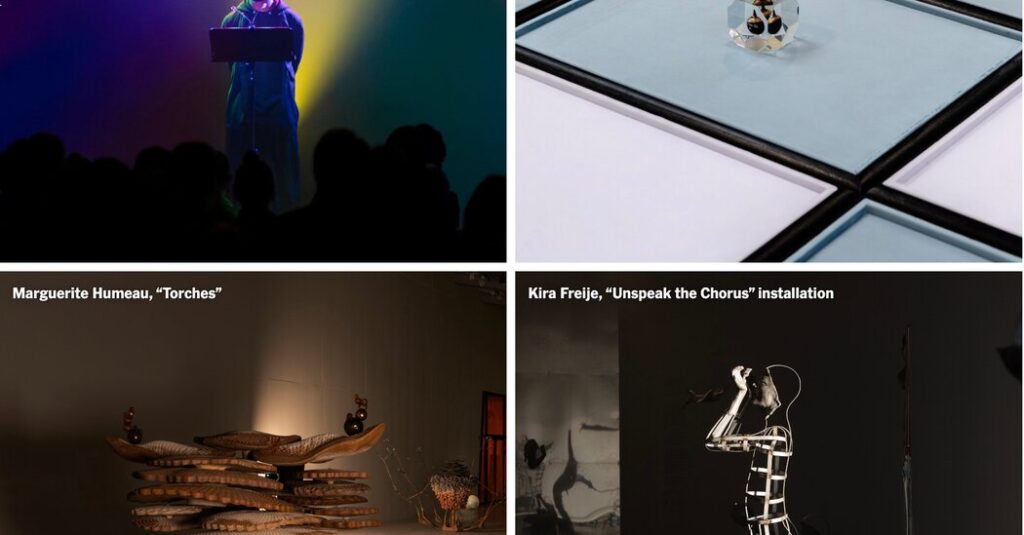
Her works often touch on the topics of extinction and environmental crisis, and she was shortlisted for “Torches,” a recent exhibition at the ARKEN Museum of Contemporary Art in Denmark and the Helsinki Art Museum in Finland. That show included a large sculpture of a dying elephant, accompanied by a sound installation that evoked its vanishing heartbeat. It also featured works made with beeswax, yeast and wasp venom.
The other artists are less well known, although Sasraku received some attention in Britain last year for her show “Morale Patch” at the Institute of Contemporary Arts in London. That exhibition included an installation featuring paperweights, created by fossil fuel companies to celebrate oil field discoveries, that the artist bought from eBay and then arranged in a grid.
Sasraku told The Guardian newspaper that she was “thinking about oil alliances and clashes between nations” as she made that piece. The exhibition also featured paperweights that Sasraku had commissioned depicting the U.S. flag.
Barclay is nominated for “The Ruin,” an hourlong spoken-word performance that explored issues of class and masculinity, drawing from Barclay’s experiences of growing up in a former industrial city in northern England. He staged the show at venues including the Institute of Contemporary Arts in London.
Freije, was chosen for “Unspeak the Chorus,” which features humanlike sculptures made using casts of the artist’s own hands and feet, metal bars and scraps of fabric. Freije’s first major solo exhibition in Britain, it is at the Hepworth Wakefield art museum until May 4.
The jury will announce the winner of this year’s Turner Prize on Dec. 10 during a ceremony at the Middlesbrough Institute of Modern Art, a museum in northeast England. A free exhibition of work by all four nominees will open at the museum on Sept. 26 and run through March 29.
Alex Marshall is a Times reporter covering European culture. He is based in London.
The post Turner Prize Nominees Take Viewers on ‘Extraordinary Journeys’ appeared first on New York Times.