‘We Will Turn Trauma Into Something Beautiful’
April 19, 2026
Last September, Bablu Gupta, 28, was dragging bodies away from Nepal’s Parliament through gunfire. Security forces were stalking young protesters who, at his urging, held up the pirate flag that is a worldwide symbol of Gen Z resistance.
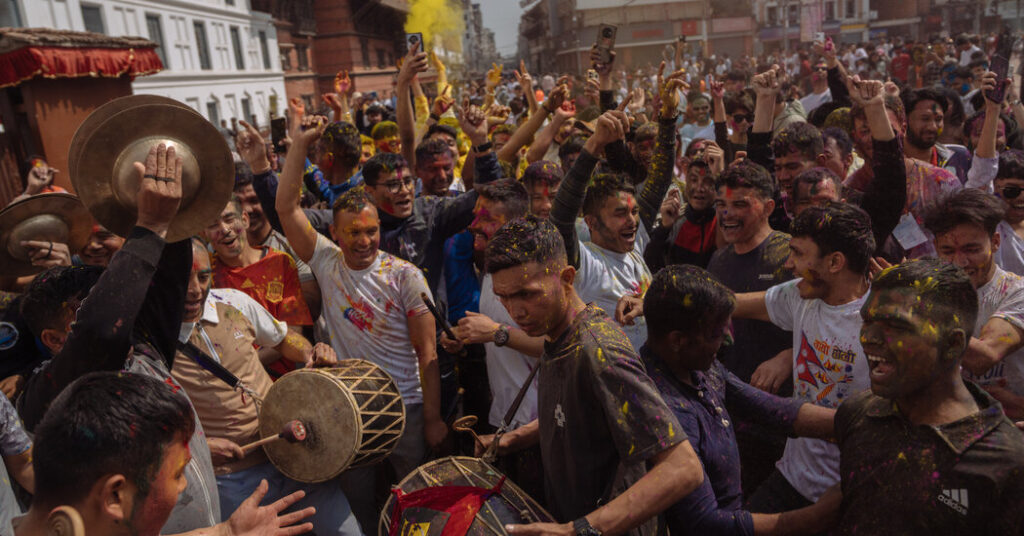
The defiance of Mr. Gupta and his peers during an uprising that toppled the government still flashed last month, but it was joined by a new emotion — hope. He and a group of villagers from Nepal’s south, where more than half of youths leave for jobs abroad, gathered to celebrate Holi, the colorful festival of renewal, and to support his candidacy for Parliament.
Only a few days before the March elections, the men smeared bright powders on Mr. Gupta’s face. His sweat-misted visage turned green, then purple, then yellow, then red. He blinked. A fine fuchsia fluttered from his eyelashes.
Mr. Gupta won, and so did many of his Gen Z protest cohort. The elections handed a landslide victory to the youth-driven Rastriya Swatantra Party, giving it a mandate not seen in decades. Nearly 10 percent of Nepal’s recently elected lawmakers are 30 or younger, compared with less than 2 percent in the last Parliament.
The young Nepalis demanded change because they were sick of it all: sick of the corruption that forced them into menial jobs abroad, sick of the nepotism that reserved positions of power for high-caste families, sick of the conspicuous consumption of the gilded class, and sick of a government social media ban that robbed them of a respite from the dispiriting reality of being young, educated and underemployed.
“We were desperate,” Mr. Gupta said. “Not just us in Nepal, many Gen Z around the world. We knew things needed to change.”
Mr. Gupta was at the forefront of the Gen Z protests last September, which deposed a septuagenarian prime minister and his government in only 48 hours. The uprising cost dozens of lives, many at the hands of the security forces, and catalyzed a mass paroxysm of arson that consumed thousands of buildings nationwide. But the ashes of revolutionary destruction also nourished seedlings of hope. A Himalayan nation squeezed between China and India had, once again, transformed.
“We have a lot of trauma from what happened last year,” said Mr. Gupta, who also served briefly as the youngest cabinet member in the caretaker administration that followed the revolution. “I think we will turn trauma into something beautiful, something for the future generation.”
A Wave of Anger
Nepal’s Gen Z rose up amid a global groundswell of disgust for a political old guard tainted by corruption, impunity and an unyielding grip on power. Protests flashed in Indonesia, Peru and Togo. Youths rallied in Morocco, Kenya and the Philippines. Across the world, young people traded memes and tips on how to organize dissent. Weeks after Nepal unseated its leaders, young people in Madagascar sent their president into exile.
The months since then, though, have proved sobering. In Bangladesh, home to the world’s first successful Gen Z revolt in 2024, voters in February chose an establishment party over a younger alternative. In Madagascar, the military leader last month fired the entire interim government, amid accusations of corruption. Protests elsewhere mostly fizzled, though not before lives were lost.
Nepal, which dispensed with its monarchy 18 years ago and tamed a Maoist insurgency two years before that, remains an outlier, with its electorate endorsing the political yearnings of the young generation.
On March 27, Balendra Shah, 35, a rapper and former mayor of the capital, Kathmandu, was sworn in as prime minister. With his trademark rectangular sunglasses and lyrics lifting up the oppressed, Mr. Shah is perhaps the most prominent incarnation of a global youth movement against political stasis.
In a victory rich with symbolism, he seized the parliamentary seat long held by K.P. Sharma Oli, the four-time prime minister deposed by Gen Z.
In one of the new government’s first actions, Mr. Oli was arrested in March, along with the former home minister, amid an investigation into the killing of protesters last September. (The men have now been released by a court order.) Mr. Oli and two other former prime ministers are also under investigation for money laundering. In a social media post, Nepal’s new home minister, Sudan Gurung, a social activist who helped organize the youth protests, wrote that “now the country will take a new direction.”
Still, the durability of Nepal’s political transformation is not guaranteed. As the withering of the Arab Spring showed 15 years ago, elites tend to stay entrenched. The systems they built are too profitable to abandon. After Mr. Oli’s arrest, supporters of his party took to the streets, burning tires and clashing with the police.
Nepal exemplifies nations confronting similar challenges — a demographic youth bulge, climate change, mass emigration and the geopolitical strain of navigating between superpowers.
It is shaped by other global trends: Mr. Shah, popularly known as Balen, has used nationalist rhetoric to burnish his persona. On the eve of taking office, he released a video replete with crowds adoring him and lyrics extolling his power: “I will roar like an earthquake of revolution.”
“We have to be cautious about the idea that there is one savior for our country, a god named Balen who doesn’t have to follow normal rules,” said Sanjeev Humagain, a political scientist at Nepal Open University. “We need a leader strong in governance, in parliamentary process and teamwork, not just a populist who is saying, ‘Down with the old elite.’”
The Young Guard
Ranju Darshana, 30, missed the final days of campaigning because she gave birth to her first child 10 days before the elections. Her absence did not matter. She was representing the R.S.P., the party sanctified by Nepal’s youth, and won her parliamentary seat in Kathmandu decisively.
Her victory, the first to be recorded in the elections, helps explain the party’s rise.
For years, Ms. Darshana positioned herself as an outsider. At 21, she ran for mayor of Kathmandu, as an unknown candidate raised by a single mother who took in sewing. She paid for her university degrees with telemarketing and gave speeches on issues rarely raised in Nepal: sexual health, queer rights and female empowerment. While she finished third, she captured an unexpectedly high number of votes.
For this year’s parliamentary elections, Ms. Darshana joined the R.S.P., which grew quickly to include gender activists and social workers.
“These elections were built on the blood of the youth who were killed by the state,” Ms. Darshana said. “It’s our responsibility to bring the change they died for.”
The appeal of the R.S.P., founded in 2022, is rooted in that promise. Its avatar is Mr. Shah, who raps about migration, corruption and an ineffectual political leadership. As mayor of Kathmandu, he swept away trash and straightened up schools. The party’s founder is Rabi Lamichhane, a former newscaster who has pitched himself as a symbol of a clean, can-do class.
Neither man is free of blemishes. Mr. Lamichhane is embroiled in legal troubles and broke out of prison during the Gen Z protests. Mr. Shah, who also joined the R.S.P. for these elections, faced criticism as mayor for overseeing the forceful clearing of slums and the arrests of street vendors.
For Ms. Darshana, the new lawmaker who had criticized Mr. Shah, these imperfections were not disqualifying. Her choice to join the party showed the pragmatism of young Nepalis who were willing to code switch from revolutionaries to reformers working within the system.
Now in power, they face the same demands for accountability they once directed at others. Members of the R.S.P. have been linked by videos and a leaked official inquiry to the chaos of the Gen Z protests, when many institutions were destroyed by fire.
Pratibha Rawal, an R.S.P. spokeswoman, told The New York Times that the party had not devised an official position on the September protests.
A third of ministers in Mr. Shah’s cabinet are women. Mr. Oli’s cabinet of 22 ministers had only two. Still, for 165 directly elected parliamentary seats, the R.S.P. ran only 16 female candidates.
Ms. Darshana, one of the 13 R.S.P. women who won, refrains from hagiography for Nepal’s new premier. “No leader is a god or a demon,” she said. “They are just human.”
She looked at her newborn, snuggled in her arms.
“The Nepali mind-set is to wait for a leader to appear and rescue us,” she said. “We need to rescue ourselves.”
Migrant Dreams
In early March, four young men stood at Tribhuvan Airport in Kathmandu with their luggage, which they had marked with their names, phone numbers and the misspelled country where they planned to work: “Romonia.” Sujal Pun Magar, 22, had a vermilion streak gracing his forehead and colorful scarves around his neck for good luck.
Despite the elections, Mr. Magar is voting with his feet. After three years of failed attempts to work in the Netherlands, Egypt, South Africa, Montenegro and Croatia, he had finally signed a contract to work at a Romanian pig farm.
Mr. Magar, who had worked as a barista and fast-food server, says he does not know much about pigs. While agency fees will eat up the first of his two-year contract, he expects to eventually make $680 a month, compared to $80 in Nepal.
“Compared with other countries in our neighborhood, like China and India, we are so much behind,” Mr. Magar said.
Like many young nations — 56 percent of Nepalis are under 30, according to the 2021 census — Nepal does not have enough jobs. Mr. Magar’s father worked in the Persian Gulf, where at least 1.7 million Nepalis labor, many in construction or security. His sister is in Croatia. A figure equivalent to about one-quarter of Nepal’s gross domestic product comes from remittances, the money sent home by the 10 percent of the population working abroad.
Nepal’s new leadership has promised to create 1.2 million jobs, ensure all citizens have health insurance and develop a fully digital government.
Already, it has made health checkups for working abroad more affordable. In the past, labor agencies charged extortionate fees, with officials accused of taking a cut. The new finance minister is a former World Bank economist.
But the revolution and promises of reform have not stanched the outflow. This month, after multiple flight cancellations, Mr. Magar and his friends finally made it to Europe, to a new beginning.
“I want to be able to come back after two years and see that my country has made progress,” he said.
A New Nepal
Nepal is changing. Or, rather, Nepal has changed. It is not every day that a millennial rapper is sworn in to lead a nation. Mr. Shah is also the first prime minister considered a son of Madhesh Province. This lowland flank bordering India is Nepal’s most densely populated, but its residents have felt like second-class citizens in a country dominated physically and spiritually by the Himalayas.
An anti-establishment spirit animates Mr. Shah, although he is not someone to explain his party’s bold reforms. Since the elections, he has held no news conferences. Still, at a time when old forces are pushing against Gen Z’s political power in other parts of the world, the idea of change, the hope of it at the start of Mr. Shah’s tenure, resonates.
Change keeps coming in unexpected ways. Last month, Surendra Pandey, 29, a plumber, put on a frayed suit and went campaigning near Parliament with his wife, Maya Gurung, a transgender woman. In the eyes of Nepali law, they are a same-sex couple, the first to have their union legally registered in 2023.
They handed out fliers for his tiny political party composed of L.G.B.T.Q. candidates. She led the way, striding into cellphone and sweetmeat shops, occasionally poking her shy husband to talk. He spoke of equality in a new Nepal and how basic human rights should extend to everyone. One shopkeeper ripped up the pamphlet after the pair left, but others listened politely.
“I want people to understand that everyone’s voices, especially from marginalized communities, should be heard,” Mr. Pandey said. “We deserve to be part of democracy.”
Mr. Pandey won only five votes. But an R.S.P. candidate became Nepal’s first transgender lawmaker — another triumph of this Gen Z revolution.
“The whole world needs a bit more, you know, transformation,” Mr. Pandey said. “I think it is finally starting in Nepal and that makes me very happy.”
Hannah Beech is a Times reporter based in Bangkok who has been covering Asia for more than 25 years. She focuses on in-depth and investigative stories.
The post ‘We Will Turn Trauma Into Something Beautiful’ appeared first on New York Times.