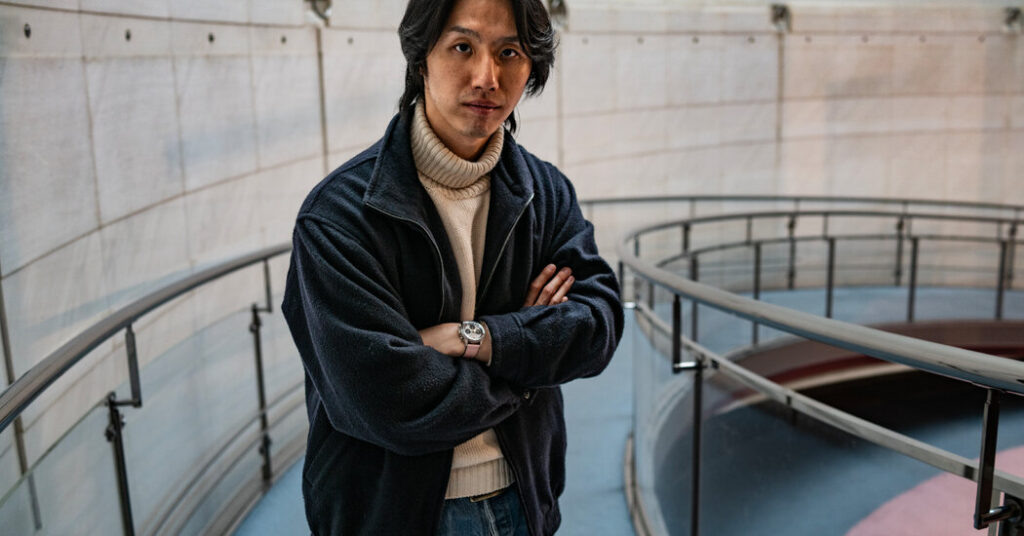
At Grill Bon in Tokyo’s Ginza district, Jay Liu, a watch collector, and I sat side by side at the counter, watching the staff as they assembled the restaurant’s signature deep-fried beef tenderloin cutlet sandwiches: lightly toasted white bread layered with sauce and meat, served with pickles and a side of salad. Mr. Liu gestured toward illustrations of Kabuki makeup styles on the wall. “Kabuki actors sometimes come here to eat,” he said, as his cuff shifted just enough to reveal a white gold Rolex Day-Date from the 1970s on his wrist.
He enjoys Kabuki, the traditional Japanese theater with its stylized movement and painted faces, even if he doesn’t fully understand what’s being said. “You can still appreciate the nuances,” he said — a word he returned to when talking about watches. Mr. Liu, 30, who lives in Hong Kong and travels regularly to Tokyo, was guiding me through some of his favorite spots in the city during a recent visit, sharing the watches that matter most to him along the way.
His interest in watches dates back to a visit he made about 12 years ago to an auction in New York, where he had gone to look at Chinese ceramics, but ended up in a space filled with vintage timepieces. Arranged alongside bowls and porcelain from the 1920s, ’30s and ’40s, the watches struck him differently. “I used to think of them as modern, luxury consumables, just things you could buy,” he said. “But seeing them presented next to antiques, you feel that they are also part of history. I immediately felt the connection.”
The Rolex Day-Date on his wrist is a case in point. “It’s a really meaningful one,” he said of the timepiece. A friend gave it to him after a trip they took together to Dubai. “At the end of the trip, he took off his watch and gifted it to me,” Mr. Liu said. “I was moved by this gift.”
Several years later, its meaning has only deepened. “If I could only keep one watch, this is the one I’d keep,” he said.
After lunch, we made our way to Aoyama, an area known for its designer boutiques, where Mr. Liu showed me the Spiral building, named for the ramp that coils through its interior. “It doesn’t look like much from the outside but once you step in, you realize it has such interesting structure inside,” he said. “It’s sort of like a very complicated mechanical watch.”
From there it was just a short walk to the concrete geometry of the Collezione building, which was designed by the Japanese architect Tadao Ando and houses the F.P. Journe boutique, among other retail spaces.
Along the way, Mr. Liu brought out another watch: a “Paul Newman” Rolex Daytona Ref. 6239 from the late 1960s with a panda dial. Mr. Liu has outfitted his with a pink Hermès leather strap. The original owner was Australian, he said, and this particular piece notably lacks luminous material on the hands and markers. “It’s a nuance I like, just like in Kabuki,” Mr. Liu said.
From Aoyama, we caught a taxi to Daikanyama, where leafy streets, galleries, design shops and bookstores give the area an artsy feel. At Daikanyama T-Site, a complex comprising a bookstore and cafes, he went directly to the watch books section. For Mr. Liu, collecting has always been tied to research. “I think you can never read too much about them,” he said of watches. “Especially if they’re vintage, there’s so much history.” He is particularly drawn to the stories behind each piece: how a model was made and the people involved in its design and production.
Mr. Liu said he learns a lot from talking to other collectors, including Auro Montanari, an Italian collector and author who uses the pseudonym John Goldberger.
“I was very impressed by his knowledge on vintage watches,” Mr. Montanari said by email of Mr. Liu, whom he first met in his city, Bologna, after exchanges on social media.
“He is a humble guy with a great passion for wristwatches and, in a short time, with great discipline, he built an interesting collection of rare and almost unique Patek Philippe watches,” Mr. Montanari continued. “He has a great eye and he is very focused on the quality and rarity of his timepieces.”
Upstairs from the bookstore, at Anjin Lounge, a dimly lit cafe lined with books, we settled at the bar. Mr. Liu placed a watch on the wooden counter, a Patek Philippe Ref. 96 from 1937, its sector dial signed by Hausmann & Co. and marked with what looked like splattered ink.
“I received it from my Patek Philippe mentor, a vintage specialist,” he said.
The watch, he had learned in the auction catalog, was originally given to a 7-year-old boy as a school enrollment gift. The marks, however, remain a mystery. “Either way, it became part of the history,” Mr. Liu said.
If watches are one of Mr. Liu’s obsessions, food is another. Lately, he said, he has been particularly taken with French toast, so we headed to Satsuki, a restaurant inside the Hotel New Otani Tokyo in Chiyoda, where he ordered without hesitation. The table quickly filled: brioche French toast and thick and fluffy pancakes, both served with strawberries, whipped cream and jam, as well as a neatly assembled melon shortcake.
To add to the assemblage, Mr. Liu brought out a Patek Philippe triangular watch from 1961 that was designed by Gilbert Albert. Only a handful were made, with some now held in museum collections. The watch reflects Mr. Liu’s interest in the people behind the pieces — designers whose names are often overshadowed by the brands they worked for.
Mr. Albert, who designed some of Patek Philippe’s most experimental watches in the 1950s and ’60s, was relatively unknown during his lifetime (he died in 2019). “We often forget the artist behind the brand,” Mr. Liu said. “We think it’s Patek Philippe’s job to do everything, but actually it was different people that spent a lot of time making this watch come into fruition.”
Recognition, he said, tends to come later, sometimes too late. “More often than not, we only realize how great the artist is after they pass.”
Mr. Liu had been discussing that very watch with a friend when, the following day, the friend sent Mr. Liu a message on Instagram: one had surfaced at auction. “We both wanted it,” he said. Instead of fighting over who should own it, they decided to buy it together and share it. “It’s like having a pet together,” he said.
For Mr. Liu, it’s another watch with another story. “I’m much happier to own it with a friend instead of just having it on my own.”
The post With Every Watch, He Collects a Story appeared first on New York Times.