On a chilly Saturday late last month, I met Eric Swalwell at a Little League diamond near Capitol Hill, where the Bay Area congressman and his wife, Brittany, would be watching their 8-year-old son. Swalwell, who was running to succeed Gavin Newsom as the next governor of California, had been gradually rising above a Lilliputian cast of candidates and had acquired a strong scent of momentum in the race.
“Impeccable timing for you,” he’d texted me on my drive over. He attached a just-published Washington Post article reporting that FBI Director Kash Patel was seeking to release files relating to a decade-old investigation into Swalwell that had turned up no evidence of wrongdoing. If true, the Post story presented a publicity godsend to Swalwell’s campaign, further elevating his status as a nemesis of the vindictive president.
The family-guy tableau of the Little League game felt consistent with the wholesome image that the campaign had been straining to project of late, for reasons that would become clear soon enough. Our interview occurred on the same weekend that Swalwell released a video of him and Brittany holding hands on a boardwalk stroll, while she called him a “really great dad” and a “really good husband.”
As we sat together in the bleachers, Swalwell introduced me to Brittany, dropped the names of his better-known endorsers, and referred to Nancy Pelosi as his “work mom.” He also mentioned Adam Schiff, his former House colleague, whose trajectory into statewide office Swalwell had watched closely. Like Schiff, Swalwell had become a ubiquitous antagonist of Donald Trump—about as good of a credential as any for leading the de facto capital of Blue America.
“I am the only candidate whose name the president knows,” Swalwell told me.
[Read: Donald Trump’s gift to Adam Schiff]
A few weeks later, a lot more people know Eric Swalwell’s name, which has now been stained immeasurably. He is leaving Congress; his campaign is over, probably his political career too; and the California governor’s race is even messier than the colossal fiasco it had been before.
Swalwell’s collapse has been sudden and swift, if not surprising. Recurrent talk of bad behavior toward women had trailed him around Washington for years, and proliferated as he approached front-runner status. Late last week, the rumors detonated: Multiple women, one of them a former staffer, accused him of sexual misconduct, including sexual assault, unwanted advances, and explicit Snapchat messages. Swalwell admitted to “mistakes in judgment” but denied the allegations and vowed to “fight” them. In short order, he has been met with multiple investigations, and instant pariah status. (I reached out to him after the accusations came out but did not hear back.)
The fact that Swalwell was, until recently, the Democrats’ leading candidate for governor is itself illustrative of the race writ large. Or, as far as the people still running, writ small. The glaring lack of candidate talent, political skill, and personal appeal—let alone star power—has been the defining quality of the race. Bigger names, such as Kamala Harris and Senator Alex Padilla, opted not to run. Newsom is term-limited. Jerry Brown is 88. George Clooney lives in France.
Beyond the perverse pull of watching such ineptitude on display, the main allure of this campaign is that it could produce the ultimate man-bites-dog political result: the election of a Trump-aligned Republican governor in this bluest of states, concurrent with a national election that could produce the bluest of waves. Such a monumental upset would not occur because the two GOP candidates—Riverside County Sheriff Chad Bianco and the British-bred commentator and strategist Steve Hilton—remind anyone of Ronald Reagan, Arnold Schwarzenegger, or any of the other larger-than-life Republicans in the party’s rich (if not recent) California tradition. Rather, a Republican win would represent an act of Democratic self-immolation, spectacular even by Team Donkey standards.
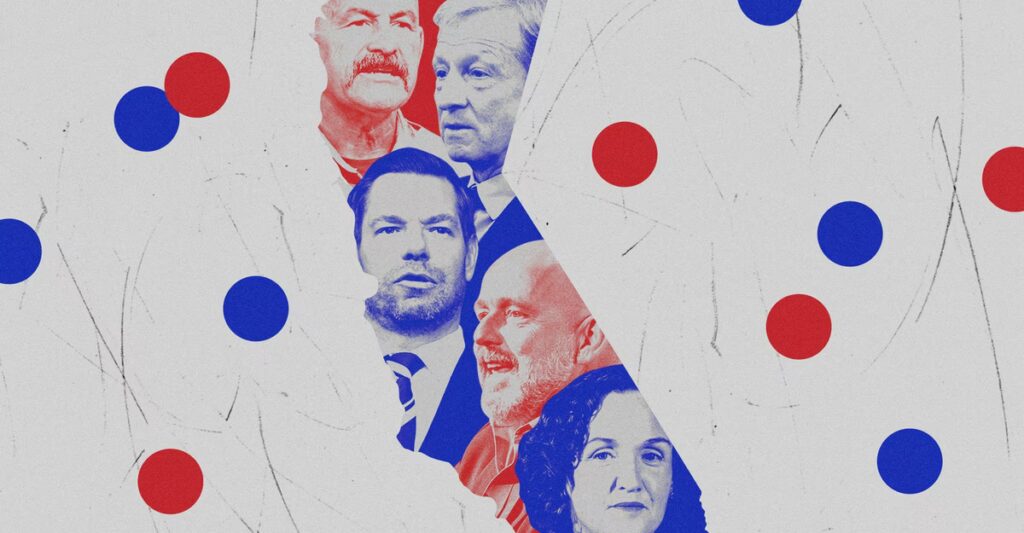
Here’s how the Democratic-lockout scenario could play out. California elections are winnowed through a so-called jungle primary, in which the top two finishers—regardless of party—advance to the general election in November. The current field has been crowded and stagnant for months, with eight major Democratic candidates (now seven). Until Swalwell dropped out, he, the billionaire investor Tom Steyer, and former Representative Katie Porter had each been polling in the low-to-mid teens. They were followed by a parade of single-digit laggards, including San Jose Mayor Matt Mahan, former Los Angeles Mayor Antonio Villaraigosa, and former California Attorney General and Health and Human Services Secretary Xavier Becerra. Hilton and Bianco, meanwhile, were polling in the mid-to-high teens through the first week of April. If no Democrat exceeds the others before the June 2 primary, the Republicans could finish first and second, guaranteeing a GOP victory in November.
A big part of the Democrats’ problem is that the party’s top tier, such as it is, consists of deeply flawed candidates, each encumbered with distinct personality impairments.
Steyer ran for president in 2020, burned through a ton of cash, went nowhere, and is now attempting to spend his way to Sacramento. He has already saturated the state’s airwaves with more than $130 million in ads, which may or may not be enough to buy him a modicum of personal appeal. His one viral moment of the campaign so far was not pretty: A local TV reporter asked him how he would grade Newsom’s two terms, and Steyer became flustered before muttering forth with the worst possible explanation: “I haven’t followed it closely enough to give him a grade.” The Steyer campaign declined to make him available for an interview.
Porter, an economic-populist gadfly in the fashion of Elizabeth Warren, became a social-media sensation during her years in the House. She wielded her signature whiteboard at congressional oversight committee hearings while making mush of CEOs and Trump-administration officials. Not all of her viral moments have been flattering, however. There was an infamous video last fall of Porter berating a news reporter while terminating a local television interview, and another from 2021 of her cursing out a staff member during a Zoom call (“get out of my fucking shot!”). Porter expressed regret over the videos, saying that she “could have been better in those moments.” A Porter spokesperson did not respond to multiple requests to interview the candidate.
Then there is—was—Swalwell, who at this point has graduated to his own special classification of toxicity. With his exit, the Democrats’ flailing field might be narrowed slightly, and perhaps improved by subtraction, but very much remains a bottleneck of B-listers.
At the end of March, I headed out to Los Angeles to better understand this predicament. My arrival coincided with a scheduled primary debate at the University of Southern California—which, naturally, would become a steaming debacle in its own right.
Not long after the debate was supposed to start, I found myself in a musty warehouse event space in Boyle Heights, just east of the Los Angeles River. Republican Chad Bianco’s campaign had decided to go ahead with a watch party, even though a slight wrench had been flung into the evening: The debate had been abruptly canceled the night before.
[Read: How Tom Steyer built the biggest political machine you’ve never heard of]
I’d attended many debate watch parties in my career, but never one with no debate to watch. Not only that, the candidate we were supposed to be watching was present at the party.
“It’s very disheartening, very disheartening,” Bianco told me as he mingled among roughly 60 guests. Bianco described the whiplash of his last 24 hours: After being canceled, the debate had been briefly resurrected, canceled again, and nearly resuscitated another time before finally being euthanized for good. He parked himself in a corner to talk with a few reporters. His wife, Denise, stood next to him.
“How are you supposed to do a watch party if there’s nothing to watch?” I asked Denise, as Ozzy Osbourne’s “Crazy Train” blared in the background.
“We’re celebrating!” she exclaimed.
“What are we celebrating?” I asked. “What are we watching?”
“We are watching Chad,” she said.
Chad looks like the sheriff he is: short-cropped hair, studded belt buckle, six-pointed-star badge, and an excellent mustache, which I complimented him on. “I know Steve wasn’t looking tough enough, so he grew a beard,” he said, referring to Hilton, his Republican rival. “He dresses like me now too. It’s kind of weird.”
“Are you guys friends?” I asked.
“No, I will never be friends with him,” Bianco told me. “He’s unethical and dishonest.” Bianco did not elaborate.
The non-debate debate at least provided a tidy distillation of this muddled campaign. The hosts—the USC Dornsife Center for the Political Future, KABC-TV Los Angeles, and Univision—had invited the five top-polling candidates and also a sixth, Mahan, even though he had been polling lower than many of the uninvited also-rans. This did not go over well among said uninvited also-rans. Villaraigosa and others pointed out that the Latino, Black, and Asian American candidates had all been excluded. Various activists, groups, and state lawmakers piled on. USC finally decided that the controversy was distracting “from the issues that matter to voters,” and the complainants declared victory. “We fought. We won! We stood up against an unfair candidate debate set-up,” Becerra wrote on X.
Another grievance about the debate was that Mike Murphy, the co-director of the Dornsife Center, is publicly supporting Mahan. Murphy told me that he is on leave from USC and had nothing to do with the event. The organizers, he explained, had faced a simple challenge: “How do you pare it down so it’s not a stupid circus?” Clumsily, in this case.
My basic approach to spending 72 hours in this stupid circus was to scramble around and visit with as many candidates and campaign-adjacent characters as I could. That included Murphy, a longtime Republican media strategist and raconteur, one of my all-time favorite campaign-adjacent characters. Murphy moved to Los Angeles in 2003, went full Never Trump, and has dabbled in screenwriting, podcasting, and TV punditry, as well as the odd Democratic campaign—i.e., Mahan’s. He invited me to a divey Chinese joint in the Palms neighborhood, Hu’s Szechwan, where he says he likes to keep office hours, like an old-school mayor in a back booth of a red-sauce Italian joint.
When I asked him to assess the candidates, Murphy wanted to make the point that they are all, figuratively, diminutive. But he was also aware that language sensitivities have heightened since, say, the 1980s, when pundits dismissed the Michael Dukakis–led field of Democratic presidential candidates as “the Seven Dwarfs.”
“I want to do a little-person joke without losing my career,” Murphy told me. “This thing is a Wizard of Oz wrap party,” he went on, not able to help himself.
He pivoted to safer rhetorical ground, noting that it’s near-impossible for candidates with little statewide name recognition to get traction in California, which is larger in size than Germany. “If you’re not famous or you don’t have a lot of money,” he said, “you’re a margin of error.”
Murphy believes that the Blue Armageddon result—both Republicans in the runoff—will not come to pass, a view that plenty of California politicos share. Their theory is that the Democrats idling in the margin-of-error lane will eventually start dropping out and rally around whoever the leading non-Republican is. But other than Swalwell, none of the remaining candidates has quit yet, and all of them make a similar argument: Voters are still not “tuned in” to the race, and those who are skew heavily to the undecided.
One candidate making that case is Murphy’s pick, Mahan, who in most polls sits in the low-to-mid-single digits. I met the boyish-looking, Harvard-educated mayor of San Jose at a café in downtown L.A. as he snacked his way through a plastic container of blueberries. Mahan, 43, entered the race late, at the end of January, after growing “incredibly frustrated with what the field was offering,” he told me. He has been trying to position himself as a results-oriented pragmatist who is not afraid to defy the party establishment, progressive groups, or Newsom himself.
“What I’m suggesting—no, not suggesting—what I’m arguing with conviction is that we have to demand that our government do better,” Mahan said. He has become a chic choice for Silicon Valley types, good-government centrists, and the national media—California’s straight analogue to Pete Buttigieg. Like Mayor Pete, Mahan exudes high-minded, data-driven sophistication, with that special dash of “aw shucks” they teach at Harvard.
[Read: Katie Porter is tired too]
“A Democrat who talks about math,” Mahan told me. “Imagine that!”
Okay, let’s talk about math. As in, what happens if the weeks go by and Mahan does not see any significant addition or multiplication in his polling? Would he drop out then to help his party? Mahan maintains that he likes his chances. Democrats will eventually consolidate, he said. Around him.
“I plan to be the one,” he said.
Funnily enough, that’s what a lot of the math-challenged candidates say. This includes Villaraigosa, the former Los Angeles mayor, whom I met at his office in a Wilshire Boulevard tower, a clear view of the Hollywood sign out his picture window.
Villaraigosa is undeniably credentialed; in addition to running the nation’s second-largest city for two terms, he was speaker of the California Assembly in the 1990s. But he has not held any office since 2013. In the governor’s race—his second campaign for the job—he has consistently polled in the single digits and struggled to gain traction.
“Why do you want to do this?” I asked him.
Villaraigosa launched into his origin story (“Mark, this state’s given me more than I could have ever hoped for”), his litany of when-I-was-mayor selling points (“more housing, more schools, more community colleges”), and his explanation for why a 73-year-old politician with a heavily antiquated aura could become the next governor.
People are hungry, he said, for a leader who can bring this most diverse, dynamic, and populous state in the country together. California, after all, has only ever had one nonwhite governor—in the 19th century.
“I was everybody’s mayor,” said Villaraigosa, who seems especially fond of that trope of politicians claiming honorary status in certain identity groups (such as when the poet Toni Morrison called Bill Clinton “the first Black president”).
“Jewish Journal called me the first Jewish mayor,” Villaraigosa boasted.
As best I can tell, this referred to a 2017 Jewish Journal article in which Villaraigosa identified himself as being “the Jewish major,” in addition to “the Muslim mayor” and “the Korean mayor.”
“I get introduced in the African American communities a lot of times as the second Black mayor,” he also told me.
I started to ask Villaraigosa whether he could be considered an Asian or gay mayor of Los Angeles, but he shot me a look, so I dropped it.
“You know the point I’m making,” he said. “I was a uniter.”
Unfortunately for Villaraigora, few California voters seem to be uniting around the first Jewish and second Black mayor of Los Angeles.
From Villaraigosa’s lair, I headed to the patio of a fancy-pants hotel in Pasadena for the next stop of my tour de farce: a meeting with Steve Hilton before he had to head off to a fundraiser.
“I want to have a pee,” he announced after he walked in and introduced himself. Lots of traffic en route, very relatable. I was supportive.
Hilton returned a minute later, and seemed immediately amused by his circumstance: a Brit on a big adventure across the pond, a Republican somehow atop the governor’s race in California. “I’ve been leading or second in most of the polls,” Hilton told me. “There was one where I was fourth,” he added, giggling, “which is obviously a fake poll.”
On this day, Hilton was cheerfully annoyed by the canceled USC debate, which he blamed on the “inevitable whining” of what he called “the LPDs.”
“The low-polling Democrats were jumping up and down, ‘Racism, racism!’” said Hilton. “My line has been, they weren’t excluded because of race, they’re excluded because they weren’t doing better in the race.” He was clearly pleased with his cleverness.
Hilton is a different breed of American candidate. But he’s spent much of his life around politics, mostly in England. He is an Oxford-educated provocateur who was a top aide to conservative U.K. Prime Minister David Cameron. He moved to the United States in 2012; his wife, Rachel Whetstone, a British communications executive, has held top jobs at a Mount Rushmore of Silicon Valley firms (Google, Netflix, Facebook, Uber). Still, Hilton has never held or even run for office.
I wondered aloud whether there had ever been a governor of a U.S. state with a British accent. “I don’t think so,” Hilton replied, though he invoked Schwarzenegger, who very much had an Austrian accent. Hilton also noted, for the record, that both of his parents are from Hungary. Therefore, he sometimes jokes that since the last Republican governor in California was from Austria, electing Hilton would be like California’s version of the Austro-Hungarian Empire.
“So, I say, ‘You’ve had the Austrian, now the Hungarian.’”
“That’s a great message!” I assured Hilton.
Hilton calls himself “a pragmatic kind of person” and insists that his “whole campaign is positive and practical.” His main theme is that California is an object lesson in how Democratic excess can ruin an otherwise glorious state. “You’ve had 16 years of one-party rule,” he said. “Are you happy with the way things are? The answer is going to be no.”
This could be a solid strategy, except for one thing: Donald Trump remains the dominant figure in American politics, including in California, where he is especially loathed by the general electorate. If Democrats can avoid the two-Republicans outcome and Hilton winds up facing a Democrat in November, his opponent will be relentless in trying to tie him to Trump. Hilton sometimes shifts into the language of the Fox News host he used to be, for example, promising to go “FULL DOGE” on California if given the chance. I kept asking him about the president and how MAGA Hilton considers himself to be. He kept ducking. “The whole Trump thing is just a ridiculous distraction from fixing California,” Hilton said. “I truly am not ideological.”
Hilton’s dilemma is that if he is too dismissive of the president pre-June, California Republicans and right-leaning independents—which includes a considerable pro-Trump contingent—could prefer Bianco, a much more unabashedly MAGA figure, with notes of extremism. Bianco was once a member of the Oath Keepers, the far-right anti-government group whose ranks were heavily represented at the Capitol on January 6, 2021. (After his affiliation became public in 2021, Bianco said that he had left the group years before.) More recently—March—he took the bizarre step of seizing 650,000 ballots from the state’s 2025 election in Riverside County, saying that he was going to “physically count the ballots and compare that result with the total votes reported.” California’s attorney general called Bianco’s gambit “unprecedented in both scope and scale,” and the state’s Supreme Court eventually ordered Bianco to shut it down.
The real goal of Bianco’s “investigation” was likely to flutter his eyelashes at a certain connoisseur of bogus election fraud, the one sitting in the White House. But to no avail. Trump gave Hilton his “COMPLETE & TOTAL ENDORSEMENT” on Truth Social last week, calling him a “truly fine man.” Hilton dutifully went on X and said he was “deeply honored.”
He was, in all likelihood, deeply ambivalent.
Against his party’s interest, Trump had given Republican voters a reason to rally behind one candidate, and thus create an opening for a Democrat to advance to November. But although Hilton jumped into the lead in most polls taken afterward, Bianco remains close to the front of the pack. California Republicans held their convention last weekend, and neither candidate had enough support to earn the party’s endorsement.
Hilton still looked to be enjoying the stupid circus. If nothing else, he struck me as a rare sanguine Republican on a ballot anywhere in America this year.
In the days since Swalwell’s demise, no clear consensus has arisen about who will benefit and who will not. If there’s one area of agreement, it’s that the race remains an underwhelming hodgepodge of half-weights, has-beens, and, oh yes, a billionaire.
Steyer, largely on the strength of his limitless ad budget, seems to have inherited at least some of the emerging Swalwell momentum. He’s picked up a few endorsements (the California Teachers Association, for example), drawn some big crowds at campaign events this week, and, for what it’s worth, replaced Swalwell as the darling of the prediction markets. Trump even attacked “SLEAZEBAG Tom Steyer” on Wednesday, which in 2026 is probably the best attention that a Democrat, even a free-spending billionaire, can buy.
It does not seem obvious, however, that more publicity will make voters’ hearts grow fonder of a self-funded hedge-fund magnate whose last vanity campaign, for president, spent $345 million and won zero delegates. Meanwhile, at least one poll conducted after Swalwell’s exit showed a continued logjam at the top: Hilton at 17 percent, with Bianco and Steyer tied at 14 percent. Beyond that, the survey’s most significant development was probably Becerra climbing to 10 percent (tied with Porter).
The job of California governor has changed significantly during the Trump years, becoming more national than ever. Trump’s repeated incursions into the state—sending the National Guard into Los Angeles, denying federal funding, even endorsing calls for Newsom’s arrest—are likely to persist in some form. California voters will want their governor to be a “fighter-protector,” Swalwell had told me, in better days for him. “They’re asking, Who’s going to step in and fill the role?”
[Read: The week that changed everything for Gavin Newsom]
The last California governor’s race I wrote about was the 2010 campaign to succeed Schwarzenegger. I remember asking Jerry Brown, the eventual winner, how he would rate Schwarzenegger’s performance. Brown surprised me with his answer, crediting his predecessor with “making the job of governor bigger.” Reagan, Brown said, had also “added size” to the position. His point—I think—was that, in such a boundless and targeted state, the personality and perceived stature of the person in charge seemed to count for more than they would elsewhere. That’s only become more true in Trump’s second term.
On Friday, I asked Newsom himself what advice he would give the next governor in dealing with the president. “You know, it’s interpersonal with Trump, that’s how it starts,” Newsom told me in a Zoom interview. He said he would encourage his successor to fly to Washington, try to build some rapport; Newsom guessed that Trump would be receptive, in part to spite the departed governor.
“So you take advantage of that, the fresh air,” Newsom said, adding that it won’t last. “You’re dealing with an invasive species.” Inevitably, the president will try to bully the next governor if he senses he can. “His superpower, from my perspective, is exploiting weakness,” Newsom said.
I took a shot at getting Newsom to assess the race, and whether he believed any of the candidates was better suited than the rest to repelling the invasive species. But this he was reluctant to do. “I don’t want to get into the merits or demerits of people as individuals,” he said. “I think all of them are remarkably qualified in their own unique ways”—except for Hilton and Bianco (the latter of whom he called “the guy who tried to take all those ballots”). The governor referred to the wannabe Democrats as “an extraordinarily well-versed group” and also “just an interesting field.”
Newsom insisted that he’s not getting involved, or favoring anyone just yet. Nor does he seem to believe that the pileup of Democrats—and the prospect that it could result in a Republican governor—constitutes an emergency just yet.
I asked Newsom if he would endorse a Democrat before the primary.
“Only in a break-the-glass scenario,” he said, not elaborating on what that was, or whether it was getting close.
*Illustration sources: Anjali Sharif-Paul / MediaNews Group / The Sun / Getty; Jeff Gentner / Getty; Kevin Dietsch / Getty; Ronaldo Bolaños / Los Angeles Times / Getty; Sarah Reingewirtz / MediaNews Group / Los Angeles Daily News / Getty.
The post The California Governor’s Race Is a Debacle appeared first on The Atlantic.