Times Insider explains who we are and what we do, and delivers behind-the-scenes insights into how our journalism comes together.
The movie “All the President’s Men” is the stuff of cub reporter dreams.
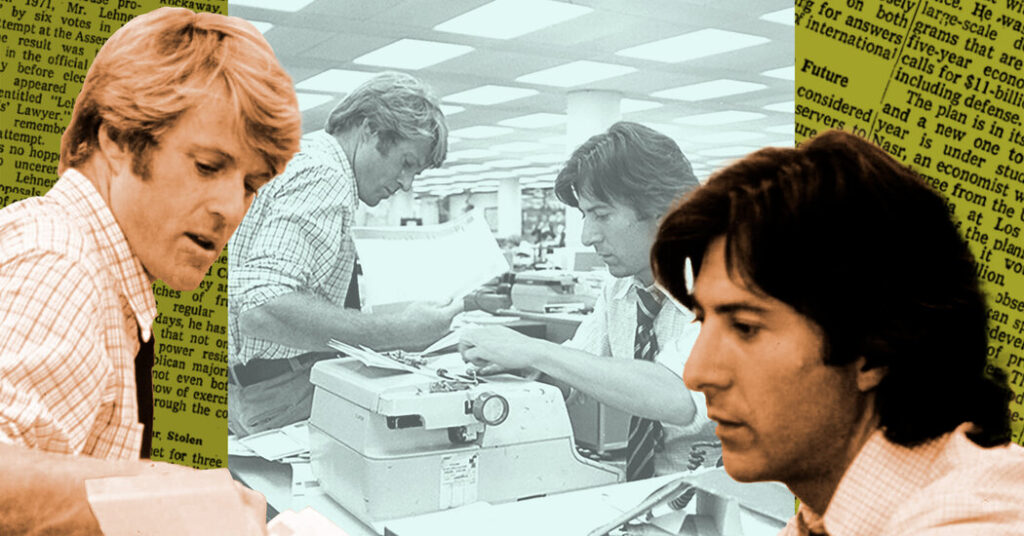
Just picture it: A dapper Robert Redford and a shaggy-haired Dustin Hoffman dash around the nation’s capital as the Washington Post journalists Bob Woodward and Carl Bernstein. They’re hot on the trail of the culprits behind the 1972 break-in at the Democratic National Committee headquarters at the Watergate complex.
The 1976 film, written by William Goldman and directed by Alan J. Pakula, was adapted from Mr. Woodward and Mr. Bernstein’s 1974 book of the same name. Watching their dogged pursuit of the truth has inspired generations of journalists to pursue the craft.
I’m among them. I first watched the film in my high school journalism class in Brownsburg, Ind., and then several more times in college. Each time, I was left with a sense of admiration for the reporters’ tenacity and the hope that, one day, I too might uncover a story that changes the world.
With the film celebrating its 50th anniversary this month, several New York Times journalists shared their own memories. Their reflections have been edited.
A.O. Scott, critic at large, the Book Review:
I saw “All The President’s Men” in the theater when it first came out. I was 10, and something of a Watergate obsessive. I knew all the names — Donald Segretti, Martha Mitchell, L. Patrick Gray — even if I couldn’t quite figure out what they were supposed to have done. The movie may not have made matters any clearer, but it had swearing, Robert Redford and typewriters, all of which were of great interest to me. It’s still my favorite newspaper movie.
Elizabeth Kennedy, White House editor:
There are so many great scenes and perfect details in this movie, it’s tempting just to list them off: the racket in the newsroom; those beautiful, clacking typewriters; the flag in the flowerpot; the local editor Harry Rosenfeld, who fought off the big shots from the National desk to keep his own reporters on the case; the parking garage; the “nondenial denials”; Woodward’s corduroy suit; those headlines at the end, especially the big one from Aug. 9, 1974: “NIXON RESIGNS.”
But the part that sticks with me most comes about halfway through the film, when Bernstein sits down with the bookkeeper in her home. This scene perfectly captures the utter desperation of a reporter trying to wrench information out of a source who won’t spill the beans.
Bernstein smiles and tries not to spook her. When he pulls out his notebook, he seems almost apologetic. “Don’t pay any attention, this is for my memory,” he says. He sucks down 20 cups of coffee just to keep her talking. He’s playing it cool, but any reporter in any era will know he’s just holding himself back from begging her, “Just tell me. Come on, tell me! TELL ME!!”
Adam Bernstein, deputy editor, Obituaries:
Before coming to The Times last year, I spent 26 years writing and editing obituaries at The Washington Post, and memorialized a variety of people with some connection to Watergate.
Of all the obits — from the burglars to the congressional investigators — my two favorites were the ones for Robert Redford and William Goldman. They were pivotal to transforming Woodward and Bernstein’s deadpan recitation of their shoe-leather Watergate reporting into a gripping thriller and cultural touchstone.
Redford was enraged by the scandal and bought the book rights. “This story was allegory, about a certain innocence that was corrupted by Watergate,” he later said. “Woodward and Bernstein personified the innocence.”
Initially, Goldman was skeptical of the book’s cinematic potential. “Politics were anathema at the box office, the material was talky, there was no action,” he noted. Taking an irreverent approach that served him well on “Butch Cassidy and the Sundance Kid,” he began with a “comic opera” of Nixon operatives bumbling with the wrong set of keys as they try to break into the Democratic National Committee’s Watergate headquarters.
Redford, appalled that the subversion of democracy was being played for laughs, reworked large parts of the script. He also cast himself as Woodward. But Goldman came up with the movie’s most celebrated line — “follow the money” — for the informant Deep Throat. The catchphrase, which was not in the book, entered the journalism profession’s lexicon.
Sophie Downes, editor, Metro:
To me, the Library of Congress scene is the perfect encapsulation of why this is one of the best journalism movies: It manages to romanticize the drudgery of reporting. A plea to a well-placed source produces a comically large number of documents that Woodward and Bernstein must then go through one by one.
The slowly ascending overhead shot of them sitting at a desk in the dimly lit rotunda, accompanied by the rustling of paper as they methodically turn every page, is not only a great piece of cinematography, but a reminder that many scoops are the result of sheer perseverance.
Jennifer Szalai, nonfiction critic, the Book Review:
A lot of people first watched “All the President’s Men” in high school, but I didn’t get to it until the early months of the pandemic, when my husband and I were looking for things to watch with our 11-year-old daughter.
She was rapt; as a thriller, the movie delivers. The red flag in the flowerpot, the secret communiqués slipped between the pages of the morning paper, the cranking up of classical music to fool any listening devices — the scenes with that old tradecraft stuff are great.
But what really stayed with me was the ending: Woodward and Bernstein hunched over their typewriters, while a TV in the newsroom shows a triumphant Nixon being sworn in for his second term. Then there’s the fade into a Teletype machine, with its relentless clickety-clack of headlines that would eventually end Nixon’s presidency, more than 18 months later.
Now that so much information seems to dissipate into the digital ether, there’s something deeply moving about watching the old-school Teletype move methodically across the page, getting the last word.
Sarah Bahr writes about culture and style for The Times.
The post ‘All the President’s Men’ at 50: Times Journalists Look Back appeared first on New York Times.