Last summer, Representative Joe Wilson, Republican of South Carolina, sat in his Capitol Hill office in rapt attention as Middle Eastern investors laid out their plans in a video call to develop coastal property in Syria.
A cruise ship port. A polo club. A Bugatti car showroom. A world-class golf course. All in a country that had just recently been torn apart by civil war.
Nor was this everything. While Mohamad Al-Khayyat, a powerful Syrian-born businessman, was pitching the proposal, his brothers were winning more than $12 billion in government-sponsored contracts to rebuild a wide swath of the devastated Syrian economy.
There was a hitch, though. The Khayyats needed a big favor from Congress with the support of President Trump: the permanent lifting of crippling sanctions imposed on Syria before the fall of President Bashar al-Assad in late 2024.
That is when Mr. Wilson, himself a former real estate lawyer and proponent of the sanctions repeal, offered a tactical suggestion.
“I know how to get the president’s attention,” Mr. Wilson said. “Make it a Trump National Golf Course in Syria.”
Mohamad Al-Khayyat was already a step ahead. He said he had planned to propose a Trump-branded resort.
At the same time, his two older brothers were negotiating an even bigger real estate partnership with Ivanka Trump, the president’s elder daughter, and Jared Kushner, her husband, to help them finance a multibillion-dollar resort in Albania.
Such a mixing of personal and diplomatic affairs has long been the norm in Middle Eastern nations, where a small set of players have historically run, and profited from, their dominant role in society. But it has become the way Washington operates in Mr. Trump’s second term, too.
Business discussions involving the president’s family, be it merely aspirational like the golf course or active like Mr. Kushner’s project, are consistently blurred with important policy decisions or consequential nation-to-nation negotiations.
It is also a sign of how powerful Mr. Trump has become. To get almost anything done in the nation’s capital requires not alienating a vexed and vengeful president, and, ideally, pleasing him.
Other presidents, both Democratic and Republican, have taken steps to avoid even the perception of a conflict of interest, while in Mr. Trump’s world it is almost the reverse. The family has been open that it intends to keep doing business deals around the world.
That has led to a warped system of executive patronage in which investors donate millions to the president’s pet projects, or invest alongside the Trump family, in hopes of achieving their policy goals, even if no explicit ask is ever made.
In fact, the White House and the Trump Organization assert that they were not aware of the proposed Trump golf resort for Syria, and the Trump Organization said that no discussions were underway.
And White House officials rejected any suggestion that Trump family-related real estate discussions had any impact on the president’s foreign policy choices related to Syria.
“President Trump performs his constitutional duties in an ethically sound manner and to suggest otherwise is either ill-informed or malicious,” David Warrington, the White House counsel, said in a statement.
The Khayyat family also said their financial partnership with Mr. Kushner was unrelated to the sanctions repeal effort.
Lawmakers on both sides of the aisle had favored lifting the sanctions, to enable Syria to draw the hundreds of billions of dollars that would be needed to repair the devastated country. Mr. Trump himself had been in favor of lifting them early in his current term, and did so temporarily last spring.
Still, some members of Congress were reluctant to repeal the legislation permanently without leverage, in case the new Syrian regime turned out as brutal as the old one had been.
The golf course proposal became part of a lobbying effort on Capitol Hill, a hint of how simply invoking the Trump brand has become politically advantageous to certain political causes.
Mohamad Al-Khayyat returned to Washington late last year toting a special stone celebrating the proposed golf course, carved with the Trump family emblem. He presented it to Mr. Wilson in his Capitol Hill office to deliver to the White House. Mr. Al-Khayyat then joined meetings with other lawmakers to push the sanctions repeal.
Weeks later, legislation for a permanent repeal won approval in Congress and was signed into law by Mr. Trump in late December.
Sharing Dreams
The Trump and Khayyat families came together at an Italian restaurant in Doha in 2022.
Ivanka Trump and Jared Kushner were in Qatar for World Cup soccer matches, and they dined at Carbone Doha, an extension of the New York City restaurant that sits on an island with a view of Doha’s impressive skyline.
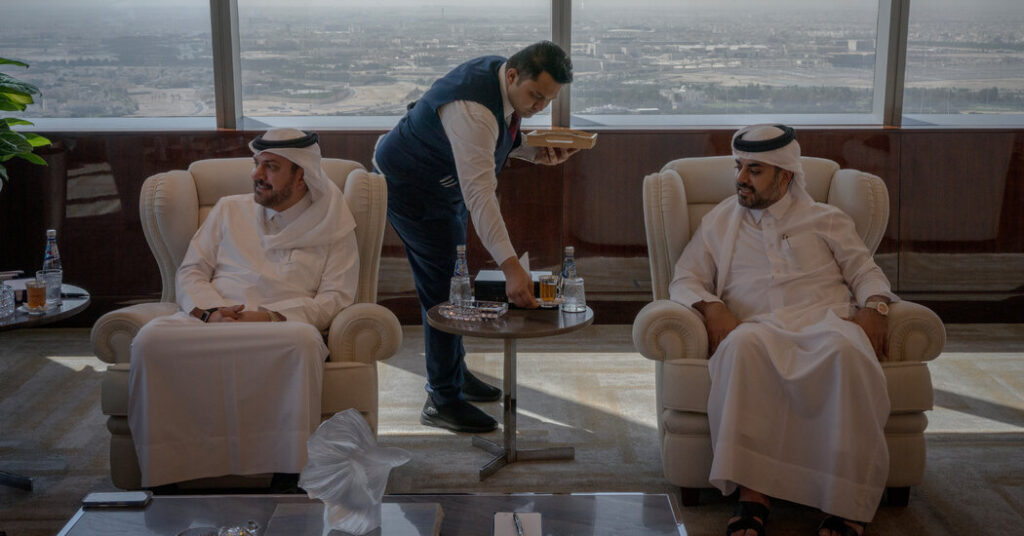
The restaurant’s owner worked his way over to meet the famous diners. It turned out that Ramez Al-Khayyat and his family owned not just Carbone Doha, but every restaurant along that street on an artificial island the family had built in just six months, at the request of the Qatari royal family, to create an entertainment zone for the World Cup.
Soon the Kushners and the Khayyats were sharing their histories as scions of real estate developers, along with their dreams for the future.
Mr. Kushner had recently tapped Middle Eastern sovereign wealth funds, including those from Qatar, to set up a $3 billion private equity firm after serving in the White House during Mr. Trump’s first term.
Now he had designs on building a multibillion-dollar resort on an island off the coast of Albania. Not too different from the one he was sitting on, in fact.
Ramez and his brothers had moved to Qatar full time in 2011. The Khayyats developed a relationship with the Qatari royal family, and built them a mountaintop vacation palace outside of Damascus.
It was one of several high-profile projects that had grabbed headlines for the family, including a wild episode when, after several neighboring countries imposed a blockade on Qatar in 2017, they flew in thousands of cows to supply milk and other dairy products to the small oil-rich nation.
Despite their success in Qatar, the Khayyats never gave up hopes of returning to Syria in some way.
A Change of Fortune
In late 2024, two monumental events changed the Khayyats’ fortunes and set them up for some globe-trotting: Mr. al-Assad was deposed, and Mr. Trump was returned to the presidency.
Weeks later, Ramez and his older brother, Moutaz, were on their way to Mr. Trump’s inauguration.
While in Washington for the festivities, the Khayyats engaged with the parents of Mr. Kushner. They also met Michael Boulos, the spouse of Tiffany Trump, the president’s younger daughter, as well as Mr. Boulos’s father, Massad Boulos, who had helped coordinate outreach to Syrian American voters during Mr. Trump’s re-election campaign, photographs posted on social media show.
“Amazing experience,” Ramez Al-Khayyat, 41, said, recalling the event and an inauguration dinner they attended, during a recent interview. “Once in a lifetime.”
Access to the candlelight dinner generally required a minimum donation of $250,000 for a pair of tickets. Ramez Al-Khayyat said that a number of foreign business executives were invited, and that he and his older brother had not paid for the invitation.
That same month, Khayyat family members flew to Damascus to visit with the new president of Syria. The president, Ahmed al-Sharaa, only weeks earlier had been a rebel leader with a $10 million antiterrorism bounty on him from the United States. Now he was in charge, but of a country in tatters. Much of its infrastructure needed to be rebuilt.
The Khayyat family was a natural pick to get these projects jump-started. “We’re ready to move, and we are ready to move fast,” Ramez Al-Khayyat said, recalling his message to the new Syrian leader.
An extraordinary string of deals in Syria emerged.
The Khayyats and their partners were granted a $4 billion deal to rebuild the decrepit airport into a Middle Eastern hub, and another $7 billion contract to build four natural gas-powered electric plants. They negotiated a third deal to work with U.S.-based Chevron to develop offshore natural gas drilling sites in the Mediterranean off the coast of Syria.
Thomas J. Barrack Jr., the president’s special envoy to Syria, has cheered along the Khayyat brothers, joining with them for each of these announcements, making it clear that the Trump administration supported the projects.
Ramez Al-Khayyat has also been buying up historic homes in Damascus’s old city, a UNESCO World Heritage site due to its status as one of the world’s oldest continuously inhabited cities, with plans to create a tourist destination.
Up the Syrian coast, Mohamad Al-Khayyat was working on his plan for the cruise ship terminal and resort where the Trump-branded golf course would be included, a project that would be built on land controlled by the Syrian government.
But there was a problem with each of these deals. They all hinged on getting the U.S. sanctions permanently repealed.
That is because international banks and other investors would not commit the capital needed to finance these efforts unless they could be assured that once the sanctions passed under the 2019 Caesar Syria Civilian Protection Act were repealed they could not be “snapped back” into place.
Named after a Syrian photographer who documented torture in Mr. al-Assad’s prisons, the act was not only severely restrictive on the country and its trading partners. It also mandated sanctions on those profiting off the Syrian conflict by engaging in reconstruction activities.
“We were all waiting for this minute for the sanctions to be lifted permanently, and it’s a great thing for Syria,” Ramez Al-Khayyat said.
Golf Course Diplomacy
The wooing of Congress began in the spring.
Free flights to Syria were being offered to some members of Congress.
Repealing the sanctions was broadly supported by Syrian American groups and some lawmakers. They argued the move would boost Syria’s recovery by encouraging more foreign investment now that Mr. al-Assad was gone.
A chunk of the heavy lifting in Washington was done by a Syrian American businessman, Tarek Naemo, a lifelong friend of Mohamad Al-Khayyat who acknowledged in an interview that he was working on the proposed Trump golf course project.
Mr. Naemo, who is based in Florida and runs an investment firm that he said had done deals with partners including the Qatari Investment Authority, began with his wife to court at least a dozen members of Congress, starting with Speaker Mike Johnson.
The access was facilitated by a series of campaign contributions, records show, by Mr. Naemo, his wife and others who were championing the cause.
Mr. Wilson, the South Carolina Republican, was a particular target. Mr. Naemo became a social partner for the lawmaker, joining with him to shoot skeet, catching up with him at the Omni Homestead Resort in Hot Springs, Va., and attending a Kennedy Center performance of “Les Misérables” with him and other Trump allies. (Mr. Trump also attended.)
By June 2025, Mr. Wilson had introduced legislation calling for the complete repeal of the Caesar Act sanctions.
The Biggest Obstacle
As this frenzy of lobbying moved ahead, there remained a major roadblock.
It was not, in fact, Mr. Trump. He was already sold.
In May, Mr. Trump temporarily lifted the sanctions after a meeting in Riyadh with Mr. al-Sharaa and Mohammed bin Salman, the Saudi ruling crown prince, who urged Mr. Trump to do so. The Saudis also want to be involved in the rebuilding of Syria.
But Syria, and investors like the Khayyats, still needed an act by Congress to make it permanent. And that is when they ran into a House lawmaker who emerged as the biggest obstacle.
Representative Brian Mast, Republican of Florida and the chairman of the House Foreign Affairs Committee, remained concerned that revoking all the sanctions against Syria could leave ethnic and religious minorities there vulnerable to continued persecution and slaughter.
The standoff came to a head on Nov. 9, the night before Mr. Trump was scheduled for a meeting with Mr. al-Sharaa — the first Syrian head of state visit to the White House since the country gained independence from France in 1946.
At the St. Regis Hotel, three blocks from the White House, Mr. Mast and other members of Congress, including Mr. Wilson, joined Mr. al-Sharaa for a private dinner.
It was an odd moment, recalled Senator Richard Blumenthal, Democrat of Connecticut, one of the attendees. After all, Mr. al-Sharaa was a former member of Al Qaeda in Iraq, directly targeting U.S. troops in Mosul two decades ago. Now he was asking for help.
Mr. Mast, a U.S. Army veteran who lost both of his legs in 2010 while serving as a bomb disposal technician in Afghanistan, was unsure if he could trust Mr. al-Sharaa, asking him at the dinner: “We are no longer enemies?” Mr. al-Sharaa responded that he wanted to “liberate” his nation from the past, Mr. Mast recalled at a House hearing in February.
No mention was made of the tie-ins to Trump family deals, Mr. Blumenthal said.
Mohamad Al-Khayyat and Mr. Naemo had returned to Washington, and were there at the hotel that night with a group of investors they were hoping would provide financing for their resort with the proposed Trump golf course.
After the bipartisan dinner with lawmakers, a second late-night meeting with Mr. Mast and Mr. al-Sharaa was hastily arranged that included Mr. Al-Khayyat and Mr. Naemo, participants in the meeting said.
By the end of the conversations that night, Mr. Mast had shifted his stance. He was prepared to support the sanctions repeal without a provision allowing them to be quickly reinstated.
He explained his revised view later that month when speaking from the House floor. “We are giving Syria a chance to chart a post-Assad future,” he said.
Aides to Mr. Mast said the tie-ins to the Trump family were not a factor in his decision.
Before leaving Washington, Mr. Al-Khayyat and Mr. Naemo presented the “foundation stone” for the proposed Trump golf course to Mr. Wilson and Representative Marlin Stutzman, Republican of Indiana. The framed stone, emblazoned with the words Trump International Golf Club, Syria, signified what Mr. Al-Khayyat called “an emblem of future American economical opportunities in Syria.”
The sanctions repeal was inserted into the must-pass piece of legislation that authorizes nearly $1 trillion in annual Pentagon spending, two pages inside a 1,260-page law.
Trump signed it on Dec. 18, 2025, almost exactly a year after the fall of Mr. al-Assad.
Deals Playing Out
Convoys of Russian troops routinely travel the local highway along the coast of northern Syria, on their way to a nearby air force base that Russia still controls. Not far away, there is a toppled statue of the former Syrian president Hafez al-Assad, father of Bashar al-Assad. One of the sculpture’s arms was broken off, and its giant face was planted in the mud.
Off the highway, at the edge of the Mediterranean Sea near the port city of Latakia, families grow cabbage, eggplants, grape leaves and other crops in one of Syria’s most fertile spots.
This is the site of the hoped-for Trump golf course.
It sits in the region the Assad family comes from, and many locals, including Bashar al-Assad and several of his relatives, are members of a religious minority known as Alawites. The Assad association explains in part why hundreds of area residents were massacred by bands of vigilantes last year in the weeks after his government fell.
There is little hard information here about the status of the planned resort that could feature the Trump family name.
But there are rumors among the local farmers, like Sinan Younis, 42, and his brothers, who have worked this land for decades even though they do not own the property. Farming supplies the only income for two dozen of their family members.
“What about us?” Mr. Younis wondered, as he and members of his family briefly paused from their task of planting eggplant seedlings one recent afternoon. “How could they take all this, for a reason like that? Why our land, the land that we live from?”
These questions only add to the tensions, as the family still lives in fear that there could be another wave of violence targeting them and fellow Alawites. The eggplant harvest last year had to wait because Mr. Younis said he had to use his farm truck to collect dead bodies of neighbors killed in the attacks.
Back in Washington, some members of Congress, including Mr. Mast, remain worried that Syria has not lived up to expectations after the sanctions were lifted.
“I don’t believe that any of us thought transitions from the dictator Bashar al-Assad to now Syrian President Ahmed al-Sharaa would be without incident,” Mr. Mast said in February at a House hearing examining recent progress in Syria. “But we’ve already seen too many incidents, in my opinion — too many incidents of sectarian violence against religious and ethnic minorities.”
But the leverage the United States had — the power to snap back the sanctions — is now gone, and getting Congress to reimpose them would be politically complicated.
Foreign money from investors like the Khayyats, meanwhile, continues to pour into Syria.
It is on display at the Damascus airport, where even as a war is now being waged elsewhere across the Middle East, a fleet of earth-moving machines are busy ripping apart what remains of a 1960s-era airport terminal for the Khayyats’ project.
In addition, Mohamad Al-Khayyat recently secured a license to serve as the exclusive importer of brands made by the American consumer products giant SC Johnson, such as Ziploc bags, Raid bug spray and Glade air fresheners, which could not be directly sold in Syria until the sanctions were repealed.
Separately, in Albania, Jared Kushner and Ivanka Trump’s mammoth seaside project is also moving apace.
At first the Khayyats were simply going to serve as a construction firm on the resort. But over the last year — when the sanctions lobbying was taking place — the negotiations have shifted, executives involved in the deal said. Mr. Kushner and the Khayyats have decided to become partners in the project.
Ivanka Trump traveled there in January to meet with Ramez Al-Khayyat for a gathering with architects and other executives to discuss potential designs. Edi Rama, the prime minister of Albania, showed up.
“We are investing in the holding in order to make sure that there is sufficient capital,” Ramez Al-Khayyat said. “So it’s a joint venture between the two companies, and actually we are managing it together.”
A spokesman for Mr. Kushner declined to comment.
There is also talk of the Khayyats joining with Mr. Kushner to do real estate projects in Syria, given that the Caesar sanctions are gone.
“He’s a great guy, and we try to do something great together,” Ramez Al-Khayyat said, referring to Mr. Kushner. “We are presenting many opportunities.”
Kitty Bennett and Julie Tate contributed research.
Eric Lipton is a Times investigative reporter, who digs into a broad range of topics from Pentagon spending to toxic chemicals.
The post Syrian Billionaires Needed a Favor in Washington. They Invoked the Trump Name. appeared first on New York Times.