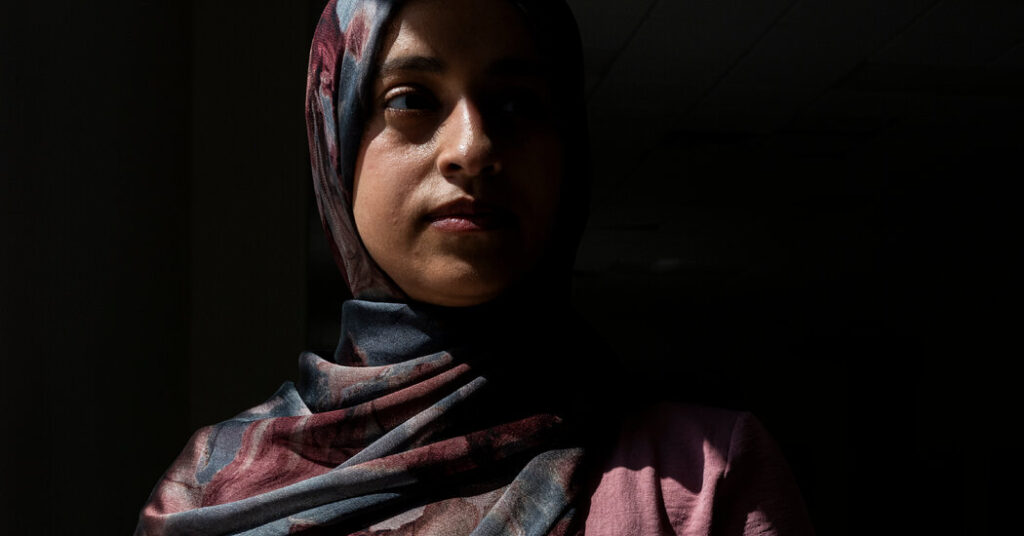
The young student in an emerald-green hijab spoke first, tumbling through the speech she had carefully practiced with her teacher. Her classmates followed, repeatedly explaining to state lawmakers in Tennessee why they felt a series of bills, many aimed at countering what Republicans see as the rising influence of Islam, was unjust.
Don’t require Tennessee to use the biblical term “Judea and Samaria” to refer to the occupied West Bank, they pleaded. Acknowledge both the Hamas-led attack on Oct. 7, 2023, and the violence that the Israeli military inflicted on Palestinians. Reject a bill that would require driver’s license exams be administered in English.
The day of lobbying this month in the State Capitol in Nashville attracted more than 100 Muslim students and community leaders hoping to counter a wave of anti-Muslim hostility not seen since the surge in hate after the Sept. 11, 2001, terrorist attacks. The rhetoric ticked up months ago, as some conservative politicians, deprived of chaos at the U.S.-Mexican border that had been a mainstay of Republican attacks during the Biden administration, shifted back to an old standby.
But with the U.S.-Israeli attack on Iran, that anti-Muslim rhetoric has crescendoed in the South. From the Carolinas to Florida to Texas, anti-Muslim sentiment has permeated state legislatures and political campaigns. Shariah — a term for traditional Islamic rules — has become a catchall for criticisms of Muslim culture and insinuations that those beliefs are incompatible with American society.
“Muslims are trying to Islamify Tennessee,” Representative Andy Ogles, a Tennessee Republican facing a surprisingly spirited Democratic challenge, wrote on social media this month, in one of dozens of such posts. “They want conquest.”
Despite representing most of Nashville’s Kurdish and Muslim residents, Mr. Ogles has said his Muslim constituents do not belong in the United States. He and another Republican House candidate in Tennessee, State Representative Johnny Garrett, have criticized student-led efforts in Nashville to accommodate and observe Ramadan, the holy month of fasting.
Representative Chip Roy, a Republican candidate for Texas attorney general, recently posted on social media, “No more Muslims.” Senator Tommy Tuberville, the Republican favored to become Alabama’s next governor, has issued a steady stream of anti-Muslim statements, including one referring to his state’s Muslim schools as “Islamic Indoctrination Centers.”
Representative Randy Fine’s comment that “the choice between dogs and Muslims is not a difficult one” prompted calls for the Florida Republican’s resignation. Representatives Nancy Mace and Ralph Norman, both Republicans running for governor in South Carolina, have also vowed to ban “Sharia,” joining dozens of House Republicans.
“It seems like there is now a shift — that the rhetoric used is OK, it’s not a fringe idea,” said Abdulkareem Omer, 29, a North Carolina-based immigration lawyer, who described a persistent fear among many of his clients who came to the United States as refugees.
The number of Muslim Americans in the South has grown over the last two decades, with many drawn to economic opportunity and family and friends who were already there. Many scoff at the demands that they leave after spending their formative years in the United States and embracing the constitutional freedoms that allow them to practice their faith.
The first mosque in northwestern Mississippi recently broke ground after rounds of litigation. Islamic schools have sought to participate in Southern states’ expansive programs that offer vouchers for private-school tuition. And in Nashville, voters in recent years have elected both a Muslim councilwoman and a Muslim school board member.
For some Muslims, the number of Christian, Jewish or atheist residents reaching out to learn about Muslim traditions offers hope that they can counter stereotypes or distortions. In some communities, they have become welcomed neighbors, as they have built food pantries and invested in community infrastructure.
Community involvement “shows my humanity, and it reaches people who might only have been reached through art and through music,” said Mo Sabri, a Muslim country music artist from East Tennessee.
Mr. Sabri’s debut performance with the Nashville Symphony, long planned for May, will be a first for a Muslim country artist, and has taken on deeper personal significance after Mr. Ogles’s comments, he said.
“People have gotten to get to know the reality of Muslims,” he said, “and that we’re just as American.”
The growing presence of Muslims in public life has given some Republican politicians an opening to stoke fears about Islam, as Christian nationalism takes hold in parts of the South. Some imams and other community leaders remain wary about publicly opposing the comments, worried that drawing attention to them will worsen the backlash.
There is a bitter exhaustion among some Muslim Southerners, who feel the need to explain and justify their faith, even if they were born in the United States or have become naturalized citizens.
“Will this be my life of anxiety?” asked Amal Altareb, a Yemeni American who moved to Memphis in 2012 and now works with organizations of other faiths. The optimistic part of her wonders “if some of these people are movable,” she said. Her pessimistic side fears that a targeted agenda will persist.
Some Muslim voters said they had initially sided with the Republican Party and its policy positions, including longstanding support for traditional family values and limits on government involvement in individual lives. But the anti-Muslim rhetoric has pushed some away in recent years.
“I don’t have a real political home,” said Hani Nofal, 33, a former submarine officer, who returned to Nashville to live with his family after leaving the Navy in 2025. He has still tried to make inroads with conservatives in the city and state government.
“It’s just this balancing act of trying to convince someone of the humanity of a certain group of people, using yourself as an example” without straining credibility, he said.
At the State Capitol, Fares Elkhayyat and his wife, Anna Lim, said they had made the three-hour drive to lobby on behalf of the Muslim American community for the first time. They held folders with notes about the legislation. Kaffiyeh scarves looped around their shoulders.
Mr. Elkhayyat, who is Palestinian American, and Ms. Lim, who converted to Islam two years ago, said the aspersions hurled at Islamic principles led them to dive deeper into the Quran. A deeper understanding of the Muslim holy book strengthened their faith.
Mr. Elkhayyat, 27, is now better equipped to counter some of the anti-Muslim rhetoric, he said.
“We know when politicians do this kind of stuff, it is a scapegoating technique,” he said. “Nobody in my community is radical.”
As for the legislation that they had come to lobby against, at least two of the measures passed. The driver’s license bill remains under consideration.
Emily Cochrane is a national reporter for The Times covering the American South, based in Nashville.
The post Muslim Southerners Face a Fresh Wave of Hateful Political Rhetoric appeared first on New York Times.