This article is part of our Design special report previewing Milan Design Week.
The island of Murano is, famously, an impenetrable place. Home to Venetian glassmaking since the 13th century, it greets newcomers — usually meaning anyone whose family arrived in the past century — with a wary eye.
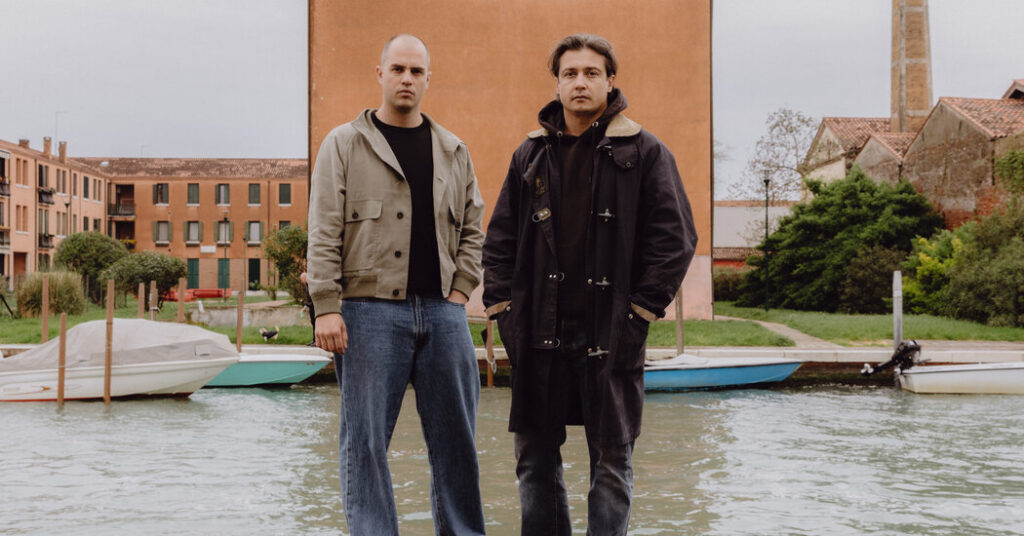
“Murano was always a mystery,” said the designer Edoardo Pandolfo, who founded, with the architect and designer Francesco Palù, the glass brand 6:AM. “Even as a Venetian myself, it felt so far away. It was impossible to get there. Nobody ever answered the phone.”
Based in Milan, Mr. Pandolfo and Mr. Palù create custom Murano glass installations for companies, architects and interior designers, while producing their own furniture, lighting and objects. They had a banner 2025 with their Design Week installation “Two-Fold Silence,” set in the abandoned showers of a Rationalist-style Milanese swimming complex, followed by a collaboration with the Italian fashion house Bottega Veneta for its spring/summer 2026 collection. This year, they are embarking on their most ambitious project yet: a large-scale installation, “Over and Over and Over and Over,” in the cavernous spaces of Piscina Guido Romano — another early-20th-century swimming complex.
It is a watershed moment for a company that began almost by accident. Mr. Pandolfo and Mr. Palù met in 2015 while producing custom projects for the Milanese architect Andrea Caputo, at his erstwhile Plusdesign gallery. “The job was a lot of cold calling craftspeople, asking them to take on projects with a very low budget,” Mr. Pandolfo recalled.
After leaving Mr. Caputo and going their separate ways, they met occasionally over beers at a pub in Milan’s Chinatown. During one of those meetings, Mr. Palù described the difficulty at his new job of extracting a custom chandelier from a Murano supplier. “Every day it was a new excuse — my grandma is sick, my dog died,” he recalled. “He just didn’t want to make it.” With confidence born of his Venetian roots and tender age (he was then in his early 20s), Mr. Pandolfo insisted that he could manage the project, even though he knew nothing about glass.
“The next morning I woke up and began calling everyone I knew,” he recalled. He found a more reliable craftsman through a family contact and helped to deliver a tiered chandelier made of rocklike chunks of glass in time for a January 2017 installation. The project was a success, and similar commissions followed.
At first, the endeavor was largely a hobby. “We were earning a bit of money, but mostly these impossible missions were a fun thing to do,” Mr. Pandolfo said. Early on, the prickly Murano artisans insisted on meeting first thing in the morning, before their regular clients arrived, which meant the men had to leave Milan the night before and wake at 4 a.m. in Venice to reach the island by 5:30 — boarding the vaporetto on the Grand Canal in the dark, with mist still clinging to the surface of the lagoon. The experience eventually inspired the brand’s name, 6:AM.
A turning point came in 2018, when they met the film-director-turned-designer Luca Guadagnino, who was designing an Aesop shop in Rome. At the time, Mr. Pandolfo was producing events for a book publisher. “On my last day, my boss gave me an unreleased copy of a book about the glass work of the Rationalist architect Tomaso Buzzi,” he recalled. “When we met Guadagnino, the first thing he said was that his reference was Buzzi. When I pulled out that book, he was stunned.”
Mr. Guadagnino commissioned goblets, a chandelier and a vase inspired by Buzzi’s work for the glassmaker Venini, followed by a lighting system for a New York City shop: a gridded network of 14,000 glass pieces arranged like a coffered ceiling in a Gothic palace. “We were the only ones who would have agreed to something so ambitious,” Mr. Palù said “An established firm would have said no — or charged 10 times the price.”
Murano has long supported a network of intermediaries who connect designers, producers and artisans. Where Mr. Palù and Mr. Pandolfo differ is in their willingness to improvise. “We had a punk attitude,” Mr. Palù said, recalling how they would substitute costly premade molds with stacked bricks. “We would go to the furnace just to watch,” Mr. Pandolfo added. “We needed to understand how the glassblowers worked, so as not to waste the one hour we could afford.”
Working with Murano glass is expensive owing to both the training required to become a master — the process takes decades — and rising fuel costs. A single hour of furnace time can cost upward of 600 euros (about $700), a significant investment for those still learning the material’s complexities.
After the collaboration with Mr. Guadagnino, the pair began contacting potential clients. “I found Hannes Peer’s phone number and called him out of the blue,” Mr. Palù said, referring to the Milan-based South Tyrolean architect and designer.
In a recent interview, Mr. Peer, the son of a glass artist, Ursula Huber, recalled being skeptical. “For me, glass has an incredibly deep meaning,” he said. “I wanted to know if these guys had done their homework.”
Something in their approach convinced him. “Just before they were about to leave, I held them back and said, ‘What do you think of doing a large-scale, modular chandelier?’” he said. “We sat down and for the next eight hours worked through the technical feasibility.” The result was the Paysage chandelier, a cluster of textured cast-glass rectangles forming an undulating cloud. “Two months later, it was hanging in my studio,” Mr. Peer said.
In his view, 6:AM is an unlikely success story in a place as insular as Murano, where seniority and tradition often take precedence over youth and new ideas. “You have to be courageous to keep going,” he said.
By the 2025 Milan Design Week, 6:AM was producing its own collections while completing commissions around the world. But growth brought new pressures. “Suddenly we needed more people, a bigger office, a new warehouse,” Mr. Pandolfo said. “We were about to reach a tipping point, which is where many companies fail.”
At that critical moment, Louise Trotter, Bottega Veneta’s creative director, commissioned 6:AM to develop seating for the spring/summer 2026 runway show. The blown-glass stools, known as Batch, are made in textured cast-iron molds and have a surface resembling rough water frozen into a transparent cube. They quickly spread across social media. “From that point, everything changed,” Mr. Pandolfo said. “Just by being associated with Bottega, the desirability of our products skyrocketed.”
The success has allowed 6:AM to invest in more ambitious work, much of which was introduced on Sunday in the installation at Piscina Guido Romano.
“We’re creating products at an architectural scale,” Mr. Palù said, describing large-format panels of black glass developed with Mr. Peer as an extension of the Paysage system. Also on view are Lego-like modules made from production off-cuts of 6:AM’s Palo Santo incense burners; cast-glass panes with a rippled texture; new versions of its Quadrato sconces in screen-printed, color-blocked glass; and a towering, Tetris-like wall of Batch stools reaching the complex’s barrel-vaulted ceiling.
They have also invited a rotating lineup of chefs to take over a garden kiosk outside the installation. Like much of what they do, Mr. Pandolfo said, it comes down to relationships. “Working with Murano glass and its artisans is not only about skill. Of course, it’s their hands that make the piece. But if they like you, their hands move a bit better.”
The post How Two Men with Hard Heads Broke Through Murano’s Glass Ceiling appeared first on New York Times.