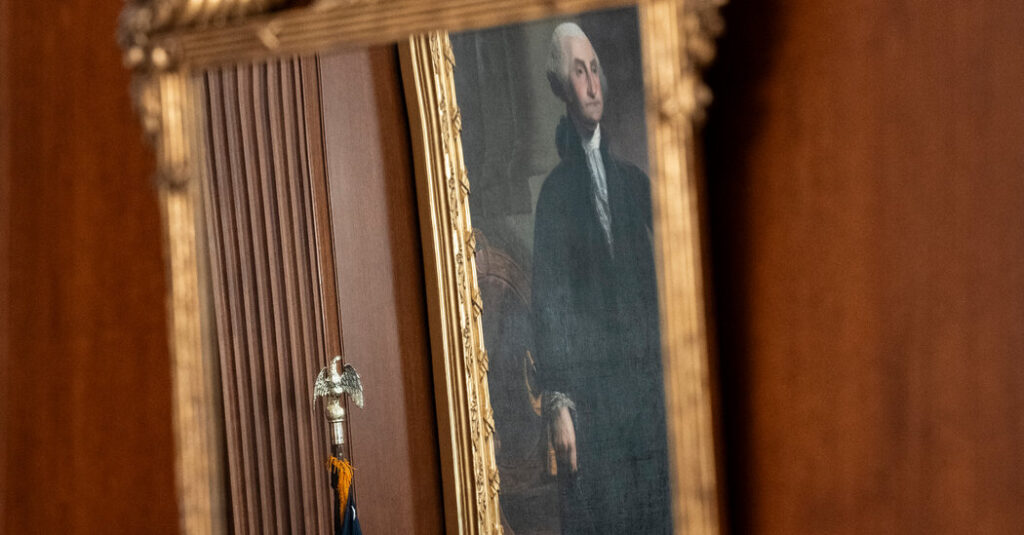
George Washington’s presidency is known best for being the first, and then for establishing the tradition that presidents limit themselves to two terms. This standard held informally until Franklin Roosevelt was elected a third time in 1940, and a fourth in 1944, after which it was written into the Constitution as the 22nd Amendment.
In the 250th year of American independence, Washington is still applauded for preserving America from lifetime presidents.
That wasn’t his intention. The preservation Washington was most interested in was of his equanimity and reputation. Political office was driving him mad. He was being mocked in the press. He couldn’t get out fast enough.
Washington hadn’t sought the presidency. He knew his gifts lay outside politics. Obligation had inspired his service in the Virginia House of Burgesses and the Continental Congress before the Revolutionary War. Military command in the war, and the victory his army attained, won him all the honor he desired. When he relinquished his command at the end of the war, he did so with the intention of living out his years privately at Mount Vernon.
But James Madison, desperate for the imprimatur of America’s pre-eminent figure, talked Washington into attending the Constitutional Convention in Philadelphia in 1787. He was elected president of the convention, and as president he endorsed the finished product in a letter to the states urging ratification. “We kept steadily in our view that which appears to us the greatest interest of every true American: the consolidation of our Union, in which is involved our prosperity, felicity, safety — perhaps our national existence,” he wrote .
After proclaiming the new government vital to America’s future, Washington was in no position to resist the pleas of Madison, Alexander Hamilton and nearly every other supporter of the Constitution that he accept the presidency upon its ratification. His dignity and renown would, they said, lend needed weight to the new government.
Yet Washington wished he could refuse. “You are among the small number of those who know my invincible attachment to domestic life, and that my sincerest wish is to continue in the enjoyment of it, solely, until my final hour,” he wrote to a friend. But he feared he would be seen as shirking his duty. “Might I not, after the declarations I have made (and Heaven knows they were made in the sincerity of my heart), in the judgment of the impartial world and of posterity be chargeable with levity and inconsistency?”
He didn’t refuse. In America’s first presidential election, he received a vote from every elector. (Each elector then had two votes. The second ballots were split, with John Adams receiving the most and thereby becoming vice president.)
But his diffidence persisted. In his Inaugural Address, Washington reiterated that he hadn’t sought the position he now assumed. “No event could have filled me with greater anxieties,” he said, referring to his election. He was sure his reputation would suffer in a job that “could not but overwhelm with despondence one who (inheriting inferior endowments from nature and unpracticed in the duties of civil administration) ought to be peculiarly conscious of his own deficiencies.”
Washington generally deferred to Congress on lawmaking. He respected that the Constitution’s first and longest article gave precedence to the legislative branch. The executive branch came second, with the president principally enjoined to “take care that the laws be faithfully executed.” Such initiative as the executive assumed was chiefly the work of Alexander Hamilton, the Treasury secretary, who proposed measures relating to debt and finance.
Washington intended to retire as soon as he could do so without insulting the Constitution or the American people. His intention only increased as political rancor infected his own cabinet. Thomas Jefferson, the secretary of state, disagreed with Hamilton on nearly every issue.
Washington laid plans to depart at the end of his first term. He enlisted James Madison to draft a farewell address.
Jefferson and Hamilton intervened. While differing on everything else, they concurred that Washington mustn’t leave office yet. If Washington left now, Jefferson said, the government might fall to pieces. Washington’s life’s work would be undone. “I am perfectly aware of the oppression under which your present office lays your mind, and of the ardor with which you pant for retirement to domestic life,” Jefferson assured Washington. “But there is sometimes an eminence of character on which society have such peculiar claims as to control the predilection of the individual for a particular walk of happiness and restrain him to that alone arising from the present and future benedictions of mankind. This seems to be your condition, and the law imposed on you by Providence in forming your character.”
Hamilton told Washington he had sounded the opinions of eminent persons about the effect of Washington’s declining a second term. “The impression is uniform — that your declining would be to be deplored as the greatest evil that could befall the country at the present juncture,” Hamilton wrote. He acknowledged the sacrifices Washington had already made for America’s welfare. The country required a bit more. “I trust, sir, and I pray God that you will determine to make a further sacrifice of your tranquillity and happiness to the public good.”
Washington let himself be persuaded. He was re-elected as decisively as he’d been elected the first time.
He soon wished he hadn’t. The fractiousness between Hamilton and Jefferson got worse, to the point where the two secretaries left the administration and began to wage their fight in the open. The political factions of Washington’s early presidency became full-blown parties. Each side enlisted journalists to tout its accomplishments and condemn those of the other side.
Washington refused to identify with either party, but he was closer to Hamilton’s Federalists than to Jefferson’s Republicans. As a result, the Republican press attacked Washington for failing to curb the creeping monarchism the Republicans detected in the Federalists. Nothing escaped scrutiny. After a public celebration of Washington’s birthday, the National Gazette inquired balefully: “Who will deny that the celebrating of birthdays is not a striking feature of royalty? We hear of no such thing during the republic of Rome. Even Cincinnatus, now consigned to immortal fame” — and to whom Washington was endlessly likened — “received no adulation of this kind.”
Washington had worried that entering politics would sully the reputation he had won on the field of battle. As his worries came true, amid partisanship he couldn’t abide, he resolved to shake the dust of politics from his feet forever.
He summoned Hamilton and asked him to rework Madison’s farewell draft. In a message published in September 1796, Washington announced his decision to retire. And he warned the country against the very partisanship that was driving him from office.
Eventually Washington’s decision to retire after two terms would be seen as evidence of his concern for the country. Objectively his self-denial had that effect, keeping the presidency from becoming an office for life.
But John Adams understood Washington’s true motivation. Adams won the 1796 election, and Washington attended his inauguration. Adams thought his predecessor looked unusually happy. “He seemed to enjoy a triumph over me,” Adams recorded. “Methought I heard him think, Ay! I am fairly out and you fairly in! See which of us will be happiest.”
H.W. Brands is a professor of history at the University of Texas at Austin.
The Times is committed to publishing a diversity of letters to the editor. We’d like to hear what you think about this or any of our articles. Here are some tips. And here’s our email: [email protected].
Follow the New York Times Opinion section on Facebook, Instagram, TikTok, Bluesky, WhatsApp and Threads.
The post George Washington Understood the Perils of the Office appeared first on New York Times.