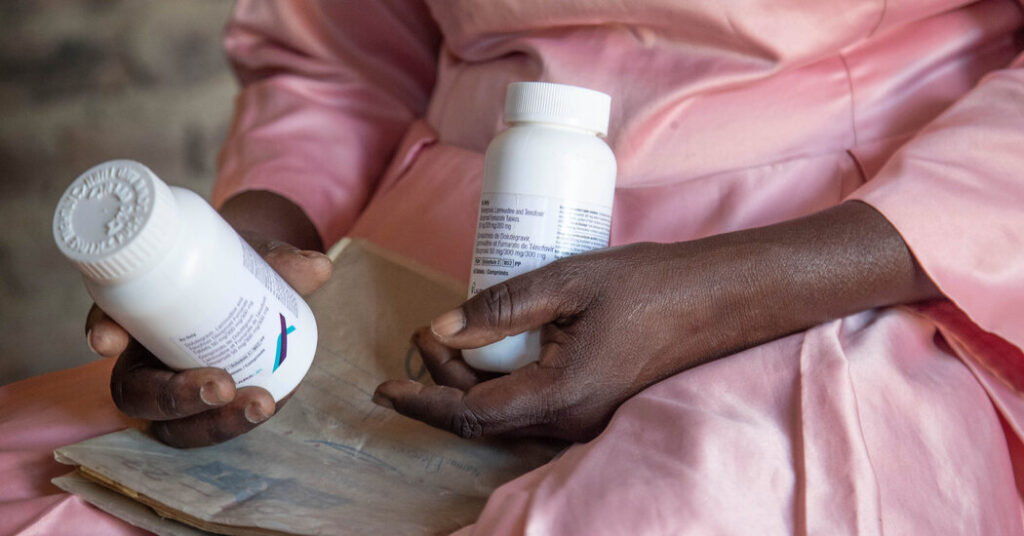
The United States-funded H.I.V. program that is credited with saving 26 million lives worldwide suffered big blows to its impact after the Trump administration’s abrupt stop and restart of its activities last year, according to the first tranche of data from the program since 2024.
Overall, the President’s Emergency Plan for AIDS Relief, or PEPFAR, treated about as many people in the last quarter of 2025 as in the same period in 2024, according to a report released on Friday by the State Department.
Jeremy Lewin, acting under secretary of state for foreign assistance, humanitarian affairs and religious freedom, framed the report as a victory, saying at a conference this week that “the numbers are very, very good.”
But the data showed sharp decreases in the numbers of people newly tested, diagnosed and treated for H.I.V., declines that will have long-term consequences, several public health experts and patient advocates warned.
In the last quarter of 2025, PEPFAR supported testing for 17.2 million people, a steep drop from the 21.9 million people tested in the same period in 2024. Diagnoses also fell, to 307,000 from 385,000, a predictable consequence of less testing.
The numbers also showed a worrying drop in treatment of infants with H.I.V., who tend to become ill rapidly and die.
The situation may not be as dire as many experts had feared in the weeks after the Trump administration froze all foreign aid, but it is nevertheless grim, said Charles Kenny, an economist at the Center for Global Development who analyzed a subset of the data that were briefly available online before being taken down.
“The long-term trajectory could be back to as depressing as I thought it was going to be last year,” he said. “I’m still really scared.”
The new numbers are consistent with a separate report in November from the Clinton Health Access Initiative. Concluding that “recovery is limited and uneven,” that report found a drop of 22 percent in new H.I.V. diagnoses in the first half of 2025, and 20 percent in the diagnosis of infants. The number of people taking oral pills to prevent H.I.V. fell by 37 percent.
President George W. Bush started PEPFAR in January 2003, when treatment for H.I.V. was unavailable in many parts of the world. The program began providing antiretroviral drugs to people in Africa in 2004, with an initial goal of treating two million people with H.I.V. over five years.
With broad bipartisan support, it soon became the most successful endeavor of its kind, helping to treat millions of people in more than 50 countries, many of them in Africa.
But last year, the Trump administration sought to reshape it, saying low-income nations must end their dependence on the United States and take on more of the onus of ending H.I.V. among their citizens.
The administration initially instructed organizations in other countries to stop disbursing H.I.V. medications purchased with PEPFAR aid, even if the drugs had already been obtained and were sitting in local clinics.
It later allowed H.I.V. testing and treatment to resume, but the freeze ruptured the web of organizations that deliver treatment and services in low-income nations. Some public health experts worried that the disruptions could cost millions of lives.
The numbers released Friday offer a slightly more optimistic picture, one that some advocates said was at least as much because of workers who continued to care for their communities without pay and countries stepping up to plug the gaps as the resumption of the program.
But, delivering medicines is only part of the fight against H.I.V. Ending the epidemic requires outreach to young girls and women; men who have sex with men; and drug users, who are at high risk and yet often have the least access to preventive tools and care, Dr. Kenny and others said.
“What these data show us is the deliberate unraveling of the elements of H.I.V. prevention and treatment service delivery that are essential to actually finish the job and defeat this pandemic,” said Asia Russell, executive director of the advocacy group Health GAP.
The administration is moving away from disease-specific programs like PEPFAR entirely, instead structuring foreign aid as bilateral agreements with governments, often with strings attached.
The report shows “important shifts towards country self-reliance” — a cornerstone of the Trump administration’s foreign aid policy — the State Department said in a release. About three million people received support through national governments rather than from nongovernmental organizations.
The budget office has also withheld funds from the Centers for Disease Control and Prevention, an implementing agency of PEPFAR that has provided treatment to more than half of the recipients.
More than 75 percent of PEPFAR’s treatment sites are owned and primarily operated by government health ministries, so they may have been better able to withstand disruptions to the program than clinics that rely solely on PEPFAR funds, said Brian Honermann, deputy director for public policy at the charity amfAR.
“The vast majority of patients have long-term relationships with their clinics for treatment,” he said. “That’s not where we would expect to see immediate disruptions.”
Dr. Kenny noted that the State Department said it was releasing data from only the last quarter of 2025 because of program interruptions and reporting challenges. “I think that probably means that their Q4 results are better than what we would have seen in previous quarters,” he said.
The data released on Friday were not vetted by nongovernmental partner organizations as they normally would have been, and are not detailed enough for thorough analyses based on the age, sex or geographic location of those being treated, Ms. Russell said.
“We have to understand the epidemics they’re actually addressing, and the current treatment cohort tells one very small part of that story,” she said. “We need more information flowing quarterly, completely and open to the public.”
Apoorva Mandavilli reports on science and global health for The Times, with a focus on infectious diseases and pandemics and the public health agencies that try to manage them.
The post New PEPFAR Data Show Worrying Declines in Testing and Treatment for H.I.V. appeared first on New York Times.