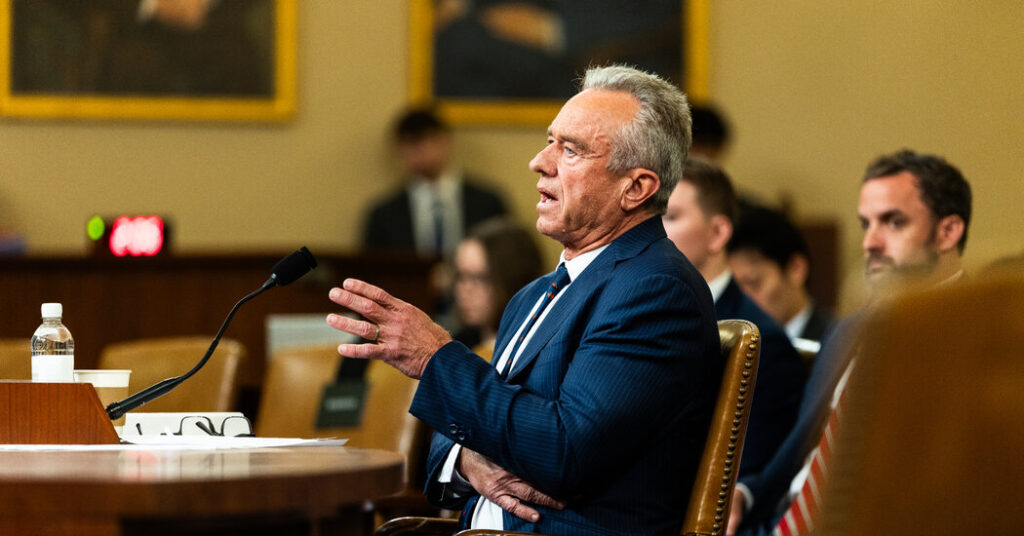
Over two dizzying days in Washington this week, Health Secretary Robert F. Kennedy Jr. appeared to change his tune on vaccines. The nation’s loudest vaccine skeptic conceded that the measles vaccine safe and effective for “most people” and put forth a slate of doctors who support vaccines to lead the Centers for Disease Control and Prevention.
But whether those shifts are merely rhetorical, or will produce real policy change, is an open question.
Mr. Kennedy is still surrounded by allies, notably the lawyer Aaron Siri, who are pushing him to roll back existing vaccine policy. Last week, apparently in response to a petition by Mr. Siri, the C.D.C. published a new charter for a vaccine advisory committee that enables Mr. Kennedy to sidestep a federal court ruling barring changes to the panel.
Mr. Kennedy’s department is fighting the lawsuit, filed by six major medical organizations, which produced that ruling. The suit seeks to prevent the government from putting into place a series of vaccine policy changes, including the elimination of a longstanding recommendation that infants be vaccinated against hepatitis B at birth.
Testifying before several congressional panels, Mr. Kennedy defended the new hepatitis B recommendation, which the court also put on hold. He also stuck by the Trump administration’s decision to withdraw funding for an international alliance that helps vaccinate children in poor nations.
“I think he is still a wolf in sheep’s clothing, just like he was in his confirmation hearings,” said Richard H. Hughes IV, a lawyer representing the American Academy of Pediatrics in that case. “I think if anybody is not looking at him during this and reminding themselves of his confirmation hearings, they’re going to be in for a rude awakening.”
Broadly speaking, Mr. Kennedy would like to reduce Americans’ reliance on vaccines. He opposes childhood vaccine mandates. Rather than have the government make vaccine recommendations, he advocates “shared decision-making” between parents and doctors. He also wants more research on vaccine safety.
During his confirmation hearings early last year, Mr. Kennedy won the support of a crucial Republican — Senator Bill Cassidy, a Louisiana physician and chairman of the Senate Health Committee — after making a series of promises about vaccines. Nine months later, most of those promises had been breached or broken.
During the measles outbreak in Texas last year, Mr. Kennedy said the measles vaccine was “the most effective” way of preventing spread of the disease. He articulated the message in writing, as part of a Fox News opinion essay about the crisis and, later, a social media post after the funeral of a child who died.
The secretary’s comments this week on the measles vaccine stand in stark contrast to what he has said in the past. In addition to acknowledging it is safe and effective for “most people,” he conceded to lawmakers that the vaccine might have saved the lives of two children who died of measles in Texas last year, and was safer than getting the disease.
But in 2019, he wrote that statements suggesting the vaccine’s rewards outweighed its risks “are just stabbing in the dark.” Addressing activists in Texas that year, Mr. Kennedy asserted that half of all measles vaccine recipients suffered injuries. “So the question,” he said, “is, are we now mandating a vaccine that is worse than the disease?”
After listening to Mr. Kennedy testify on Thursday, two veteran Democrats expressed doubts about Mr. Kennedy’s sincerity, Representative Rosa DeLauro of Connecticut, the ranking member on the subcommittee that controls health spending, and Representative Steny H. Hoyer of Maryland, the former No. 2 House Democrat.
If he really thinks the measles vaccine is safe and effective, they said, he should broadcast that view to the public and not just say so under duress when being grilled by lawmakers. “He needs to make that statement to millions of Americans who are trying to argue with themselves, ‘Should I expose my child to this vaccine?’, because he’s creating doubts,” Mr. Hoyer said.
Polls show that Mr. Kennedy’s vaccine skepticism is unpopular, even among Republicans. In addition to firing all 17 members of the C.D.C.’s vaccine advisory panel last year, Mr. Kennedy pushed out the last C.D.C. director, Susan Monarez, just 29 days after she was confirmed, in a dispute over her refusal to accede to his vaccine policy changes.
The polling data, gathered by the Republican consultants Tony Fabrizio and Bob Ward, rattled the White House, which has put pressure on Mr. Kennedy to shift away from talking about vaccines, and toward more bipartisan topics like healthy eating, in advance of the midterm elections. Mr. Hughes, for one, predicts that Mr. Kennedy’s old message will come back after the elections.
But by that time, the C.D.C. will presumably be under new leadership, which could usher in a change. On Thursday, President Trump announced a new four-person team on social media, including at least two doctors who are supportive of vaccination: Dr. Erica Schwartz, a former deputy surgeon general, nominated as C.D.C. director, and Dr. Jennifer Shuford, the Texas state health commissioner, tapped as deputy director and chief medical officer.
Mr. Kennedy helped pick the team, according to two people familiar with the selection process. He expressed enthusiasm about them when testifying on Thursday.
“We’re bringing in an extraordinary team,” that has “gotten applause from both Republicans and Democrats,” he said, adding, “I think this new team is really going to be able to revolutionize C.D.C. and get it back on track.”
Dr. Schwartz has degrees in biomedical engineering, medicine, public health and law. Some C.D.C. employees were cautiously optimistic that the new appointments showed a shift in the administration’s handling of the agency, or at least signaled that the log jam of decisions may be cleared with experienced leaders in place.
The American Public Health Association, which is a plaintiff in the lawsuit over vaccine policy, offered a tepid statement that stopped short of an endorsement of Dr. Schwartz, saying she has “the medical background and public health knowledge to understand” that the agency “must be guided by evidence-based science.”
Mr. Siri blasted Dr. Schwartz on social media, saying she “would likely be a disaster” and “lacks the basic ethics and morals to lead the C.D.C.” Dr. Schwartz did not reply to requests for comment.
Now Dr. Schwartz will face Senate confirmation. Mr. Cassidy was noncommittal on Thursday about when hearings might begin, and offered neither praise nor criticism of the nominee. “I look forward to learning more about Dr. Schwartz and speaking to her about her vision for the agency,” he wrote on X.
Like Dr. Schwartz, Dr. Shuford takes a more traditional approach to vaccines than does Mr. Kennedy. Dr. Debra Houry, the C.D.C.’s former chief medical officer, said Dr. Shuford was “very thoughtful, a good leader, very collaborative,” when they worked together on the Texas measles response last year.
“She believes in vaccines and did not want to overpromote vitamin A,” Dr. Houry said. At the time, Mr. Kennedy endorsed vitamin A as treatment for measles, despite evidence that it was mainly useful for children who are deficient in that vitamin.
But Dr. Houry and the C.D.C.’s former emerging infectious disease chief, Dr. Daniel Jernigan, both of whom resigned last year, worried that the new team might be constrained by a secretary who has expressed open hostility toward vaccines.
A spokesman for Mr. Kennedy, Andrew Nixon, said that the team reflects “our commitment to restoring the agency to its core mission of fighting infectious diseases.” He said that Mr. Kennedy “looks forward to working closely with them to rebuild trust in public health” and giving Americans “the clear, reliable information they need to improve their health outcomes.”
Even with the influx of new blood, there are still many political appointees at the C.D.C. who are committed to carrying out Mr. Kennedy’s agenda.Mr. Kennedy’s department also continues to face legal and public pressure to do so.
Mr. Siri, whose law practice focuses on vaccine injury cases, petitioned Mr. Kennedy and the health department last month to sharply ease its scrutiny of claims in a special federal court meant to compensate people injured by vaccines. He also asked the department to add about 300 conditions to the “table” of injuries presumed eligible for compensation.
Mr. Siri posited on social media that the only reason Mr. Kennedy would not approve his petition is that “the White House won’t let him.” If the department does not amend the injury table, he says, he will sue. In an email, he said he does not expect Mr. Kennedy to change course on vaccines.
“I do not see Secretary Kennedy, now or ever, changing his stance that vaccines should be made as safe as possible and that all risks should be studied and disclosed,” Mr. Siri wrote.
Sheryl Gay Stolberg is a correspondent based in Washington for The New York Times, covering Health Secretary Robert F. Kennedy Jr. and President Trump’s health agenda.
The post With Vaccines Widely Popular, Kennedy Changes Tone, but Maybe Not His Plans appeared first on New York Times.