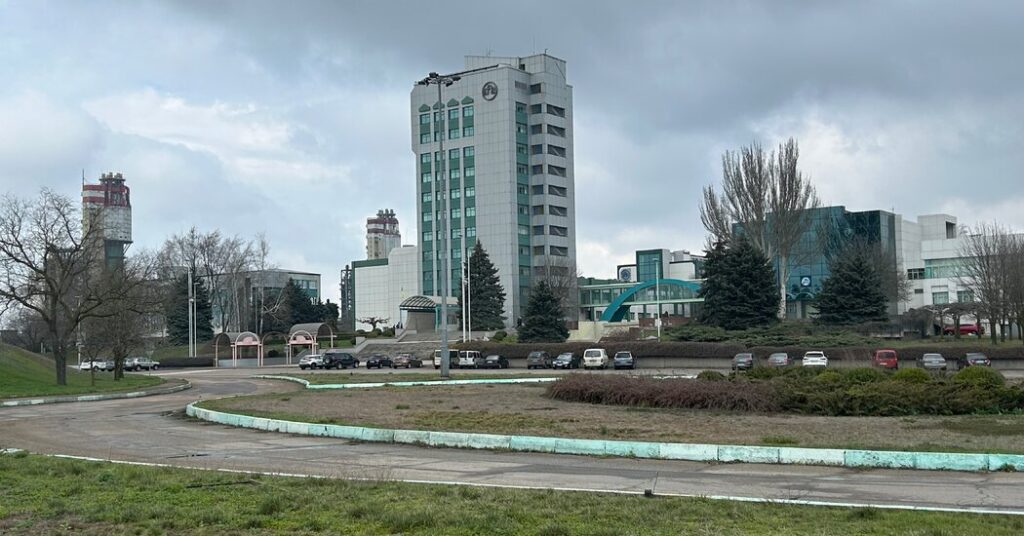
The economic potential of the vast chemical plant on Ukraine’s Black Sea coast is easy to see. Warehouses, storage depots and chimneys stretch across an area three-quarters the size of Central Park, all stitched together by miles of conveyor belts and rail tracks connected to a port handling giant cargo ships.
This is the Odesa Portside Plant, one of Europe’s largest fertilizer producers and a crown jewel of Ukrainian industry dating back to Soviet times. As part of a privatization drive aimed at bolstering a battered economy, the Ukrainian government put the plant up for auction last fall. It was priced to sell, with bidding starting at $100 million.
Still, no one bid. A closer look at the facility, gleaned from a rare visit that included observing the plant from a rooftop, explained why — and highlighted the challenges to Ukraine’s broader privatization effort. Holes could be seen in the roofs of several buildings, the result of Russian strikes. Air-raid sirens suddenly wailed, warning of Russian drones closing in from across the Black Sea.
“Let’s go out. Quick,” said Yuriy Kovalsky, the plant’s director, leading the way off the rooftop.
The plant is just one of many state assets, ranging from titanium factories to vodka distilleries, that Ukraine has offered for sale during the war. While filling chronic gaps in the national budget is one goal, the bigger aim is to modernize an economy still burdened by mismanaged and debt-ridden Soviet-era companies. Offloading these enterprises, the government believes, will prepare the country for closer integration with the West.
“The sooner we sell, the better,” Dariia Marchak, Ukraine’s deputy economy minister, said in an interview.
But while the war accelerated the privatization push, it has also been one of the biggest obstacles. Potential buyers, especially the foreign investors Ukraine is eager to attract, have been hesitant to put their money into assets that could be hit the next day by Russian weapons. On top of that, investors have been spooked by rampant corruption at state-owned companies.
The Odesa plant epitomizes both challenges.
A Russian assault last summer caused serious damage. Early in the war, the facility stopped producing fertilizer, to avoid the risk of a chemical explosion in an attack. Instead, it has been repurposed to store and ship grain.
The plant has also been tied to embezzlement cases, and it is saddled with a $250 million debt to a Ukrainian oligarch. Repeated attempts to sell it over the past three decades have failed, even as auction prices kept falling.
Dmytro Natalukha, the head of Ukraine’s State Property Fund, which manages state assets, has made it his mission to find a buyer. He said the government was tentatively planning to take bids again this summer, and described the effort as a litmus test for Ukraine’s economic development in wartime.
“It think that if the plant is sold, it will be historic,” Mr. Natalukha said, speaking from the fund’s headquarters in Kyiv. “It will send such a strong signal, both inside the country — to the establishment and to the government — and outside of the country, to foreign investors.”
A Corruption Hotbed
It was just such a foreign investor who helped bring the plant into existence. Armand Hammer — an American oil tycoon whose close ties to the Kremlin earned him the nickname “Moscow’s capitalist comrade” — financed the plant’s construction in the early 1970s. He supplied equipment to produce ammonia and urea, compounds commonly used in fertilizers.
The business model was simple. The plant received cheap Russian gas, essential for producing the compounds, and sent the finished fertilizers across the Soviet Union.
Over time, it grew into a behemoth. It could produce more than 2 million metric tons of ammonia and urea a year. Fertilizers were shipped through its port terminal on the Black Sea and a 1,500-mile pipeline connecting to Russia.
It was a typical Soviet factory where work and social life blended together. Thousands of employees lived in one-room apartments nearby and spent their vacations at a factory-owned resort in the Carpathian Mountains.
An entire town — Pivdenne, some 15 miles north of Odesa — was built around the plant. The town still carries the feel of Soviet times, with large squares lined by hulking social centers adorned with bronze statues of workers.
“This plant is a lifeline for the city,” said Olha Hodovenko, a reporter working for a local television channel partly funded by the factory.
After the Soviet Union collapsed, the factory became a target for the free-for-all privatizations that swept the former communist bloc, with oligarchs snapping up assets for a trifle.
But competition for the plant was too fierce to produce an owner acceptable to all political and business power brokers, Mr. Natalukha said. In 2009, after Ihor Kolomoisky, an oil and banking magnate, won a $625 million auction — six times today’s price — the government canceled the sale, saying the plant had been undervalued. Mr. Kolomoisky, once considered a patron of President Volodymyr Zelensky, now sits in jail on unrelated money laundering charges.
At least five other privatization attempts similarly failed. That includes one last fall in which a gas trader lined up to bid despite being linked to an embezzlement case at the plant. “Life is interesting,” said Mr. Kovalsky, the plant’s director.
Instead, the facility became a playground for financial maneuvers.
The most notorious involved Dmytro Firtash, a Ukrainian gas tycoon who lives in exile in Vienna. Mr. Firtash bought cheap Russian gas and resold it to the plant at a steep markup through a government contract. He pocketed the difference and left the plant more than $250 million in debt to him.
Mr. Firtash, who made a fortune as a middleman in the energy sector and is now under Ukrainian sanctions over his ties to Russia, has not been accused of any criminal wrongdoing in connection to his actions at the plant. But Ukraine’s Supreme Court has ruled that the plant does not owe him the debt, overturning a decision by an international arbitration court.
Separate multimillion-dollar embezzlement allegations at the plant remain under investigation. Earlier this month, a former lawmaker and former plant managers took a $3 million plea deal after admitting to a scheme in which fertilizers were sold at undervalued prices to sham intermediaries that resold them at market prices.
“I call it the pimping of state enterprises,” Mr. Natalukha said. “Losses for the state. Profits for the pimp. As simple as that.”
The ‘Right Flag’
Kyiv’s response to corruption at state-owned companies is privatizing them. “It’s the best remedy,” said Ms. Marchak, the deputy economy minister, who argued that private investors brought better management practices.
As Ukraine prepares for its postwar reconstruction, privatization has also become something of a mantra for generating growth. The word appears 15 times in a recent “Prosperity Plan” drafted by Kyiv and Western capitals, with help from the U.S. fund manager BlackRock.
Mr. Natalukha, a 38-year-old, Cambridge-educated lawyer, was appointed head of the State Property Fund in January. With his three-piece suits and slicked-back hair, he looks the part of a privatization champion.
He said he had not expected the chaos he found on arrival at the fund. A majority of the roughly 3,000 companies it owned were empty shells in need of liquidation. Mr. Natalukha recounted cases in which fund employees showed up at a state-owned factory, only to have a guard slam the door in their faces.
Mr. Natalukha said some officials had urged him to get rid of the fertilizer plant once and for all by selling it for one Ukrainian hryvnia, or about two cents. He said he had other plans for what he described as “an incredibly interesting asset” and laid out the steps needed to get it ready for another privatization attempt, including financial audits and a management shake-up.
He noted the plant’s lasting potential, especially as global fertilizer prices surge amid disruptions in the Middle East. The goal is to pitch it to investors around summertime.
Whether any will line up to bid during war remains to be seen. Mr. Natalukha said a foreign investor with “the right flag,” meaning one whose nationality carries enough weight to deter Russian strikes, could be a solution. But Russia has not shied away from hitting foreign companies in Ukraine, including the American firms Philip Morris and Mondelez as recently as this year.
He said four investors — three Western and one Middle Eastern — had signed nondisclosure agreements to explore a privatization bid. That, he said, was a sign that the plant’s economic prospects may ultimately outweigh the risks associated with war.
“Let’s be frank, it’s a challenging asset,” he said. “But it also offers a lot of opportunities.”
Dzvinka Pinchuk and Olha Konovalova contributed reporting.
Constant Méheut reports on the war in Ukraine, including battlefield developments, attacks on civilian centers and how the war is affecting its people.
The post Got $100 Million? Ukraine Has Just the Fertilizer Plant for You. appeared first on New York Times.