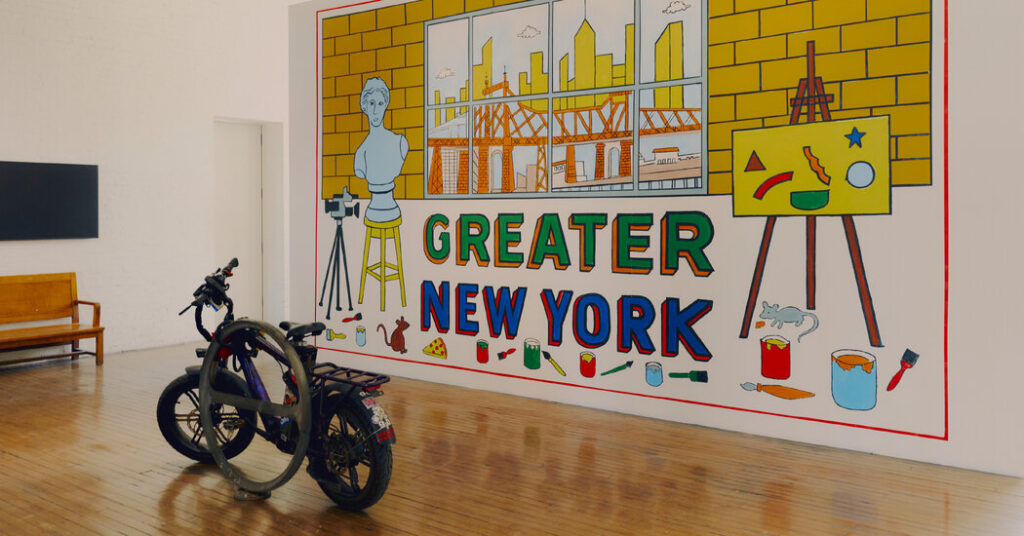
Naming a show “Greater New York,” as MoMA PS1 calls its survey of artists living and working in the city, sounds like both a boast and a prayer, trumpeting the city as a nonpareil locus of art production and yet conceding the ways in which its promise remains unfulfilled.
Unlike the Whitney Biennial, whose ballooning scope and arch theses end up kneecapping the exhibition before it begins, “Greater New York,” which happens every five years, benefits from an unimpeachable rubric. Its sixth edition, organized by a curatorial team led by Connie Butler and Ruba Katrib, includes 53 artists, ages 26 to 80-something — a decent number of whom were born in New York, but most of whom arrived from elsewhere: China and Jamaica, France and Bangor, Maine.
They work in photography, video, paper pulp, fish bones, street trash and tinfoil. Their commonality is that they do it in New York, a pluralism that gamely reflects the makeup of the city itself, in all its noise and collisions. Much of the work addresses the pressure points and delirium of city life, its capacity to alienate and extricate, who is valued and who is ignored. But other pieces look beyond city limits, making the case that the city functions as the pumping vascular system of a global cultural body.
As a stress test, the show finds that system healthy, if a bit calcified in concerns of the last decade. The exhibition does not escape didacticism, exhuming legacies of racial exclusion and migrant exploitation that have been well explored, and insisting upon generally oversimplified binaries of diasporic experience. There are moments of ponderous politics and confused conceptualism (Mekko Harjo’s haunted karaoke room, somehow both leaden and thin), but in its messy pluralism it reflects a city that is as difficult as it is alive. Here are some of the highlights.
Cevallos Brothers
For more than five decades, Victor, Carlos and Miguel Cevallos’ cartelismo — the colorful, hand-lettered advertising style popularized in Latin America — has adorned small businesses in Queens — particularly along Roosevelt Avenue in Jackson Heights, a major node of Latin American diaspora.
Ecuadorean by birth, the brothers emigrated from Colombia beginning with Victor, in 1969, who made serious-minded paintings, exhibiting at El Museo del Barrio and Taller Boricua. As a side job, the brothers made posters, developing a clear, bright language: blocky letters and unstylized illustrations that spoke in a clear, bilingual register. (Information is often communicated in a Neoyorkino Spanglish; a poster picturing the five boroughs identifies “Estaten Island.”)
Victor died in 2012, and the surviving brothers continued their work quietly. But thanks to social media, their market expanded from picanterías and panaderías to ones that reflected a changing demographic, like Pilates studios and ice cream parlors for dogs.
This is the first time their commercial work is being exhibited in a museum context, and the selection — a few recent carteleras and archival ephemera — presents both a cultural record and evidence of the New Yorker’s hustle. In the 1980s and the ’90s, the brothers painted backdrops for tourists visiting Times Square; see the photograph of Victor and Carlos grinning in front of one they made evoking the title card of Spike Lee’s “Do the Right Thing.”
Their appeal is in no small part thanks to their personal style. On social media, they appear exclusively in suits and neckties, dapper and wizened and always together, shuffling around the city or displaying a recent commission with steely pride. But there’s a deeper persistence that is astounding. Now in their 80s, the brothers continue their work, which remains stubbornly analog and which tethers them to a nostalgic, pre-venture-capitalized version of the city, one where the memory of unoptimized communal life still exists.
Kenneth Tam
Kenneth Tam’s elegiac installation takes off from his continuing engagement with cabdrivers, whose livelihoods have been imperiled by a compromised medallion system and corporate ride-hailing apps.
Once worth about $1 million each, medallions were sold at inflated rates. Drivers, predominantly South Asian immigrants, took on predatory loans; and when the medallions’ value tanked, they were left with catastrophic debt. Whereas the taxi medallion once offered the promise of middle-class stability, it is now an albatross-size tree air freshener hung from the cabby’s neck.
A video features the brothers Bilal and Suha Elcharfa, both taxi drivers, alternating between Pina Bauschian movement — a pas de deux with a metal folding chair — and recitations of grievances, fears and deferred dreams. In one sequence, Tam closes in on each of the brothers’ faces, as they flatly pronounce locations around the city, the way a passenger might upon entering the cab. Their tired eyes and drawn faces testify to a bone-deep exhaustion.
A carpet made of LEDs and the beaded seat covers favored by taxi drivers are laid out on the floor. It resembles a topographical model of the city, twinkling with promise but craggy, beautiful and unforgiving in the same breath.
Fields Harrington
Since 2019, the number of delivery drivers in New York City has nearly doubled, by some counts reaching 80,000 — an increase driven by the pandemic and a swelling migrant population. Fields Harrington’s project, which started in 2024, pictures the bikes but absent the drivers, many of whom are undocumented immigrants. It’s a decision that emphasizes their agency, which is minimal. Most delivery drivers, like other workers in a largely unregulated gig economy, lack health insurance, sick pay and job security, and are incentivized to work as fast as possible, often at personal risk. Unlike other gig workers, some drivers tend to have a liberal interpretation of traffic laws and physics.
The images have the flavor of ethnography. Without their riders, the bikes take on a curiously anthropomorphized personhood, slumped up against each other in clusters, or lying on their sides, as if experiencing a breakdown.
The work edges into activist art. Harrington, a cyclist himself, is sympathetic to the plight of the worker, perhaps to a fault. His Marxist bent doesn’t make room for how the delivery network has remade the city, transforming the streetscape, sometimes imperiling pedestrians, and encouraging an overreliance on minor convenience to the detriment of human interaction.
Tiffany Sia
The three videos playing on tiny monitors that make up Tiffany Sia’s “American Theaters of Suspension, Pt. 1: Ashokan” (2026) are almost excruciatingly dull. They consist of 360 minutes of silent footage that the artist took driving on a road around the Ashokan Reservoir in the Catskill Mountains north of New York City, which provides about 40 percent of the city’s drinking water.
The footage flits between trance and menace, the expectation of something bad that never comes. The work surfaces some jurisdictional peculiarities (the area is policed by a special arm of the New York Police Department, despite being a hundred miles from the city), but the real success here is making visible an unseen but vital infrastructure upon which urban life depends.
The installation succeeds largely thanks to its placement, suspended over a window so that unpeopled upstate roads are superimposed over traffic-choked Jackson Avenue and, beyond it, the tangle of rail tracks in this still-industrial part of Queens. It’s a visual gag that ends up having profound thrust.
Piero Penizzotto
The charm of Piero Penizzotto’s art is its artlessness. His life-size papier-mâché sculptures of his friends and family are not direct likenesses, nor do they attempt to achieve any breakthrough in representation or form, or say something about underrepresented communities or history. In fact, they’re anti-monumental, rejecting the stiff, heroic logic of cast bronzes to delight in a cartoony, lumpy modesty.
They’re a continuation of Rigoberto Torres and John Ahearn’s affectionate South Bronx portraits, which Torres and Ahearn began making out of plaster and fiberglass in 1979. (Ahearn, whose work was included in Greater New York’s 2005 edition, is a mentor to Penizzotto.) Where Torres and Ahearn worked from casts, Penizzotto’s sculptures are impressionistic translations of photographs that read like personal snapshots, true to life.
Kristen Walsh
Kristin Walsh’s enigmatic sculptures sit somewhere between sleek fantasy and mechanical nightmare. They wear the skin of industrial hardware like a bad costume, but what function they’re intended to perform remains a mystery. What they do produce is dread: Fitted with concealed motors and magnets, they emanate ominous ticking and clanging, like a buff-polished time bomb.
Each sculpture refers to and makes a mockery of industrialized efficiency — their welded aluminum contours smoothed into flawlessness, but often installed on their side or blocking a path, turgid and impotent — the machine as a fetishized art object and totally useless lump of metal. It’s an elegant indictment of the barely hidden technological apparatuses that increasingly govern our lives, and the mechanized masters we continue to build ourselves.
Greater New York 2026
Thursday noon through Aug. 17, MoMA PS 1, 22-25 Jackson Avenue, Queens; (718) 784-2084; momaps1.org.
The post ‘Greater New York’ Brings the Noisy, Messy Vitality of 53 Artists appeared first on New York Times.