Nobody talks about the arrival of the new television season anymore, in the fall or at any other time. TV no longer dresses up once a year and presents itself to us; it’s just there, waiting for our attention. Streaming has turned the purveyors of TV series from impresarios into shopkeepers, restocking their shelves and changing their displays to keep their customers from crossing the street.
There is one place where TV still gears up for an occasion, though, and not just annually. Four times a year, like clockwork, the Japanese animation industry presents a season of new and returning shows. And the discipline of the anime makers is matched by their productivity. For the spring 2026 season, around 60 series began or returned in the first two weeks of April.
Most of these are available right away in the United States, with the majority at the streaming site Crunchyroll and a sprinkling at Amazon Prime Video, Hidive, Hulu, Netflix, Rakuten Viki and other sites. Many of them will be of interest primarily to fans who are accustomed to the narrative and visual formulas of anime’s numerous subgenres.
As with any batch of TV series, though, every anime season has a few pleasant surprises. This spring’s include the long-awaited second season of the vivid scary-beast fantasy “Dorohedoro” (Crunchyroll, Netflix and Rakuten Viki) and the new shows “Eren the Southpaw,” an engaging drama about young artists (Crunchyroll); “Kirio Fan Club,” a comedy about high school besties with furious, inexplicable crushes on the same boy (Hidive); and “Snowball Earth,” a science-fiction series in which a giant-robot pilot who has been battling reptilian monsters in deep space returns to find Japan in the midst of a new ice age (Crunchyroll, Hulu).
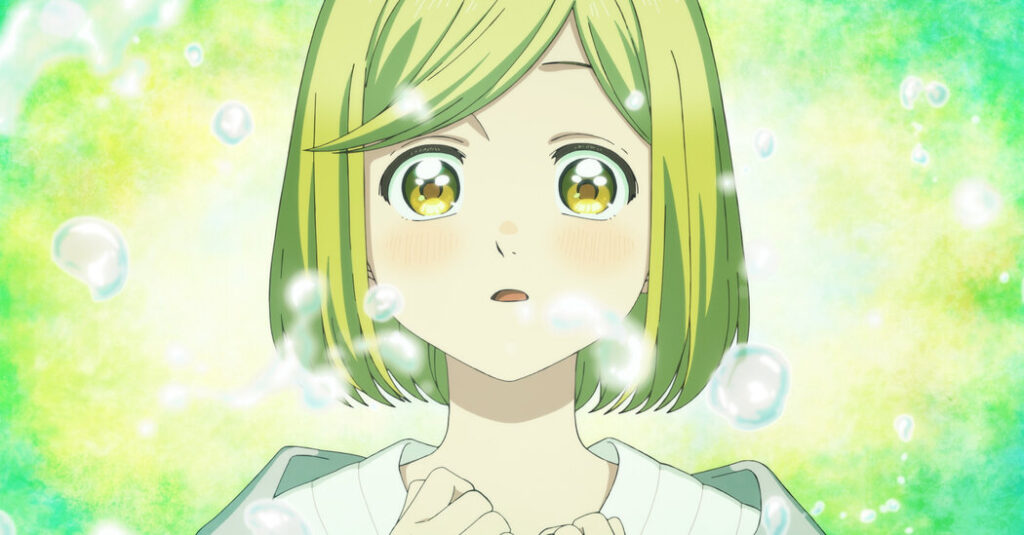
I’m going to highlight what look, in the early weeks of the season, like two standouts at opposite ends of the stylistic spectrum. Both are fantasies of fallen worlds, but they differ radically in tone and look. “Witch Hat Atelier,” on Crunchyroll, is a gentle but reasonably tough-minded fairy tale about a young girl learning to practice forbidden magic; its characters, story and animation style clearly mean to evoke the work of Studio Ghibli.
“Nippon Sangoku: The Three Nations of the Crimson Sun,” on Amazon, is a nervy satire set in a neo-feudal Japan that is not exactly postapocalyptic but is much the worse for wear. It has survived economic decline, catastrophic earthquakes and a violent social collapse that reduces the nation’s population by 90 percent. A bitingly comic story involving an obsession with revenge and one man’s destiny to rebuild the nation, “Nippon Sangoku” is a bit like an Akira Kurosawa epic crossed with “Mad Max.”
“Witch Hat Atelier” — based on books by the prominent manga artist Kamome Shirahama, and with scripts overseen by the very hot Hiroshi Seko (“Attack on Titan,” “Jujutsu Kaisen,” “Dandadan”) — focuses on a winsome girl named Coco. She is fascinated with magic, once practiced widely by humans but now prohibited; she becomes an apprentice to a male magician, hoping she can learn to undo a ruinous spell she accidentally unleashed on her mother.
The situation, and the young-girls-have-magic vibe, echo Ghibli films like “Howl’s Moving Castle” and “Kiki’s Delivery Service.” The Ghibli influence can also be seen in the character and costume designs, and in the grace of a flying carriage that wings into the first episode. Neither the storytelling nor the art has the deep emotional timbre achieved routinely by Ghibli’s master, Hayao Miyazaki, but that’s a wholly unfair standard; that the series bears comparison with the studio’s midlevel work is sufficiently unusual to deserve notice.
(“Witch Hat Atelier” is also notable for its exploration of a theme with particular resonance in anime: the correlation of magic with the art of drawing. The same idea was treated with antic comic effect a few seasons back in “Zenshu,” about an anime artist whose sketches come to life.)
Where “Witch Hat Atelier” earnestly entreats you, “Nippon Sangoku” slaps you in the face and nags at you to keep up. (Both shows premiere new episodes on Sunday mornings.) Its jazzy, sophisticated look immediately draws you in. The story is told in a spare but elaborately detailed brushwork with isolated washes of color, like hand-drawn high def. It’s a style seen in horror anime, which is appropriate for depicting the casual brutality of Yamato, the kingdom that occupies the central region of what used to be known as Japan, or Nippon.
“Nippon Sangoku” is the story of Aoteru, a cautious young man working as an agricultural agent in the sticks; he runs afoul of the regime but is saved by his quick wits and encyclopedic knowledge, then makes his way to Osaka, the capital of Yamato. It’s also a larger history of this fictional future era, and the show (produced by Studio Kafka) uses a variety of visual strategies to relay and comment on events: collage, bold titles, flashes of expressionistic ornamentation. The effect is often like watching a richly illustrated comic book flow across the screen. (The show is based on a manga series by Ikka Matsuki.)
Aoteru is a nostalgist, a collector of artifacts from the Japanese past, and “Nippon Sangoku” is a clever exercise in multiple nostalgias. Through Aoteru, the series gets to be wistful for present-day Japan, whose moldering landscape — the nonfunctioning machines, the abandoned cities — serves as a backdrop to the story. And by running history in reverse, it gets to hark back to a great age of Japanese storytelling: It’s a late-feudal samurai saga but one with a jokey contemporary sensibility.
The first few episodes are smart and stylish enough to make the whole package seem surprisingly organic. But if it doesn’t uphold its promise, don’t worry. In three months there will be a whole new bounty of anime to check out.
Mike Hale is a television critic for The Times. He also writes about online video, film and media.
The post It’s (Always) the Season for Anime appeared first on New York Times.