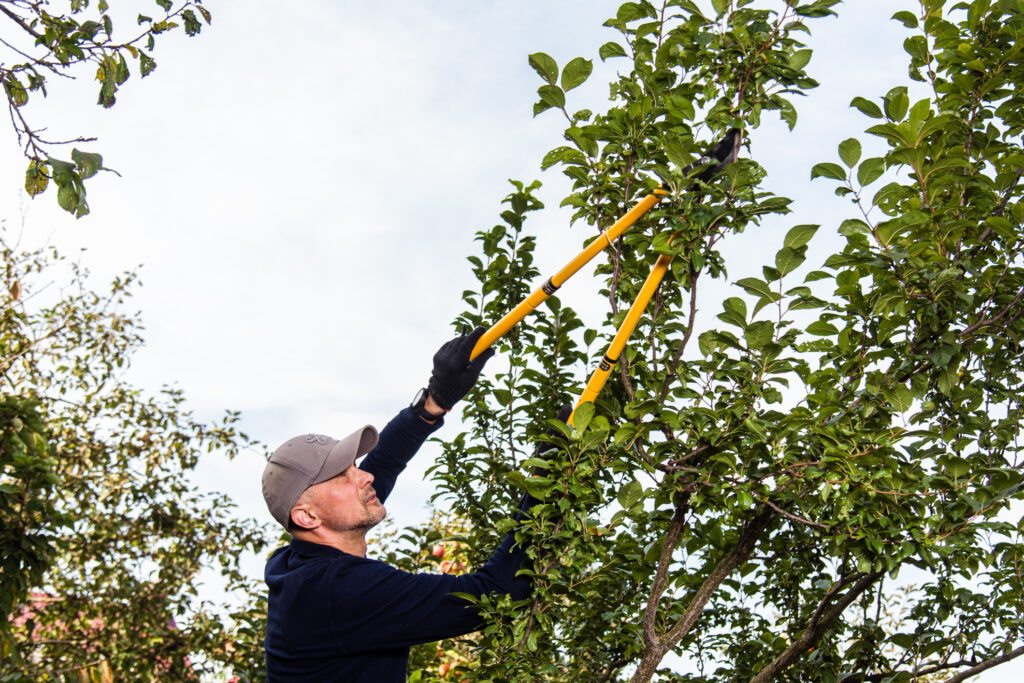
If you treat them right, trees can shade your house, beautify your property and lower your home energy costs. But diseases, pests, aging and extreme weather (hello, Winter 2026) can affect the sturdiest of oaks. And even healthy trees need a little branch management in the form of regular pruning or the occasional checkup.
To keep your trees in shape or to remove dying ones, you will probably need professional advice, skill and labor. You don’t have to be an expert, though, to spot many potential tree problems. Examine your trees several times a year for the following:
- Discolored leaves and thinning in the tree’s crown
- Roots pulled loose from the ground, and fungal growth on the roots and main trunk
- Dead and fallen branches more than two inches in diameter
- Deep vertical cracks on opposite sides of the main trunk
- Sawdust on the trunk from wood-boring insects
- A trunk that noticeably leans in one direction and a branch canopy that is not roughly balanced
- Other unusual deformations and deposits on the leaves, limbs or bark.
Other reasons for tree work include eliminating the risk to your house, or to electrical or other utility wires from rubbing limbs or precarious overhanging limbs; letting light and breezes more readily reach your house, garden or lawn; and protecting foundations and drainage systems from invading roots.
In many cases, the problem and the solution will be obvious — removing specific limbs, for example. But sometimes it’s difficult to diagnose and treat trees. At those times, you need expert advice. Washington Consumers’ Checkbook has surveyed its members and other consumers about their experiences with local tree care services. Until May 31, Washington Post readers get free access to those ratings via Checkbook.org/WashingtonPost/trees.
Don’t assume that all estimators from tree care companies can determine what’s wrong and prescribe the correct treatment. Checkbook’s evaluation found big company-to-company differences in the quality of advice and work performed. Several area companies rate quite high for the quality of their work, but the news is not all good. Companies that rate poorly drew complaints about lousy customer service, being overcharged, getting poor results and property being damaged by careless, untrained workers.
If you need tree work, the best strategy is to get more than one opinion. Get estimates from several companies, and ask the representatives to explain what they plan to do and why.
Along with several opinions, you’ll get comparative pricing. Checkbook’s undercover shoppers found striking differences in prices for tree care work. For example, to remove a 60-foot sycamore tree, including disposal of all wood and debris and grinding the stump, companies quoted Checkbook’s undercover shoppers prices ranging from $1,700 to $4,025. To remove a 75-foot Norway spruce, grind the stump and remove all debris, quotes ranged from $1,500 to $6,000.
Typically, you don’t have to be home when bidders are looking at the job — but do make sure they include a thorough description of the work in a written contract that specifies who cleans up, hauls away debris and wood, and removes the stump afterward. Anything that isn’t specified in writing is unlikely to get done. No-shows are common, so call more companies than you need bids from to make sure you get enough to make a smart decision.
If a job can wait, consider having the work done in winter, when companies are less busy, and there is less debris to haul away.
Check whether a company’s liability and worker’s compensation insurance are current. Ask to see certificates of insurance, and call the company’s insurance carrier to verify. This is a serious concern because high-powered equipment, heavy branches and trunks, lofty heights and proximity to power lines make tree work dangerous.
Companies operating in Maryland must be licensed to perform any tree care work — including removal — for trees taller than 20 feet. Licensure means that at least one employee of the company has passed a difficult state-administered written exam. To qualify to sit for the exam, a candidate must have worked for at least one year with a licensed tree care expert and taken at least two years of college coursework in an accredited forestry, arboriculture, horticulture or applied agricultural sciences program. Or they must have worked for at least three years with a licensed tree care expert. To check on a company’s licensure status, search the state’s online list or call 877-620-8367.
Neither D.C. nor Virginia requires tree care companies to be licensed, so be extra careful to check ratings and reviews and, ideally, choose a company that has done work for neighbors or friends.
Ask about the company’s payment policy to see how much of the total cost is payable upon completion of the job or later. Paying after the work is completed gives you leverage to ensure that work is carried out properly and on time. If possible, make all payments by credit card, which allows you to dispute the payment if things don’t go as planned.
Be sure to avoid companies that knock on doors or leave business cards at homes, especially after a storm, when the good companies don’t need to hunt for work but may be overscheduled, creating opportunities for bad actors. Take the time to find and hire a reputable company, even if you must wait for service.
If you need advice and help caring for healthy trees you plan to keep, look for certification by the American Society of Consulting Arborists or the International Society of Arboriculture. Certification by either organization indicates the arborist has a degree in arboriculture, several years of experience and has passed a difficult exam.
Kevin Brasler is executive editor of Washington Consumers’ Checkbook and Checkbook.org, a nonprofit organization with a mission to help consumers get the best service and lowest prices. It is supported by consumers and takes no money from the service providers it evaluates. You can access Checkbook’s ratings of local tree care companies free until May 31 at Checkbook.org/WashingtonPost/trees.
The post How to save money on tree work and still get good results appeared first on Washington Post.