The treasury secretary vs. climate science
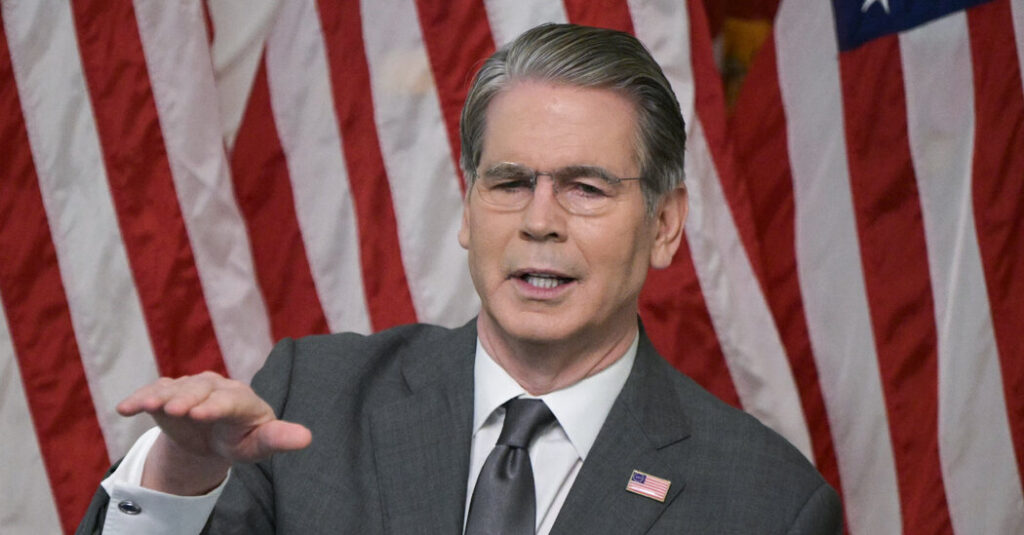
This morning, Treasury Secretary Scott Bessent said it was difficult to determine the actual causes of climate change. That statement runs counter to the broad scientific consensus that human activity — namely, the burning of fossil fuels — is dangerously warming the world.
As Alan Rappeport and I reported today, the comments came in remarks on the sidelines of the spring meetings of the International Monetary Fund and the World Bank. Bessent has been critical of the World Bank and has asked it to remove some of its climate finance targets and finance “all affordable and reliable sources of energy,” including gas, oil and coal.
At the event today, Bessent argued that global financial institutions should focus on economic growth, trade and development.
“We cannot have these elite beliefs get in the way,” Bessent said, referring to climate change.
The Trump administration has spent much of the last two years cutting spending for clean energy and rolling back dozens of environmental regulations, while boosting fossil fuels. Last year, Trump called global warming a “hoax” and a “con job.”
Bessent did not go that far, but his comments contradicted the scientific consensus about why the world’s climate is changing.
“Yes, the climate does change,” Bessent said, adding, “We are going through cycles, and I believe that it is very difficult to deconstruct the reasons around why anything changes.”
Leading scientists rejected claims like Bessent’s and noted that natural factors like the sun, volcanic eruptions and orbital cycles would be cooling the earth if not for human activity, like burning fossil fuels in automobiles, power plants and more.
“The only reason for the observed warming are human activities, and the biggest of those activities are the emissions of heat-trapping gases from burning fossil fuels,” said Katharine Hayhoe, an atmospheric scientist at Texas Tech University.
Average global temperatures are expected to rise 1.5 degrees Celsius (2.7 degrees Fahrenheit) above preindustrial levels within the next decade. That would unleash dire effects that include increased and more intense heat waves and heavy precipitation, melting of the world’s glaciers and ice sheets, and a higher risk of severe wildfires.
Bessent’s partner in the discussion today was Bjorn Lomborg, a Danish academic who argues that climate change is occurring but is not a crisis, and that poor nations require fossil fuels in order to develop. His work has been influential with members of the Trump administration, particularly Chris Wright, the energy secretary, who has referred to Lomborg as a friend.
Last week, my colleague Maxine Joselow reported that climate change deniers were seeing a new level of prominence in Washington. A conference sponsored by the Heartland Institute, a group that rejects mainstream climate science, featured Lee Zeldin, the administrator of the Environmental Protection Agency, as a keynote speaker.
Lomborg argued today that the World Bank was making nations poorer by spending money on what he called a “climate fixation” and a push to transition away from fossil fuels.
“The money that the World Bank spends on the solar panel can’t be invested in health care or education,” Lomborg said, arguing the institutions “need to get back to making rational priorities.”
Harjeet Singh, the founding director of the Satat Sampada Climate Foundation in Delhi, said calling climate change an “elite” issue purposefully ignores the threats it poses to the world’s poorest. He pointed to floods in Pakistan in 2022 that killed nearly 2,000 people and left behind more than $40 billion in damage, caused by heavier than usual monsoon rains and melting glaciers that followed a severe heat wave, both linked to climate change.
“I am sitting in a region which is one of the poorest,” Singh said, “and we are seeing how climate change is eroding the development gains we have made over the past years and decades.”
Conservation
More gray whales are visiting San Francisco Bay, and many die there
Nearly one-fifth of the gray whales that swam into the San Francisco Bay in recent years died there, mostly after colliding with ships, according to new research published on Monday.
The study estimated that 18 percent of the whales that entered the Bay from 2018 to 2025 did not survive. And among those that died, at least 40 percent had sustained lethal injuries from ship strikes.
The actual number of deaths is quite likely higher. One author of the study said the researchers had reason to believe that something close to half of the whales that come to the Bay Area are hit by ships and die. — Sachi Kitajima Mulkey
Number of the day
98 percent
Norway, a hot spot for electric vehicles, gets 98 percent of its electricity from renewable energy. But since the war in Iran began, it has also become an increasingly important source of oil for Europe, Lynsey Chutel reports. (Right now, Europe gets 30 percent of its oil from Norway.)
That has lead to uncomfortable conversations in Norway about whether it is profiting from the conflict. And to meet increased oil demand from Europe, the Norwegians say they would need to drill more in the Arctic, an area vulnerable to climate change.
Climate law
Young people who sued Trump over his energy policies ask court to revive their case
A group of 22 young people who sued President Trump over his executive orders on energy told an appeals court on Monday that their case had been wrongfully dismissed.
The group is trying to revive a case claiming that Trump violated their constitutional rights by encouraging fossil fuel use, accelerating global warming and endangering their health and safety.
“We are here because the president rewrote energy law without statutory or constitutional authority,” the lawyer for the group, Julia Olson, told the three-judge panel at the Court of Appeals for the Ninth Circuit Court in Portland. The case is one of many in recent years in which young people have sued officials and government agencies over climate change. — Karen Zraick
Quote of the day
“Help us change the climate law. We’re not saying no to it. We’re just saying give us a longer runway.”
That’s from Gov. Kathy Hochul of New York, one of several Democratic leaders of Northeast states that are scaling back or rethinking their climate plans, Brad Plumer reports. Hochul recently said the state’s goal for deeply cutting emissions by 2030 was now “unattainable” and asked the Legislature to rework its landmark climate law. Massachusetts and Rhode Island have also dialed back some of their once-lofty climate ambitions. The moves are “a sign of how the political landscape has shifted in the Trump era, as Democrats try to balance fears of a warming planet with immediate concerns about the cost of living,” he writes.
More climate news from around the web:
-
The Times of London reports that Britain has come up with a unique way of managing a surplus of renewable energy this summer: offering customers free electricity when the sun is shining.
-
Wildfires are increasingly hitting cattle country, The Guardian reports, and Nebraska has seen record fires this spring.
-
“The Environmental Protection Agency is sitting on dozens of approvals for uses of ‘forever chemicals’ at the direction of Administrator Lee Zeldin, over fears that it could anger Make America Healthy Again activists,” The Washington Post writes.
Read past editions of the newsletter here.
If you’re enjoying what you’re reading, please consider recommending it to others. They can sign up here.
Follow The New York Times on Instagram, Threads, Facebook and TikTok at @nytimes.
Reach us at [email protected]. We read every message, and reply to many!
Lisa Friedman is a Times reporter who writes about how governments are addressing climate change and the effects of those policies on communities.
The post The Treasury Secretary vs. Climate Science appeared first on New York Times.