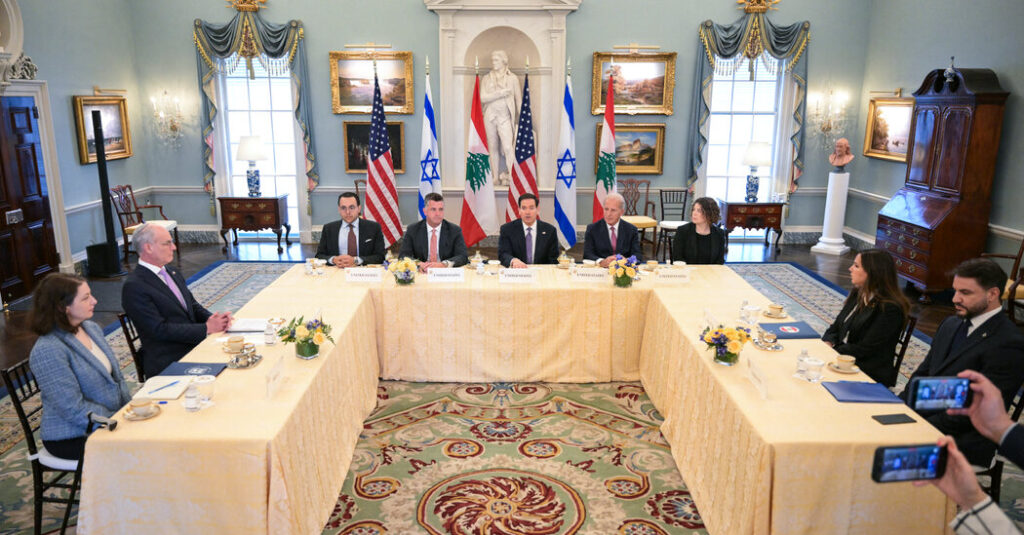
Israeli and Lebanese officials held their first direct talks in decades on Tuesday, meeting in Washington to try to end a bloody conflict that has threatened to derail the broader cease-fire in the U.S.-Israeli war against Iran.
“We understand we’re working against decades of history,” said Secretary of State Marco Rubio, who was involved in the talks.
Mr. Rubio said the negotiations had the ambitious goal of trying to bring “a permanent end to 20 or 30 years of Hezbollah influence in this part of the world.” Hezbollah, the Lebanese-based militant group allied with Iran, is not a part of the talks and has long opposed direct negotiations with Israel.
After a meeting that lasted more than two hours, Israel’s representative at the talks, Yechiel Leiter, said the two countries were “on the same side of the equation” and described the meeting as the “beginning” of an effort to defeat Hezbollah.
Lebanese officials made no comments immediately after the talks, which took place as fighting between Israel and Hezbollah continued in full force. The State Department indicated that steps had been taken toward further “direct negotiations” in a statement released after the meeting.
The talks between ambassadors from the two countries came at a precarious time for the truce in the war between the United States and Iran, a day after a U.S. blockade of Iranian ports was scheduled to go into effect. President Trump ordered the blockade, which is being enforced by the U.S. Navy, as a way to squeeze Iran into concessions in the peace talks with Washington.
But the status of the blockade remained uncertain on Tuesday.
The U.S. military said in a statement that it had successfully blocked the exit from the Persian Gulf of all ships leaving from Iranian ports during the first 24 hours of the blockade. Six merchant vessels “complied with direction from U.S. forces” and turned around, U.S. Central Command said.
Tracking data shows that several ships passed through the strait before and after the Monday deadline set by the United States. Some of those ships had left Iranian ports, were carrying Iranian products or were under U.S. government sanctions, according to the trade analysis firm Kpler.
It was not immediately known whether the ships that departed from Iranian ports had done so within a grace period around the start of the blockade, had permission to pass or had somehow bypassed the blockade.
Over the long term, the blockade could strangle an already moribund Iranian economy reliant on oil revenues. But it also threatens further disruption to a global economy reeling from the oil shock caused by the war.
In a report published Tuesday, the International Monetary Fund sharply downgraded its forecasts for global growth this year.
If disruptions to global energy markets continue into next year, the monetary fund said, global growth could slow to 2 percent and inflation could rise to 6 percent. The projection contrasts with its forecast in January of 3.3 percent global growth.
The outlook for the global economy will depend on how long the war lasts, the report said.
Mr. Trump said on Tuesday that a second round of direct negotiations with Iran could take place in Pakistan over the next two days. A marathon first round ended last weekend in Pakistan with disagreements over a number of issues, including the status of Iran’s nuclear program.
The United States proposed a 20-year “suspension” of all nuclear activity, which would allow the Iranians to claim they had not permanently given up their right, under the Nuclear Nonproliferation Treaty, to produce their own nuclear fuel. Iran responded with a proposal to suspend nuclear activity for up to five years, according to two senior Iranian officials and one U.S. official.
Other points of contention in the negotiations were the status of the Strait of Hormuz and the fighting between Israel and Hezbollah in Lebanon.
Prime Minister Benjamin Netanyahu of Israel agreed last week to the talks with Lebanon in Washington as Iran warned that it could withdraw from the cease-fire unless Israel stopped attacking Lebanon. The State Department made clear that the negotiations between Lebanon and Israel were separate from the United States and Iran talks.
Israel and Lebanon do not have diplomatic relations and have technically been at war since 1948.
A group of nearly two dozen European and Western nations, including France and the United Kingdom, threw their weight behind the talks, urging both sides “to seize the opportunity presented by the U.S.-Iran cease-fire,” according to a joint statement.
But the talks are emerging as a flashpoint inside Lebanon, exposing political divisions in a country with no unified position on engaging with Israel. Supporters of Hezbollah have taken to the streets in Beirut to protest the move in recent days, and regardless of the outcome, the fact that Israeli and Lebanese officials are meeting has raised fears of instability.
Mr. Rubio nodded to the long history of conflict leading up to the latest outbreak of fighting.
“This is a process, not an event,” he said at the start of the talks on Tuesday. “All of the complexities of this matter are not going to be resolved in the next six hours.”
The war between Hezbollah and Israel reignited last month after the militia fired on Israel in solidarity with Iran. Hezbollah has since launched more than 6,500 rockets, missiles and drones toward Israel, according to the Israeli military.
Israel has bombarded Lebanon for weeks in response, displacing more than one million people and, according to the Lebanese health ministry, killing more than 2,100, including more than 160 children.
On Tuesday, the Israeli military said its ground troops had encircled the southern town of Bint Jbeil. In a separate statement, the military said it had struck sites in the town of Aadshit on Monday. Israeli attacks across southern Lebanon and the West Bekaa region killed more than 20 people on Tuesday, according to the Lebanese state-run news agency.
Hezbollah rockets continued to fall on northern Israel as well, with at least 10 launches detected in the hour after the talks in Washington began, according to the Israeli military.
Israel and Lebanon remain sharply divided in their aims for the talks.
President Joseph Aoun of Lebanon told Italy’s foreign minister, Antonio Tajani, that his nation was hoping that a cease-fire would be reached, after which longer-term negotiations could begin, according to a statement shared by the Lebanese presidency on Monday. Mr. Aoun said that any solution must entail Israel’s heeding the growing international calls for it to stop attacking Lebanon.
But Mr. Netanyahu has ruled out a cease-fire and said that Israel would not stop its attacks on Lebanon. The aim of the discussions in Washington was disarming Hezbollah and establishing a lasting peace deal with Lebanon, he said.
Israel sharply escalated its attacks in the hours after the cease-fire was reached last week, killing at least 357 people in Lebanon on Wednesday, according to the Lebanese authorities.
Hezbollah’s leader, Naim Qassem, said in a televised speech on Monday that his organization had categorically rejected Lebanon’s planned talks with Israel. He called on the Lebanese authorities to cancel the talks, urging them not to become “a tool of Israel.”
Proceeding with the talks would represent “capitulation and surrender” to a country intent on occupying Lebanon, Mr. Qassem said.
Reporting was contributed by Alan Rappeport, Francesca Regalado, John Yoon, Johnatan Reiss, Farnaz Fassihi, Karoun Demirjian and Isabel Kershner.
Michael Crowley covers the State Department and U.S. foreign policy for The Times. He has reported from nearly three dozen countries and often travels with the secretary of state.
The post Rare Direct Talks Between Israel and Lebanon Focus on Hezbollah appeared first on New York Times.

![AEW’s Kenny Omega Gives Update on Kota Ibushi’s Recovery [Exclusive]](https://dnyuz.com/wp-content/uploads/2026/04/IMG_5301-350x250.jpeg)