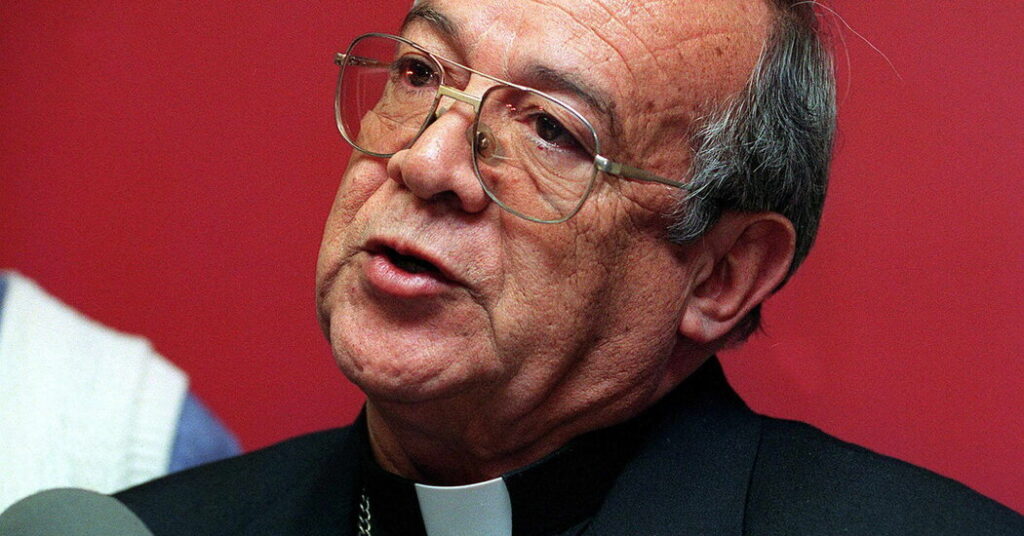
Mario Ríos Montt, a prelate who headed the Roman Catholic Church’s human rights office in Guatemala even as his brother, the country’s former military dictator, was being investigated for genocide, died on April 5 in Guatemala City, the capital. He was 94.
His death, at the Pauline Fathers provincial house, was announced by the Archbishopric of Guatemala. He was the emeritus auxiliary bishop of the Archdiocese of Santiago de Guatemala at his death, which occurred, like that of his older brother Gen. Efraín Ríos Montt eight years before, on Easter Sunday.
Everything separated the two brothers, who grew up poor in a large family in rural Guatemala. Their sharp divergence was for years seen as emblematic of a fundamental split in Latin American society, between a church that stood up for human rights and a military that trampled on them.
In public, the brothers refused to speak ill of each other. Under that surface, they had staked out radically different positions.
For years, Bishop Ríos Montt was a low-key proselytizer for human rights in his beleaguered country, which, beginning in 1960, was battered by a 36-year civil war between military or military-dominated governments and leftist insurgents in the countryside. About 200,000 people died, with the military reckoned to be responsible for more than 90 percent of the deaths.
The worst phase, a period called “La Violencia” in Guatemala, occurred during the 17-month rule of his older brother, who came to power in a coup in 1982. There were some 86,000 victims on his watch, many of them Mayan Indian peasants from the Ixil ethnic group. About 4,000 villages were targeted or destroyed by the general’s military, and perhaps 1.2 million were driven into exile as a result of his scorched-earth anti-insurgency campaign.
Before being toppled by his own defense minister in 1983, General Ríos Montt delivered a body blow to the guerrilla insurgency. President Ronald Reagan praised his crusade against communism and called allegations of human rights abuses a “bum rap.”
When the reckoning finally began to unfold, years later — the war ended in 1996 with a peace treaty between government and rebels — the two brothers were more at odds than ever.
To his surprise, the unassuming bishop was made head of the Guatemalan church’s human rights office. His appointment came in 1998, just after ecclesiastical authorities had published a damning accounting of the military’s atrocities.
His predecessor in the human rights office, Bishop Juan José Gerardi, had been bludgeoned to death with a concrete slab in the garage of a church parish house, two days after presenting the report, “Guatemala: Nunca Más!” (“Guatemala: Never Again”), on April 24. Three army officers were convicted of Bishop Gerardi’s killing in 2001.
Bishop Ríos Montt’s brother Efraín was making a political comeback in the 1990s, first as a member of Guatemala’s Congress, and then as its president. He had never lost his popularity among some voters as a tough-on-crime leader.
The church human rights office, followed by a newly independent judiciary and human rights lawyers, soon made the first inquiries into Efraín’s conduct during the civil war, leading to his genocide conviction in 2013. He was sentenced to 80 years in prison. That same year, the conviction was overturned on a technicality, but human rights advocates saw the conviction as a victory. At his death, as a retired general, he was being retried.
“What interests me is the truth, and come what may, the truth is the truth,” Bishop Ríos Montt said in December 2000 at a news conference, where he announced that it was likely that his brother would be pursued for civil war atrocities. “The work of the church is the work of the church.”
Bishop Ríos Montt had taken over Bishop Gerardi’s work with a fervor that surprised church observers, who had known him mainly as an administrator. “He knew it was a very risky time,” Nery Rodenas, who worked for him, said in an interview. “But he was very clear about the role the office should play in social matters.”
In a church that had become radicalized by the country’s sharp inequalities and by the guerrilla struggle itself, Bishop Ríos Montt did not stand out as a strident leftist.
“He was a church man, a good man — a normal person,” the Rev. Ricardo Falla, an anthropologist, activist and Jesuit priest who is one of the country’s best-known intellectuals, said in an interview. “He was not a liberation theologian,” Father Falla added, referring to the Marxist-influenced Christian doctrine that swept through the Latin American church in 1970s and 1980s.
But Bishop Ríos Montt had been transformed by his experience in the 1970s and ’80s as bishop in the southern coastal province of Escuintla, which was poor and riven by strife between sugar plantation owners and striking workers.
“He endorsed the strike, and he was with the people,” Alejandro Rodriguez, a human rights lawyer in Guatemala City, said.
Two priests and two seminarians, advocates for the poor, were killed in murky circumstances during Bishop Ríos Montt’s tenure. As a result, he “was really for human rights and justice,” said Mario Trinidad, a former missionary priest in Escuintla and author of “Missionaries and Resistance in Guatemala” (2024).
Bishop Ríos Montt himself was on a government “death list,” according to a U.S. Embassy cable from June 1981 — after the murders and before his brother seized power — unearthed by a researcher, Ben Parker.
The government of Guatemala, the bishop told the anonymous embassy official, “simply doesn’t have the will to change” or “the will to do good.” The government, he added, “could care less for the humble and the poor.” The official commented about the bishop in the cable, “He did not fear for his own safety as he felt resigned to his fate.”
Bishop Ríos Montt spent much of his brother’s rule in exile — in Costa Rica and then Italy — after receiving a phone call from the general telling him that his life was in danger. He returned after his brother was deposed. Pope John Paul II appointed him auxiliary bishop of Santiago de Guatemala in 1987. He retired in 2010.
Mario Enrique Ríos Montt was born on March 17, 1932, in Huehuetenango, in Guatemala’s western highlands, one of 12 children of Hermogenes Ríos and Consuelo Mont (as it was listed on his birth certificate; his mother’s family was of French origin).
His father was a well-off shopkeeper bankrupted during the Depression. As a boy, Mario attended Mass every day; his older brother was said to have been keen on military parades. Efraín later became an evangelical Christian.
Mario studied at the National Seminary in Costa Rica and in 1959 was ordained as a priest in the Society of St. Vincent de Paul, whose mission is care of the poor. After serving as a parish priest in Guatemala City and in El Salvador, in its capital, San Salvador, he spent time as a missionary in Cuba.
Information about survivors was not immediately available.
Although Bishop Ríos Montt appeared critical of the armed forces in a 1999 interview on Guatemalan television, noting that “the history of Guatemala is a history of injustice and impunity,” those who worked most closely with him never heard him speak of his brother.
“He was my immediate supervisor for many years and never mentioned anything to me, whether what his brother had done was right or wrong,” Mr. Rodenas said.
That did not surprise many analysts of the country. “It has to do with the glue that holds Latin America together,” said Virginia Garrard, an emeritus professor of history at the University of Texas and author of a book about General Ríos Montt. “It’s a sense that blood is thicker than water.”
At the same time, Bishop Ríos Montt was not silent about the crimes that were committed during the country’s long internal strife.
“Some people just want to forget things,” he said in an interview with The Los Angeles Times in 1999. “But first, it can’t be done; and even if it could, that would not let us learn from experience.”
Jody García contributed reporting from Guatemala City.
Adam Nossiter has been bureau chief in Kabul, Paris, West Africa and New Orleans and is now a writer on the Obituaries desk.
The post Mario Ríos Montt, Prelate and Brother of Genocidal General, Dies at 94 appeared first on New York Times.
![AEW’s Kenny Omega Gives Update on Kota Ibushi’s Recovery [Exclusive]](https://dnyuz.com/wp-content/uploads/2026/04/IMG_5301-350x250.jpeg)