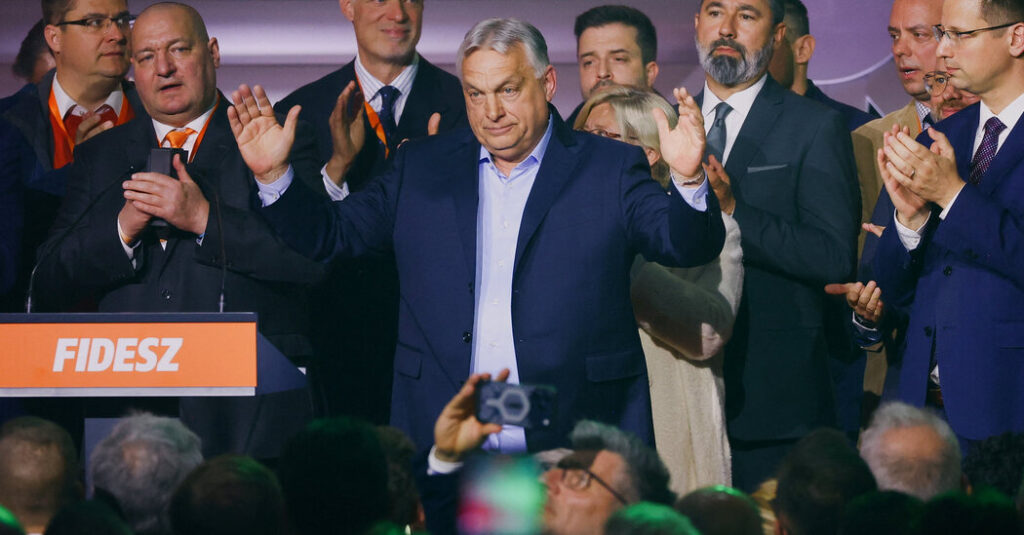
Viktor Orban, the godfather of the global nationalist right and Hungary’s prime minister for 16 years, lost big in last weekend’s elections. In the end, it was corruption and a sickly economy that brought him down.
His loss was also a loss for other right-wing populists who had looked to Orbanism as a model for how to turn election wins into entrenched political control. Today I write about that model and how it engenders the kind of economic decline that ultimately cost Orban the election.
Orban and the populist paradox
He has inspired MAGA culture warriors in America and nationalist populists in Europe. But after 16 years in power, Viktor Orban conceded defeat. The main reason was the abysmal state of the Hungarian economy.
Once the darling of foreign investors after the Cold War, Hungary is now one of the poorest countries in the European Union. Economic growth last year was just 0.4 percent. Unemployment is at a 10-year high.
It’s not a coincidence that Hungary is the most corrupt country in the E.U., according to Transparency International. (It shares that ranking with Bulgaria.) That corruption, which voters voiced their disgust with last weekend, has hollowed out the country’s economy.
It’s also no coincidence that all of this happened on Orban’s watch.
During his time in power, he became the global guru of “illiberal democracy,” a system of extensive political control over Hungary’s institutions, including the judiciary and the media.
That system came at a steep economic price: Government contracts went to companies based on political loyalty, not skills or economic efficiency. Corruption and cronyism, in other words, were integral parts of Orbanism.
Long a model for like-minded movements, Orban’s Hungary is also a case study of what results from an unrestrained executive and the systematic dismantling of the rule of law.
In these models, “politics are more important than the economy,” said Ivan Krastev, a political scientist who has written extensively about populist regimes. “The aim is to control everything. And as a result, the economy pays the price.”
A ‘golden age’ falls short
After Orban’s last election victory in 2022, he promised a “golden age” for Hungary’s economy.
It didn’t turn out that way. The statistic that most caught my eye was the incredible decline in Hungarian productivity growth since Orban took power. In the decade leading up to his first election, it averaged 2 percent. In his first decade in power, it dropped to 1 percent. Since 2020, it has averaged only 0.2 percent, E.U. statistics show.
How did this happen?
There’s a well-established pattern that some have called the “populist paradox.” Some populist leaders win on promises to drain the swamp and fight corruption. Then, once in power, they chip away at the institutions that help guard against corruption, while using it to entrench their rule.
This played out in Hungary. Orban stacked courts and once-independent government agencies with loyalists. He took control of media outlets. In 2014, he baptized this construct “an illiberal state.”
Eventually, this “illiberal state” took its toll on the economy.
I spoke to Krisztian Orban (no relation), an economist who has closely followed the impact of Orbanism. He told me that Orban’s model extended deep into the private sector.
It meant preventing the rise of powerful independent economic actors — multinationals were favored over local companies. And it meant empowering loyalists — companies that pledged fealty to Orban were blatantly favored in public tenders, including companies run by the prime minister’s family, he said.
Istvan Tiborcz, the prime minister’s son-in-law, has become one of Hungary’s wealthiest businessmen, thanks to a vast private equity and real estate empire built on state-backed financing.
After 16 years of Orbanism, the share of G.D.P. controlled by Orban allies has ballooned to a fifth of the entire economy, Krisztian Orban estimates.
“These companies aren’t cost efficient, they aren’t providing good services, they’re not good at what they do — they’re only good at getting along with Viktor Orban,” he said.
Lessons for Orban’s fans
Orban also used taxpayers’ money to reward voter groups that supported him. He subsidized energy prices and repeatedly handed out pension increases. He ensured that the bulk of development funds from the E.U. went to political supporters, too.
Voters knew it. Then, when the E.U. started freezing funds to Hungary in 2022, citing systemic problems with procurement and corruption, they felt it.
That explains why Peter Magyar, who promises a clean break with the corruption of the Orban era, beat Orban so resoundingly in Sunday’s election.
What does this mean for nationalist populists elsewhere?
Orban inspired many, not least Trump. The Hungarian leader’s governing model was a direct influence on Project 2025, a blueprint for radically restructuring the U.S. government, put together by the conservative Heritage Foundation. Trump has followed through on many of its ideas, including taking direct control of independent government agencies.
The U.S. has a much bigger economy, which may limit what one administration can do, Krisztian Orban said. But the populist paradox has also made itself felt in Brazil, under Jair Bolsonaro, and in the Philippines, under Rodrigo Duterte. Will America be any different?
More on Hungary’s election: Peter Magyar, once a loyal Orban ally, changed sides and defeated his former boss. But does he represent real change?
ASK A CORRESPONDENT
Do you have questions about Saudi Arabia?
A kingdom once known for religious police and a ban on female drivers has become, in the span of a decade, a place where women can travel and work and some people can even buy alcohol.
Saudi Arabia’s transformation has been overseen by Crown Prince Mohammed bin Salman, who has also deepened repression and turned himself into a global power player. Now, he finds himself drawn into the war with Iran.
If you have questions about Saudi Arabia, send them to us here and we’ll take them to Vivian Nereim, our Gulf bureau chief. We’ll feature her answers in this newsletter. (Thank you to the readers who submitted their questions when we first ran this call-out in February. We haven’t forgotten you.)
MORE TOP NEWS
The war will slow global growth, the I.M.F. warned
The International Monetary Fund said in a report released yesterday that disruptions to the oil markets from the war in the Middle East were expected to slow economic growth, fuel inflation and raise the possibility of a global recession.
The economic impact is expected to be particularly damaging to low-income and developing economies, and Persian Gulf energy exporters. The biggest winner appears to be Russia, whose economy is now expected to grow 1.1 percent in 2026, up from 1 percent in 2025.
Other developments in the war:
-
Israel and Lebanon agreed to “launch direct negotiations” to end fighting between Israel and Hezbollah, according to the U.S.
-
Tracking data showed that several ships passed through the Strait of Hormuz, including some from Iran, raising questions about the U.S. blockade.
-
The U.S. and Iran are trading proposals on restrictions to Tehran’s nuclear program. Trump said that new talks could take place over the next two days in Pakistan.
OTHER NEWS
-
Prime Minister Mark Carney of Canada won a parliamentary majority — but it wasn’t pretty.
-
Italy suspended a defense agreement with Israel, a sharp reversal for Prime Minister Giorgia Meloni’s right-wing government.
-
Amazon said it was buying Globalstar for $10.8 billion as it aims to build out a satellite network.
-
China enacted sweeping regulations to punish foreign companies that stop using Chinese suppliers.
-
Romuald Wadagni, Benin’s finance minister, won a landslide victory in Sunday’s presidential election, according to provisional results.
Top of The World
The most clicked link in your newsletter yesterday was about questions surrounding Trump’s mental health.
SPORTS
Champions League: Paris Saint-Germain beat Liverpool in the quarterfinal. Here are the highlights.
Football: Andoni Iraola, the Bournemouth manager, will leave the club at the end of the season.
World Cup: FIFA officials have discussed asking Trump for a moratorium on ICE raids during the tournament.
PASSPORT PHOTOS OF THE DAY
In his London studio, David Sharkey did the impossible: He created flattering passport photos. The shop, which operated from 1953 to 2019, attracted some of the biggest names of the era, including Muhammad Ali, David Hockney, Sting and Kate Winslet. Three hundred of those photos have been compiled into a new book.
MORNING READ
My colleagues Hannah Beech and Daniel Berehulak spent three weeks reporting in Myanmar, where a civil war, ignited by a coup five years ago, is raging. There, they saw how the military rules by fear despite recent elections that sought to signal to the world that Myanmar was open for business.
Civilians are petrified by the military’s relentless bombing and burning campaign, but after a spree of assassinations, so are top military officers. “I saw how terror comes for everyone,” Hannah writes. Read more.
AROUND THE WORLD
A hit novel from a very young writer
Nelio Biedermann, a 22-year-old student at the University of Zurich, is a literary sensation in Europe. His first novel, “Lázár,” is a sweeping story about an aristocratic family based in part on his own ancestors. It spent 29 weeks on the German best-seller list, and it could soon be made into a movie.
The book, which was recently translated into English, has drawn comparisons to “Buddenbrooks,” Thomas Mann’s celebrated family epic from 1901. Read our review.
RECOMMENDATIONS
Watch: “Exit 8” takes place almost entirely in a Tokyo train station that turns into a maze and a very harsh life lesson.
Peep: Mariah Carey has listed her New York City penthouse for $27 million. Take a look inside.
Snack: What is it about oats that make them so healthy?
Uplift: The Book Review’s five-day poetry challenge will bring you games, videos and writing about one wonderful poem. Sign up here.
RECIPE
In Mexican cooking, salpicón is a dish of fish, shellfish or meat mixed with chopped vegetables and tossed in an aromatic dressing. In this version, quick-roasted fish fillets are tossed in lime and orange juice to mimic the tropical flavors of the Yucatán.
WHERE IS THIS?
Where is this park?
TIME TO PLAY
Here are today’s Spelling Bee, Mini Crossword, Wordle and Sudoku. Find all our games here.
That’s it for today. See you tomorrow! — Katrin
We welcome your feedback. Send us your suggestions at [email protected].
Katrin Bennhold is the host of The World, the flagship global newsletter of The New York Times.
The post Hungary’s Populist Paradox appeared first on New York Times.

![AEW’s Kenny Omega Gives Update on Kota Ibushi’s Recovery [Exclusive]](https://dnyuz.com/wp-content/uploads/2026/04/IMG_5301-350x250.jpeg)